- Follow our account @DrZayed for the latest crypto news.
CFTC expands stablecoin rules to let national trust banks issue dollar-pegged tokens under the GENIUS Act framework.:
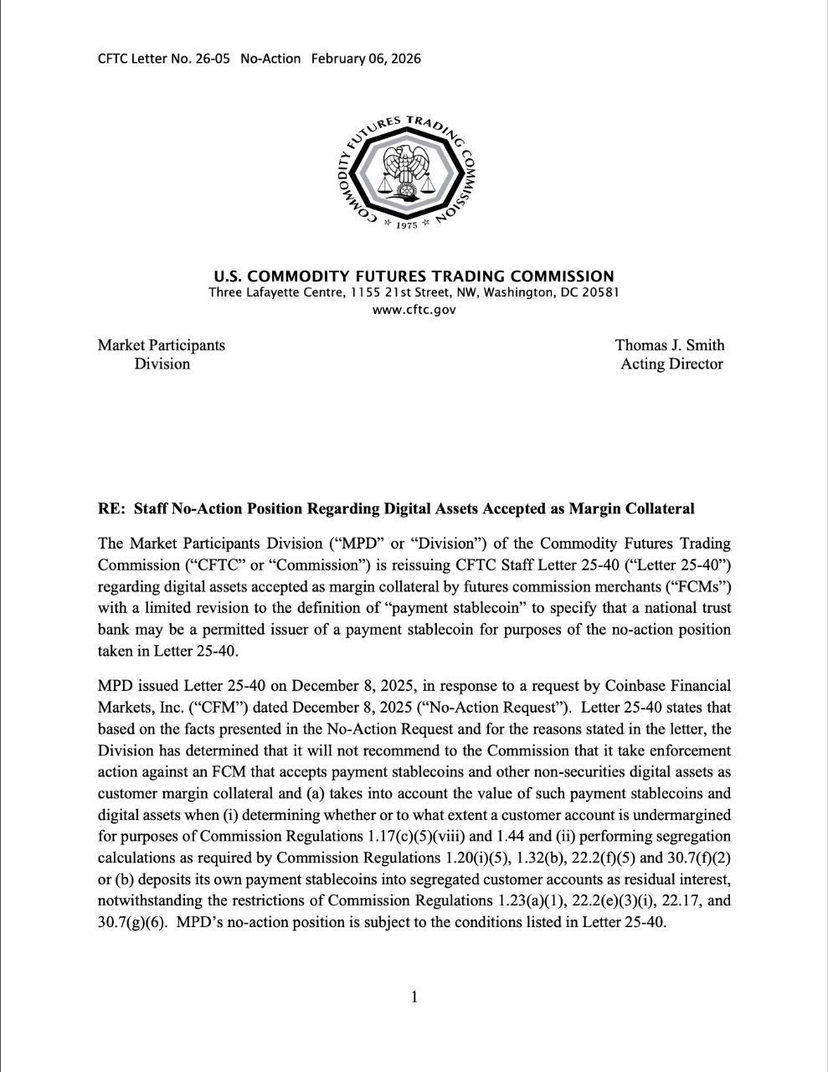
In early 2026, the U.S. Commodity Futures Trading Commission (CFTC) announced a pivotal update to its digital asset collateral framework. By revising existing staff guidance to align with the Guiding and Establishing National Innovation for U.S. Stablecoins (GENIUS) Act of 2025, the CFTC officially cleared the way for national trust banks to issue and manage dollar-pegged tokens for use in regulated derivatives markets.
This move effectively ends a period of regulatory asymmetry where state-chartered entities held an advantage in the institutional stablecoin space, while federally chartered trust banks—often the preferred vehicles for large-scale digital asset firms—were sidelined.
The Regulatory Bridge: GENIUS Act and the CFTC
The GENIUS Act of 2025 serves as the primary architecture for this expansion. It provides a comprehensive federal framework that classifies payment stablecoins as distinct from traditional securities or commodities, placing them under the primary supervision of banking regulators like the Office of the Comptroller of the Currency (OCC).
Under this act, a Permitted Payment Stablecoin Issuer (PPSI) can be a subsidiary of an FDIC-insured bank, a state-qualified issuer for volumes under $10 billion, or an OCC-chartered national trust bank.
The CFTC’s recent expansion specifically addresses the third category. By updating its margin rules, the CFTC now allows Futures Commission Merchants (FCMs) to accept stablecoins issued by these national trust banks as eligible collateral. This harmonizes CFTC oversight with the OCC’s December 2025 move to grant national trust bank charters to major industry players.
Why National Trust Banks?
For years, the crypto industry struggled with charter drift. Companies wanting to operate at a national level without managing 50 different state licenses sought national bank charters. However, full-service commercial bank charters require FDIC insurance and come with heavy restrictions on non-banking activities.
National trust banks offered a middle ground. They are federally chartered by the OCC but do not take traditional deposits or make commercial loans. Instead, they focus on fiduciary activities, custody, and—under the new rules—the issuance of payment stablecoins.
Key Advantages of the National Trust Charter:
Federal Preemption: They can operate across state lines without individual state money transmitter licenses.
Single Regulator: Primary oversight comes from the OCC, providing a streamlined compliance path compared to the previous state-by-state patchwork.
Institutional Trust: Large institutional players like hedge funds and pension funds are more comfortable using assets issued by a federally regulated bank than by a private non-bank entity.
Core Requirements under the GENIUS Act
The CFTC's expansion does not mean a free for all. To qualify for issuance and use in CFTC-regulated markets, national trust banks must adhere to the stringent requirements of the GENIUS Act:
1:1 Reserve Backing: Every token must be backed 100% by high-quality liquid assets (HQLA), such as physical U.S. dollars, short-term Treasuries (93 days or less), or overnight repo agreements.
No Rehypothecation: Issuers are strictly prohibited from lending out or re-using the reserve assets. This ensures that the reserves are always available for immediate redemption.
Public Disclosures: Issuers must publish monthly, third-party-attested reports on the composition of their reserves.
Redemption Rights: Holders of the stablecoin must have a clear, legally enforceable right to redeem the token for fiat currency at par value on demand.
Market Impact: From Retail to Derivatives
Previously, the stablecoin market was dominated by offshore entities or state-regulated firms. While these were popular for retail trading, the institutional pipes of the financial system—specifically the derivatives and futures markets—required a higher level of regulatory certainty.
By allowing stablecoins from national trust banks to serve as margin, the CFTC is facilitating a shift in how institutional trades are settled.
1. Instantaneous Margin Calls: Instead of waiting for wire transfers which take hours or days, firms can post stablecoin collateral instantly, 24/7.
2. Liquidity Efficiency: Large firms can keep more of their capital in productive digital formats rather than constantly converting back to fiat to satisfy regulatory margin requirements.
3. Risk Mitigation: Since these tokens are issued by federally chartered banks and backed by Treasuries, they are viewed as cash equivalents, reducing the counterparty risk typically associated with digital assets.
The Path Forward
The inclusion of national trust banks marks the final step in the institutionalization of stablecoins in the United States. With the CFTC and OCC now aligned under the GENIUS Act, the crypto-native banks that were once viewed as experimental are now being integrated into the core of the U.S. financial system.
As more national trust banks receive their charters and begin issuing tokens, we should expect a significant increase in the total market cap of U.S.-regulated stablecoins, potentially challenging the dominance of older, offshore incumbents.