
Blockchain infrastructure has historically been designed around technical possibility rather than economic reality. Early networks optimized for censorship resistance and programmability, assuming that general-purpose execution would naturally support all future use cases. In practice, on-chain activity has converged around a narrower set of demands: moving value, settling trades, and managing liquidity at scale. These workloads expose structural weaknesses in existing architectures—fee volatility, fragmented execution, and inefficient capital usage.
Plasma approaches this problem from first principles. Instead of extending general-purpose blockchains with additional layers, it redesigns the base infrastructure around the actual requirements of on-chain finance. The result is a system optimized for predictable performance, verifiable settlement, and sustained high-volume activity.
Why Financial Systems Stress Blockchains Differently
Financial infrastructure differs from experimental decentralized applications in one key respect: failure modes are unacceptable. Payments, settlements, and treasury operations require consistency over flexibility. Yet most Layer-1 networks prioritize broad composability, forcing financial activity to compete with unrelated workloads for block space.
Layer-2 rollups improve throughput but often shift complexity elsewhere—introducing delayed finality, cross-domain liquidity fragmentation, and reliance on external data availability guarantees. These trade-offs may be acceptable for retail experimentation, but they complicate deployment for institutions and long-term capital allocators.
Plasma’s architecture is built on the assumption that financial systems deserve dedicated infrastructure rather than shared, congestion-prone environments.
Architecture Built for Deterministic Settlement
At the protocol level, Plasma is designed to minimize variance. Execution paths are deterministic, state transitions are optimized for transactional throughput, and fees are structured to remain stable under sustained load. This stands in contrast to generalized virtual machine environments, where execution cost is highly variable and sensitive to network conditions.
Rather than layering execution and settlement across multiple domains, Plasma integrates these functions directly. This reduces coordination overhead, lowers latency, and simplifies the security model. The emphasis is not on supporting every possible computation, but on executing a specific class of operations—financial transfers and settlements—with maximal efficiency and clarity.
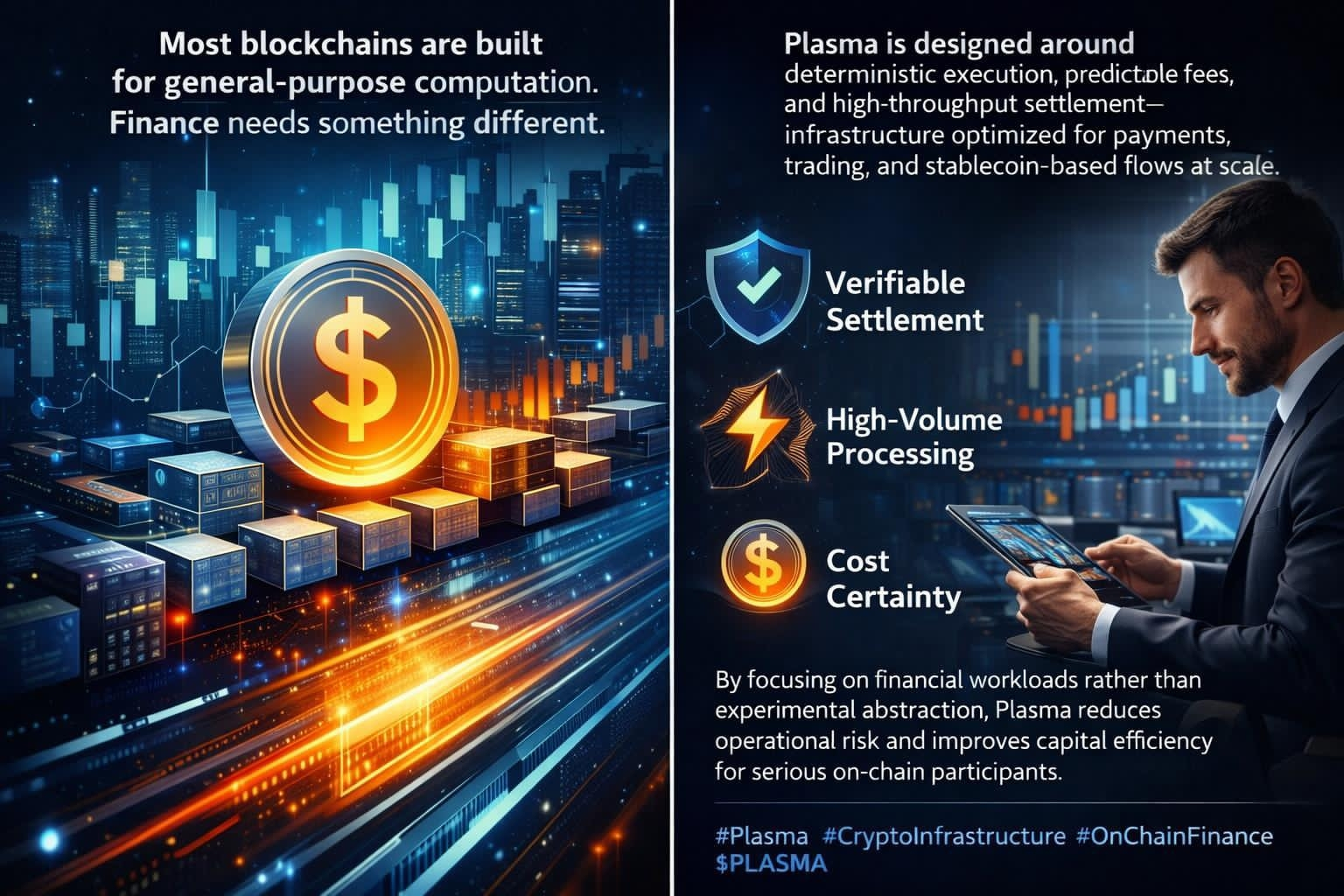
Structural Contrast with Existing Blockchain Models
Traditional Layer-1s attempt to balance decentralization, expressiveness, and scalability simultaneously, often at the cost of performance predictability. Rollups improve scalability but depend on upstream layers for finality and data availability, creating implicit trust and timing assumptions.
Plasma takes a different approach by narrowing its design scope. By optimizing around a defined economic function, it can deliver stronger guarantees where they matter most: execution certainty, cost control, and verifiable outcomes. This specialization allows Plasma to avoid many of the systemic risks that emerge when financial activity is forced onto generalized infrastructure.
Relevance to Institutional and Enterprise Use
For institutional participants, blockchain adoption hinges less on innovation narratives and more on operational reliability. Plasma is designed to support use cases such as:
High-volume payments and settlement with predictable costs
Trading and liquidity operations requiring sustained throughput
On-chain treasury management where capital efficiency is measurable
These applications benefit from infrastructure that behaves more like financial plumbing than experimental middleware. Plasma’s design reflects this requirement by prioritizing stability and auditability over maximal flexibility.
Verification, Transparency, and Reduced Trust Assumptions
Plasma emphasizes transparent execution and verifiable state transitions, enabling independent validation of network activity. This reduces reliance on discretionary operators or opaque intermediaries—an important consideration for enterprises operating under regulatory and fiduciary constraints.
By making system behavior observable and predictable, Plasma aligns on-chain finance more closely with the expectations of traditional financial infrastructure, without sacrificing cryptographic assurance.
Ecosystem Design and Long-Term Adoption
Developer adoption is influenced as much by clarity as by capability. Plasma’s focused scope simplifies application design by removing unnecessary abstraction. Tooling and incentives are aligned toward sustained usage rather than short-term speculation, supporting an ecosystem built around real transaction demand.
Interoperability with existing blockchain ecosystems further positions Plasma as a complementary layer within a broader financial stack, rather than an isolated network competing for attention.
Strategic Positioning in the Next Phase of Blockchain Growth
As blockchain infrastructure matures, specialization is likely to replace generality as the dominant design principle. Not every network needs to do everything; some need to do a small number of things exceptionally well.
Plasma’s strategy reflects this shift. By concentrating on scalable, capital-efficient financial settlement, it addresses a core bottleneck in on-chain adoption. If blockchain-based finance is to operate at real-world scale, infrastructure designed explicitly for that purpose will be essential. Plasma positions itself as a candidate for that role.