
There is a quiet phase every serious blockchain project must pass through. The early noise fades. Speculation cools. The charts stop making headlines. What remains is not price momentum, but structure. Not excitement, but execution. Vanar is living in that phase right now and it is precisely why it deserves closer examination.
Vanar Chain was not designed to be another abstract infrastructure experiment. It was built with a clear thesis: mainstream adoption will not arrive through technical superiority alone, but through products that people actually use. That may sound simple, yet in a market filled with chains optimized for throughput benchmarks and validator counts, it represents a deliberate strategic choice. Vanar’s foundation is not only protocol engineering, but consumer experience.
At its core, Vanar operates as an EVM-compatible Layer 1 network. That compatibility matters less for marketing and more for survival. Developers do not want to relearn fundamentals for every chain. They want portability. By aligning with Ethereum’s virtual machine standards, Vanar reduces friction for builders while attempting to differentiate itself through application-layer focus rather than base-layer novelty. It is not trying to reinvent the programming model. It is trying to own a vertical.
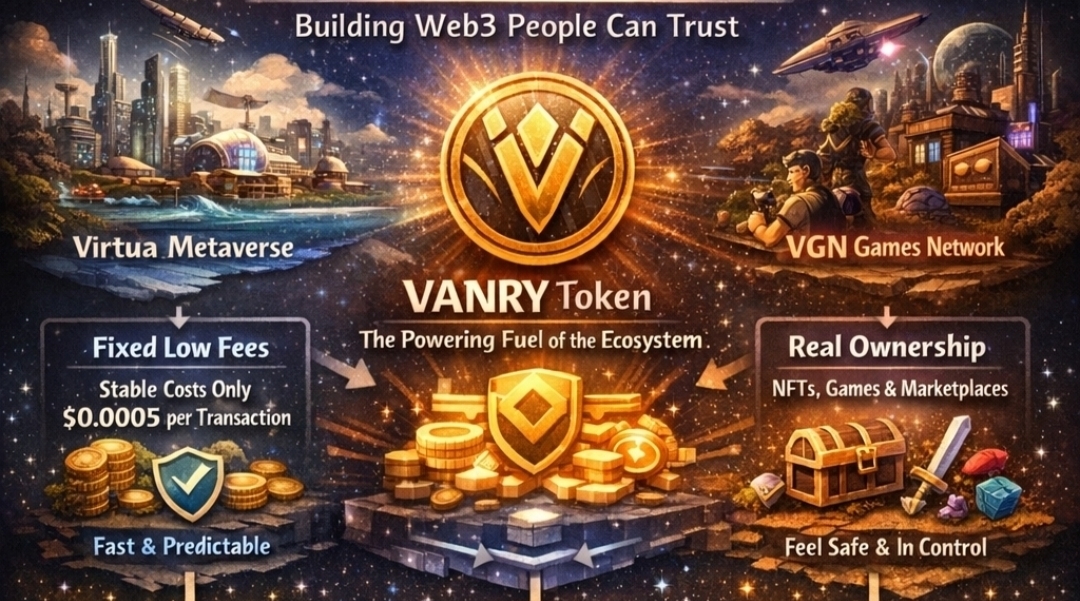
That vertical is consumer interaction: gaming, metaverse environments, digital ownership, and brand integrations. The ecosystem includes Virtua, a social metaverse environment designed for immersive digital experiences, and VGN, a gaming network structured around blockchain-based game economies. These are not theoretical frameworks. They are attempts to generate sustained user behavior rather than one-time token speculation.
The difference between a speculative token and a living ecosystem is recurring activity. That is where the real test lies. During bullish periods, VANRY the native token of the network behaves like many mid-cap assets: responsive, volatile, sensitive to narrative waves. But what matters more is what happens when the broader market slows. Does activity inside the ecosystem persist? Do users continue to transact? Does value circulate independently of external excitement? These are questions that define long-term credibility.
VANRY itself carries a maximum supply structure designed to create scarcity over time. Scarcity, however, is not merely a number. It is a function of distribution and behavior. A capped supply only becomes meaningful when tokens are held with conviction or locked within productive use cases. If staking participation is strong and aligned with genuine network engagement, float compresses naturally. If staking is driven primarily by yield expectations without ecosystem attachment, supply pressure eventually returns to the market.
One of the more subtle aspects of Vanar’s design is its focus on structured on-chain storage and AI-integrated modules. Rather than positioning itself solely as a transactional chain, it aims to host logic and data in ways that reduce reliance on external systems. In theory, this creates stronger internal cohesion. In practice, it must prove efficiency. Advanced architecture is valuable only when it lowers operational cost or increases reliability for real applications.
Gaming offers perhaps the clearest path to that kind of internal value creation. Game economies generate frequent micro-transactions. When successful, they create persistent demand for the underlying token. But history has shown that blockchain games struggle with retention once token incentives fade. Entertainment must stand on its own. If gameplay relies too heavily on financial reward, sustainability weakens. Vanar’s long-term viability within gaming will depend on whether its ecosystem produces experiences that people return to for enjoyment rather than extraction.

The metaverse component introduces another dimension. Digital social environments have powerful psychological appeal, especially when combined with ownership and creative expression. Yet user retention in virtual platforms follows a difficult curve. Initial curiosity is easy. Habit is rare. For Virtua to anchor value, it must foster communities that transact repeatedly, not episodically. The durability of those communities will determine whether VANRY becomes embedded in everyday digital interaction or remains cyclical.
From a market perspective, Vanar occupies a nuanced position. It is not competing directly with Ethereum for decentralized finance dominance. It is not chasing Solana purely on speed metrics. It is pursuing a consumer-facing narrative that intersects entertainment and emerging AI integration. That positioning makes it sensitive to shifts in broader sentiment. When capital rotates aggressively toward innovation themes, Vanar benefits. When risk appetite contracts, mid-cap narratives feel pressure first.
Liquidity patterns reinforce this dynamic. VANRY’s price movements often expand rapidly during periods of increased attention and contract just as quickly during broader corrections. This elasticity reflects holder composition. Assets dominated by long-term institutional capital tend to move more gradually. Assets influenced by retail enthusiasm respond sharply to momentum. Recognizing that structural reality helps frame expectations without judgment.
What distinguishes mature evaluation from optimism is resilience analysis. How does the network behave under stress? Does validator participation remain stable? Does staking participation fluctuate dramatically during downturns? Do transaction volumes collapse or merely soften? These metrics, more than marketing announcements, reveal structural integrity. Every ecosystem eventually faces an environment where attention fades. Those that survive are the ones where internal activity continues quietly.
There is also the matter of treasury and ecosystem funding. Building consumer platforms is capital-intensive. Incentive programs, grants, and partnerships require sustained resources. The pacing of these allocations influences long-term stability. When ecosystems grow primarily through subsidies, participation often mirrors the incentive curve. When growth emerges organically from user satisfaction, stability deepens. Observing this balance over time is critical.
Emotionally, Vanar’s journey reflects a broader truth about crypto cycles. Projects born in optimism must mature through skepticism. There is something quietly admirable about networks that continue building when headlines move elsewhere. It reveals whether the thesis was constructed for valuation spikes or for endurance. In this stage, conviction becomes quieter but stronger.
Looking forward, the decisive signals will not come from price charts alone. They will emerge from behavior: active wallets returning week after week, developers shipping updates without reliance on temporary incentives, token circulation stabilizing rather than accelerating under stress. If those patterns form, valuation follows naturally. If they do not, volatility remains the defining feature.
Vanar today represents potential structured around execution rather than speculation. It sits at the intersection of technology and consumer psychology, where adoption is earned gradually rather than declared. The path ahead will not be defined by short-term rallies but by whether the ecosystem can cultivate lasting digital communities and self-sustaining economic loops.
Markets reward durability over time. They test conviction relentlessly. And in that testing process, the true character of a project emerges. Vanar is still in the proving phase not because it lacks ambition, but because ambition in this industry must withstand indifference before it earns belief.
That is the stage where real foundations are laid.