
The blockchain industry has developed a habit of measuring success through flashy metrics — Transactions Per Second (TPS), Total Value Locked (TVL), or token price momentum. While these numbers can signal growth, they rarely explain whether a network is actually solving long-term infrastructure problems.
Fogo positions itself differently. Instead of chasing headline numbers, the project appears focused on building an invisible yet reliable backend infrastructure that reduces friction for developers and simplifies onboarding for mainstream users.
To evaluate whether Fogo truly offers innovation or simply repackages existing technology, it is important to examine its architecture, developer tooling, and user accessibility.
Infrastructure Over Marketing
Most modern blockchains compete in performance wars. Networks attempt to outperform rivals like Ethereum by promising faster transaction speeds or lower fees. However, high TPS alone does not guarantee usability or developer adoption.
Fogo’s use of the execution environment inspired by Solana architecture suggests a different design philosophy. Rather than optimizing for sequential transaction processing, the network utilizes parallel execution. In simple terms, it allows multiple transactions to be processed simultaneously instead of waiting in a queue.
From an infrastructure perspective, this matters more than marketing claims. Parallel processing can reduce network congestion, improve latency, and create a more stable environment for decentralized applications.
But performance alone does not build ecosystems. Developers do.
Developer Experience: Reducing Friction
One of the biggest barriers to blockchain adoption is developer complexity. Historically, developers had to choose between performance and compatibility.
Fogo attempts to solve this by supporting Ethereum Virtual Machine compatibility. EVM compatibility means developers who already build smart contracts using Ethereum-based tools can migrate or deploy applications without learning an entirely new programming stack.
This reduces friction significantly.
More importantly, developer tooling plays a critical role in ecosystem growth. Platforms like thirdweb have simplified smart contract deployment, wallet integration, and backend infrastructure management. If Fogo integrates or supports such tooling, it dramatically lowers the entry barrier for builders.
From a pragmatic standpoint, blockchains succeed when developers spend less time managing infrastructure and more time building products.
The Real Bottleneck: User Onboarding
While developers build the ecosystem, mainstream users determine its survival. Unfortunately, Web3 still suffers from usability challenges.
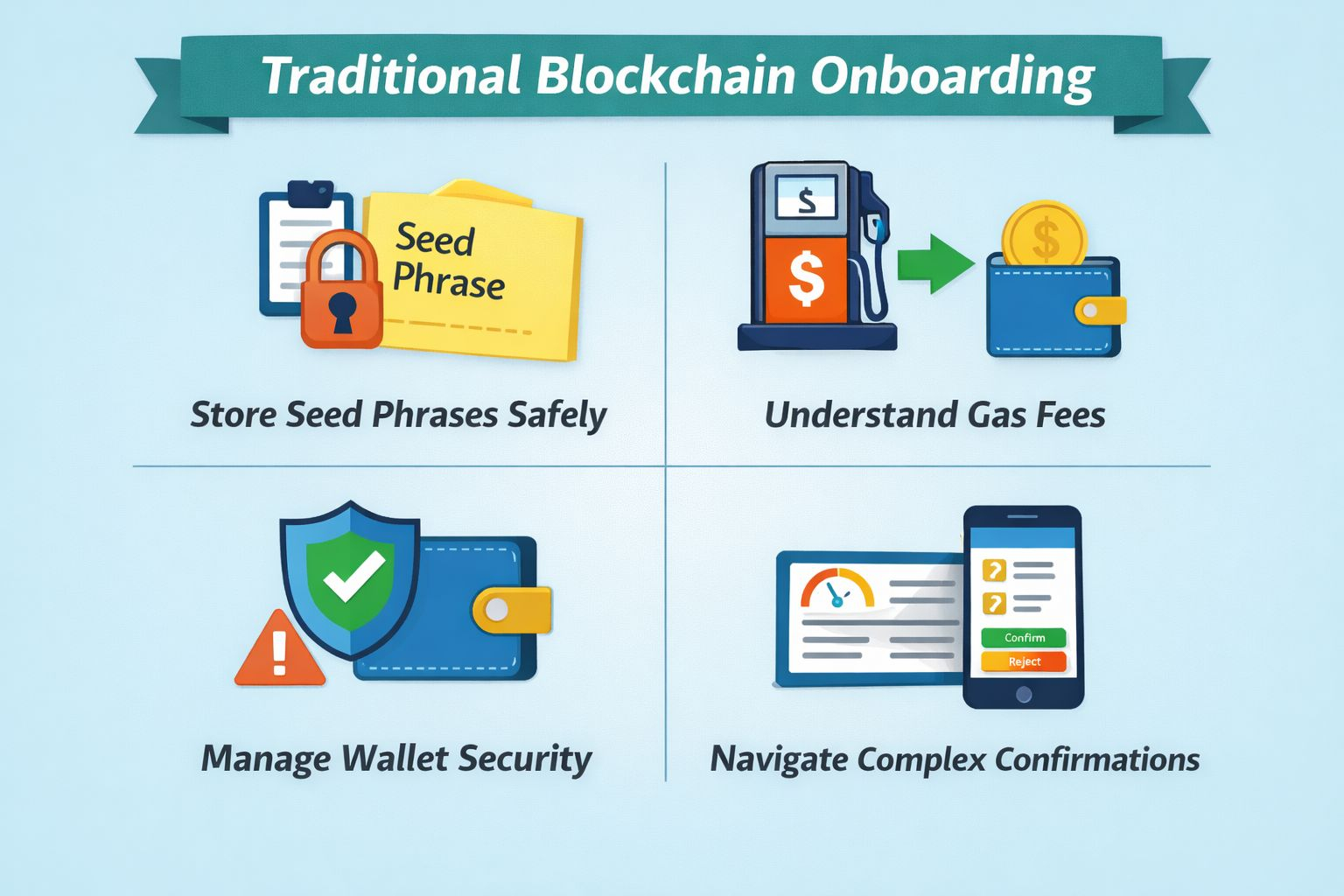
Traditional blockchain onboarding requires users to:
Store seed phrases safely
Understand gas fees
Manage wallet security
Navigate complex transaction confirmations
For average users, this process is intimidating and often results in onboarding failure.
 Account Abstraction: Simplifying Web3
Fogo’s long-term relevance may depend heavily on how it approaches Account Abstraction — a concept designed to make blockchain wallets behave more like traditional apps.
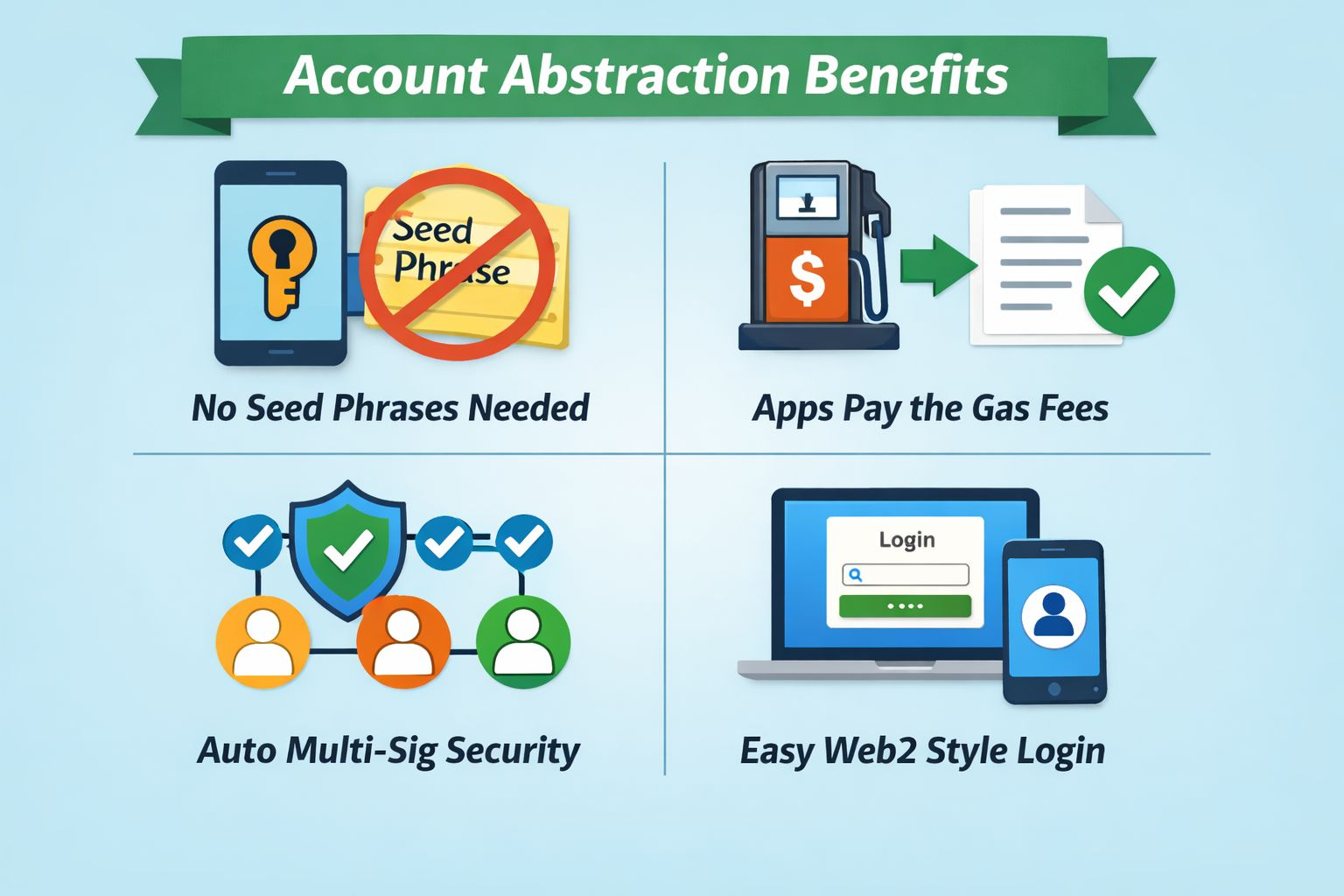
In simple terms, Account Abstraction allows:
Wallet recovery without seed phrases
Gas fees paid by applications instead of users
Multi-signature security handled automatically
Login experiences similar to Web2 platforms
Instead of forcing users to memorize recovery phrases or manually approve complex transactions, applications can handle these processes behind the scenes.
If implemented correctly, this transforms blockchain into invisible infrastructure — users interact with applications without realizing they are using Web3 technology.
Moving Away From TPS and TVL Competition
Many blockchain projects attempt to gain credibility by competing in TPS benchmarks or liquidity races. While these metrics attract investors, they often ignore sustainability.
Fogo appears to take a quieter but potentially more impactful route. By focusing on execution efficiency, developer compatibility, and user abstraction layers, the network is targeting structural improvements rather than surface-level performance.
Invisible infrastructure is rarely celebrated in marketing campaigns, but historically it defines successful technology platforms. The internet itself succeeded because users did not need to understand TCP/IP protocols to browse websites.
Fogo seems to follow a similar philosophy.
Reliability and Network Stability
Another overlooked factor in blockchain adoption is reliability. High-performance networks often struggle with outages or network instability when scaling rapidly.
Parallel processing architectures, if optimized correctly, can distribute computational load more effectively. This reduces bottlenecks and improves uptime consistency.
For enterprises and large-scale decentralized applications, reliability is often more valuable than raw transaction speed.
Why Fogo May Stand Apart From Glitzy Projects
Many blockchain launches rely heavily on marketing narratives, influencer promotion, or speculative token demand. These strategies may generate short-term visibility but rarely build long-term ecosystems.
Fogo’s potential differentiation lies in three areas:
Developer Accessibility
EVM compatibility and integration with modern tooling platforms reduce entry barriers for builders.
User Simplicity
Account Abstraction and gas abstraction concepts can make blockchain applications accessible to non-technical users.
Infrastructure Focus
Parallel execution and performance optimization aim to build scalable backend systems rather than chasing promotional benchmarks.
The Long-Term Outlook
Blockchain adoption will likely depend less on token speculation and more on user experience and developer productivity. Networks that hide complexity while maintaining decentralization will likely dominate the next phase of Web3 evolution.
Fogo’s architectural decisions suggest an attempt to move in this direction. Whether it succeeds depends on execution quality, developer ecosystem growth, and real-world application adoption.
Final Assessment
From a pragmatic technology perspective, Fogo is not attempting to reinvent blockchain fundamentals. Instead, it is attempting to refine infrastructure, reduce onboarding friction, and improve developer accessibility.
This approach may not generate immediate hype, but historically, infrastructure-driven innovation tends to create more sustainable ecosystems than performance-driven marketing.
If Fogo successfully balances compatibility, usability, and reliability, it could contribute meaningfully to making blockchain technology usable for mainstream audiences rather than just crypto-native communities.
#fogo @Fogo Official #FOGOAstronomy $FOGO


