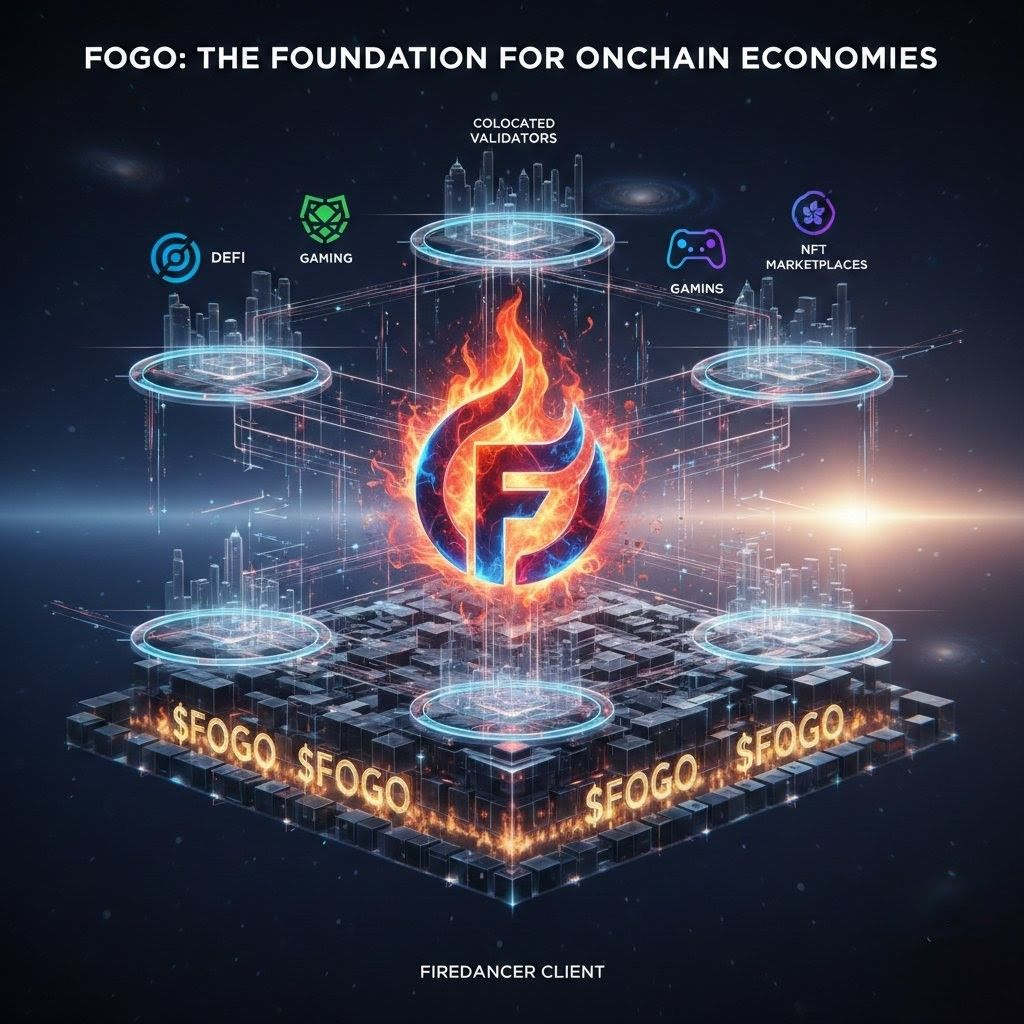
If you spend enough time around crypto builders instead of just traders, you start to notice something uncomfortable. Most Layer 1 conversations revolve around throughput numbers, token listings, and ecosystem funds. Very few revolve around the harder question: what kind of economic activity should actually live onchain, and what does the infrastructure need to look like to support that long term. That is the space where @undefined is positioning itself, and it is more interesting than it first appears.
Fogo exists because the current generation of high-performance chains solved one problem and quietly created another. Yes, block times are faster. Yes, transaction costs are lower. But performance without coordination is fragile. Many networks can process transactions quickly under ideal conditions. Far fewer can maintain credible neutrality, decentralization pressure, and economic alignment when real value starts moving across DeFi protocols, NFT marketplaces, DAOs, and gaming economies simultaneously.
What Fogo seems to recognize is that infrastructure is not just about speed. It is about predictable execution, sustainable validator incentives, and a clean developer surface that does not collapse under complexity. In practical terms, that means focusing on how applications interact with the base layer, how state growth is managed, and how incentives are distributed between validators, builders, and users. These details are not flashy, but they are where most chains quietly struggle.
The architecture behind Fogo is designed to support high-performance execution while keeping validator participation economically rational over time. That matters because decentralization is not a philosophical feature. It is an economic equilibrium. If running a validator only works during bull markets, the network is not stable. If governance is dominated by short-term token speculation, protocol upgrades become political rather than technical decisions. Fogo’s approach to staking and validator rewards appears structured to balance network security with long-term participation rather than quick emissions-driven growth.
The $Fogo token plays a central role in that alignment. It is not just a fee token or a governance badge. It ties together staking, network security, and participation in protocol-level decisions. Validators stake $Fogo to secure the network and earn rewards from transaction fees and protocol incentives. Token holders can participate in governance, shaping upgrades and economic parameters. The important part is not the mechanics themselves, which are familiar across Web3, but how tightly they are integrated. When governance, fees, and security share the same economic layer, the system becomes harder to game.
From a developer perspective, the value proposition is more subtle. Builders want stable tooling, predictable costs, and an ecosystem that does not shift direction every quarter. Fogo’s infrastructure choices appear aimed at reducing friction at the protocol layer so that teams can focus on application logic rather than constantly adapting to base-layer instability. In DeFi, that means more reliable liquidity infrastructure. In gaming, it means consistent execution for in-game economies. In NFT ecosystems, it means lower uncertainty around minting and trading costs.
There is also a broader point here about onchain economies. Many chains optimize for transaction count, but fewer optimize for meaningful economic density. If a network processes millions of low-value transactions but cannot support complex financial coordination, it does not become the backbone of digital ownership. Fogo’s long-term relevance will depend on whether it can host applications where real capital, governance decisions, and user identities converge in durable ways. That requires more than technical throughput. It requires social and economic coherence.
Community participation is another dimension that often gets reduced to token incentives and marketing campaigns. A resilient Layer 1 needs contributors who are not just yield-seeking but structurally invested in the protocol’s evolution. If @undefined can cultivate a builder and validator community that sees $Fogo as a long-term coordination tool rather than a short-term trade, the network’s governance layer will mature differently from many of its peers.
None of this guarantees success. The Layer 1 field is crowded, and attention is finite. But Fogo’s focus on infrastructure fundamentals rather than surface-level metrics is a rational response to where the market is today. The next phase of Web3 will not be defined by how many chains exist, but by which ones can support complex, capital-intensive applications without breaking their own incentive models.
If Fogo can maintain performance while preserving decentralization pressure and economic clarity, it has a real chance to matter. Not because it promises to replace everything else, but because it is trying to address the structural weaknesses that most people only notice when networks are under stress. In a maturing crypto landscape, that kind of thinking is not flashy. It is necessary. #fogo $FOGO @FOGO