
I’m going to describe Fogo the way it reads in its own technical writing and the way it feels in the real world when people are trying to trade or move value fast. Fogo is a high performance Layer 1 that keeps compatibility with the Solana Virtual Machine so existing Solana style programs and tooling can carry over with far less friction. If It becomes important to explain what makes Fogo different it is not only the execution engine. It is the refusal to ignore physics. The litepaper makes the point in plain language that latency is the base layer and that user perceived performance is dominated by tail latency meaning the slowest slice not the average node. We’re seeing a design that starts from the uncomfortable truth that the planet sized network is the real constraint and then builds everything else around that.
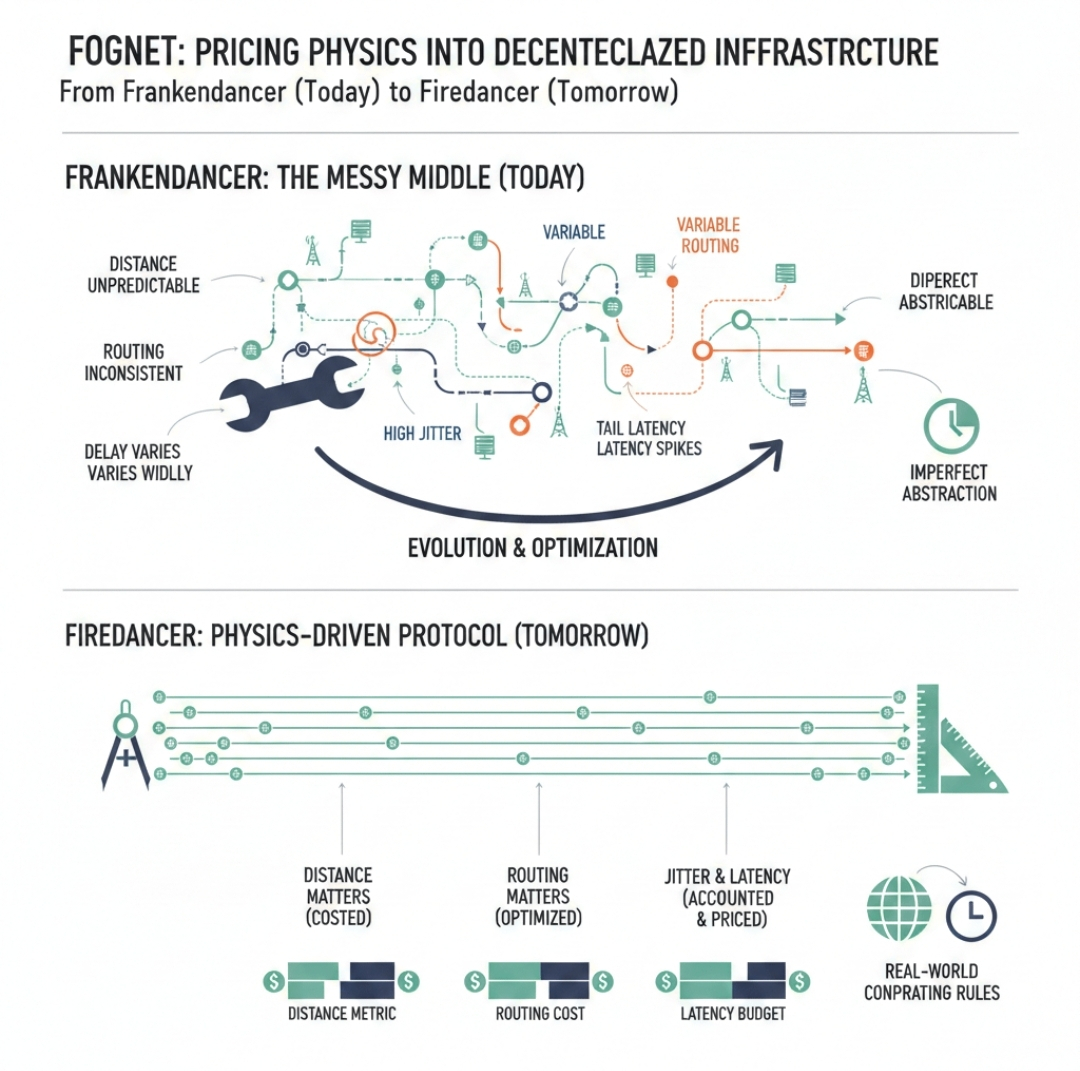
The original idea is not a new virtual machine and not a new programming religion. The idea is to keep what already works and focus attention on what usually breaks under stress. Fogo frames two constraints that keep showing up in every fast chain design. One is that latency is not a nuisance. It is the base layer. The other is that distributed performance is dominated by the slowest tail not the average node. They’re basically saying if you want fast confirmations you cannot only optimize the math. You have to control the physical distance and the variability in validator performance that consensus depends on.
That is why the choice to stay compatible with the Solana Virtual Machine matters. It lets Fogo inherit an execution model that already supports high throughput patterns and parallel execution while giving builders a familiar environment. I’m noticing the emotional side of that decision too. Developers do not just move code. They move confidence. If It becomes easier to reuse known programs and tooling then fewer teams feel like they are gambling with their time.
Now the system itself. Fogo describes itself as an adaptation of the Solana protocol with an SVM execution layer and a consensus design that is tuned for fast settlement. The network follows the general rhythm you would expect in a Solana style chain. Leaders propose blocks. Validators receive blocks validate execute and vote. The chain advances as votes converge on a single history. What Fogo highlights is that before something can be final socially it has to be known physically. That is where distance becomes a real limiter because the farther the data has to travel the more the protocol is fighting propagation delay and variance in who has seen what.
Fogo’s first big design decision is to treat geography like a protocol feature. The docs describe a multi local consensus approach where validators are grouped into zones and only one zone is active for block production and voting during a given epoch. The inactive zones still track the chain but they are not on the critical path for consensus in that epoch. This is the heart of the thesis. If It becomes possible to reduce the physical distance that the quorum needs to coordinate across then confirmation latency can drop in a way that pure algorithm tweaks cannot match. We’re seeing an attempt to trade always on global dispersion for a rotating model where the active set is geographically tighter and therefore faster.
I’m going to say the trade out loud because that is where trust lives. Zoning can improve latency but it also concentrates operational dependence for that epoch. If a region suffers routing instability outage or external pressure then the system has to prove it can rotate recover and continue without losing its integrity. The litepaper is explicit that it is building from physical constraints and that means it is also taking on physical risks as first class concerns. They’re not pretending the trade does not exist. They are saying it is worth managing because users experience the slowest tail as reality.
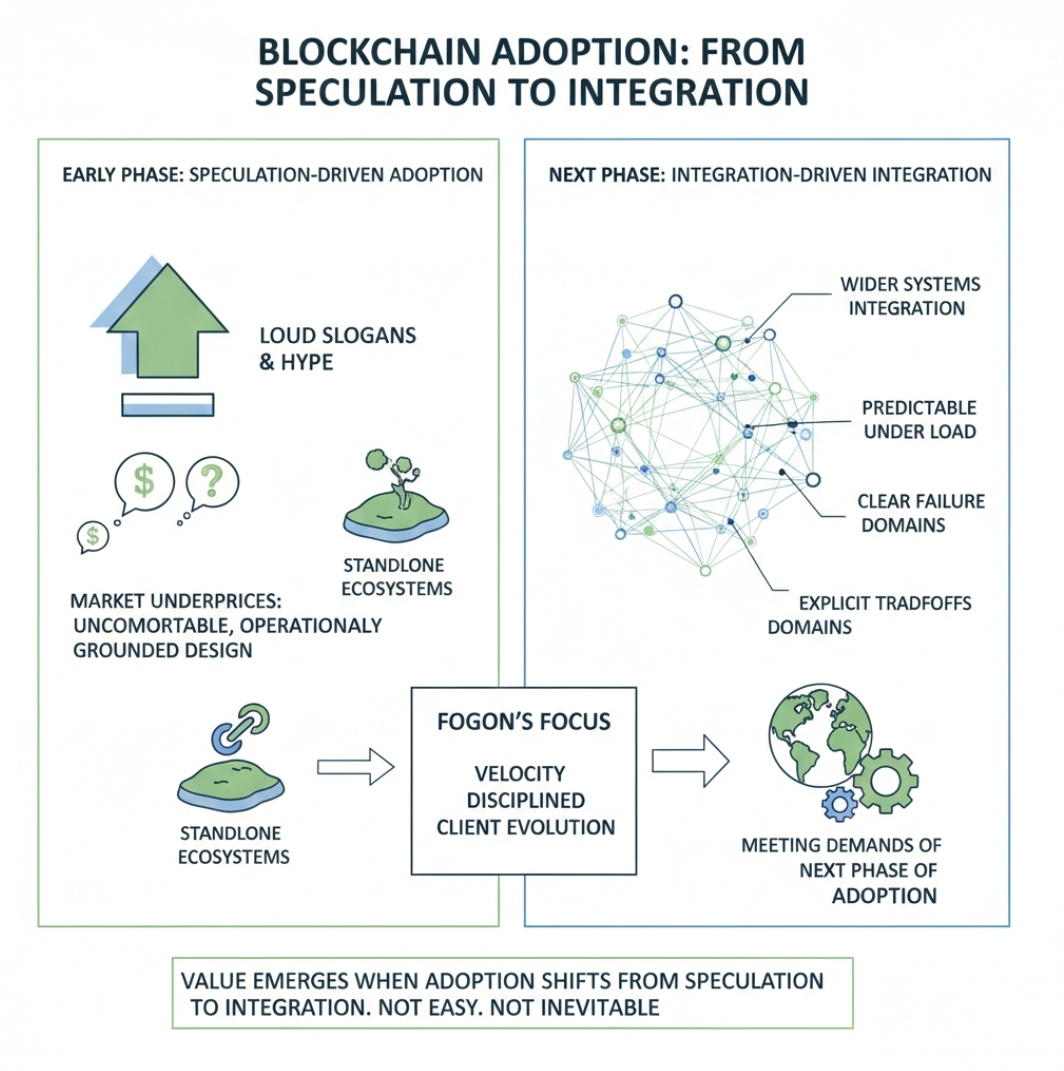
The second major decision is to standardize high performance validation rather than accept wide variance across clients hardware and tuning. The litepaper explains the weakest link dynamic. In a quorum based protocol you do not need every validator to be fast but you do need the quorum threshold to be reliably reachable within the target latency window. If validator performance varies widely across implementations and hardware then real time behavior is governed by that distribution not by the elegance of the consensus design. Fogo’s approach is to require high performance validator implementations rather than allow the network to slow down to accommodate the long tail.
This is where Firedancer enters the story. Fogo’s architecture docs state that the network will initially deploy using Frankendancer a hybrid implementation and then transition toward the full Firedancer client as development completes. Frankendancer is described in Firedancer documentation as a hybrid approach used to gather feedback and harden the path toward a fully independent client. Jump Crypto has described Firedancer as an independent validator client built for performance and security. Other independent summaries also note Firedancer’s modular tile architecture and the fact that a fully independent production release has been under active development. The point for Fogo is not branding. The point is narrowing performance variance so the chain can target consistent fast confirmation.
The litepaper goes deeper and explains a tile based pipeline that processes networking signature verification deduplication address resolution packing execution proof of history block encoding and storage. It describes tiles communicating through shared memory queues so data stays in fixed memory locations while tiles pass lightweight pointers. That reduces copying overhead and latency. It also explains how parallelism especially in signature verification can scale across multiple cores and how pinning work to cores helps predictable execution while zero copy paths and kernel bypass techniques reduce per packet overhead. If It becomes clear why this matters the answer is simple. The chain is trying to feel fast not only in a lab but under real load where overhead and jitter become the enemy.
Fogo also talks about congestion management and fees in the context of making the chain usable under stress rather than only fast under ideal conditions. The litepaper frames the goal as fast confirmations and low fees while targeting better end to end behavior during congestion. The docs position Fogo as built for DeFi applications that need high throughput and low latency which are difficult to implement elsewhere. Messari has also summarized Fogo as an SVM based L1 aimed at institutional grade onchain finance and positioned as making targeted technical tradeoffs to meet traditional finance performance expectations. They’re telling you who they want to serve. People who cannot tolerate uncertainty when the market is moving.
Then there is the user experience layer where the project tries to remove the small repeated friction that drains people. Fogo Sessions is described in the official docs as a combination of an account abstraction mechanism and paymasters for handling transaction fees with user protection features and widgets for a consistent experience across apps. The public GitHub repository describes Sessions as an open source standard for app sessions on Fogo aimed at improving the onchain experience. Independent coverage explains the concept in simple terms as session keys that let an app carry out pre approved actions for a limited time without prompting a user to sign every transaction which is closer to single sign on behavior. I’m calling this out because it targets the emotional pain point people actually feel. The endless pop ups and repeated signing that makes users hesitate even when the backend is fast. If It becomes easier to interact safely without constant prompts then users stop feeling like every click is a risk.
But I will not pretend Sessions are automatically safe. Any system that delegates permission introduces a new boundary that must be designed carefully. The promise only holds if scope limits time limits and defaults are conservative and clear. The docs emphasize user protection features which suggests the team is aware of the risk surface. Still the reality is that convenience can become a trap if apps request broad permissions or users do not understand what they are granting. If it becomes too easy to approve too much then the chain can feel friendly right up until it becomes painful.
Now the progress metrics. The most important point is that Fogo is not only measuring peak throughput. It is measuring what the litepaper frames as end to end performance which includes latency and tail behavior and congestion management. In practical terms the metrics that matter for this design are confirmation time distribution not only average block time. Tail latency during spikes. Consistency across epochs and across zone rotations. Validator participation and the ability to reach quorum reliably within the target window. Packet loss sensitivity and recovery behavior. We’re seeing a philosophy where the scoreboard is built around the worst moments because that is what users remember.
The risks deserve to be stated plainly. Zoned consensus creates a dependency on the active region for that epoch and therefore raises the importance of operational resilience and rotation design. Standardizing on high performance validation reduces variance but it also narrows who can realistically participate which can concentrate influence if governance and transparency are not handled carefully. And building around a high performance client path ties part of the roadmap to the maturity of that client ecosystem including the transition path from hybrid approaches like Frankendancer to fuller implementations. I’m not saying these are deal breakers. I’m saying these are the real costs that come with a performance first promise.
The token and economic layer exists to pay for security and execution. The Fogo token white paper states that the token is used as gas consumed by validators to process transactions and reiterates compatibility with the SVM execution environment including parallel execution and reuse of Solana based programs and tooling. It is also structured as a regulatory style document in parts which signals an intention to describe the asset in formal terms rather than only technical terms. That matters for the kind of participants who care about documentation standards as much as they care about throughput.
When we look forward the roadmap is easiest to describe as tightening the same thesis rather than changing it. Improve zone selection and rotation so performance gains do not become governance confusion. Harden the network against regional disruptions. Keep reducing variance through client maturity and operator requirements. Improve developer experience so SVM compatibility translates into real deployments not just theoretical portability. Expand Sessions tooling and safety patterns so apps can deliver smoother flows without turning users into permission blind clickers. The architecture docs already set an expectation that the early phase uses a hybrid approach before transitioning toward the full client path which is a clear indicator of how they intend to mature.
If you ever see the token listed on an exchange such as Binance the real question will not be the listing. The real question will be whether the chain continues to behave the same way when attention and volume arrive at once. That is the moment the design is tested.
I want to close in a way that stays with you because this kind of infrastructure only matters when people feel something while using it. They’re trying to build a chain that reduces the fear of waiting. The fear of clicking again. The fear that you will be late because the network is late. I’m not asking you to believe in perfection. I’m asking you to notice what Fogo is aiming at. A blockchain that stops fighting geography and starts working with it. A blockchain that treats the slowest tail as the real enemy. If It becomes true that the network can stay calm while the market is loud then the biggest win is not speed. It is relief.
We’re seeing a chain that wants to earn trust the hard way by making the worst moments better. And if that happens then people will not remember the marketing. They will remember the feeling of sending a transaction and not holding their breath.