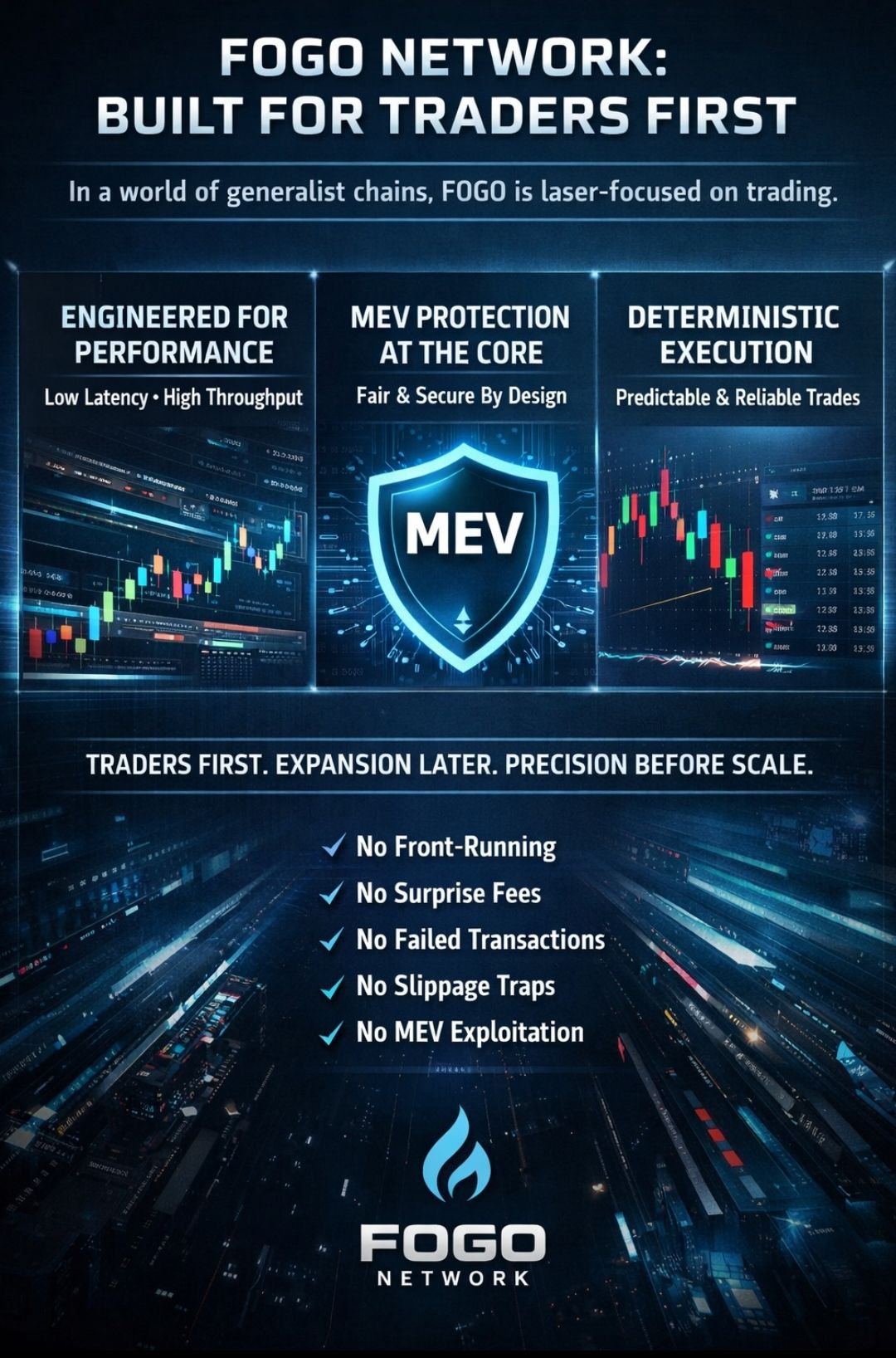
In a cryptocurrency ecosystem where most Layer 1 blockchains attempt to support every possible use case at once, from payments and NFTs to gaming and metaverse applications, Fogo Network is positioning itself with a fundamentally different philosophy. Rather than competing to become the most versatile chain in the market, it is narrowing its focus. Its core thesis is simple but deliberate: build infrastructure specifically optimized for traders before expanding into broader verticals.
Over the past few years, trading activity across decentralized markets has grown exponentially. With that growth came stress. Many general-purpose chains, originally designed to accommodate diverse applications simultaneously, began to reveal structural weaknesses under volatile conditions. During peak trading periods, users encountered spiking gas fees, delayed confirmations, front-running, excessive slippage, and failed transactions. In calm markets, performance appeared sufficient. Under pressure, cracks emerged.
The issue was not necessarily a lack of innovation but a matter of architectural priorities. When a network attempts to handle gaming logic, NFT minting, social applications, payments, and high-frequency trading all at once, congestion becomes almost inevitable during demand spikes. For traders operating in fast-moving markets, milliseconds matter. Predictability matters. Execution certainty matters even more.
Fogo Network’s approach reorders those priorities. Instead of treating trading as just another application layer on top of a generalized base chain, it treats trading performance as the foundation itself. The objective is not to advertise the highest theoretical transactions per second, but to deliver consistent execution under real market stress. This distinction is critical. Benchmark numbers in controlled environments often fail to reflect the chaotic conditions present during high volatility events.
A trader-first design begins with latency. In decentralized markets, delays translate directly into cost. Low-latency execution reduces the gap between intent and confirmation, narrowing the window where adverse price movement can occur. Beyond speed, however, fairness in transaction ordering becomes equally important. Many existing chains rely on sequencing systems that unintentionally allow value extraction opportunities through transaction reordering.
This leads directly to the issue of MEV, or Maximal Extractable Value. MEV has quietly acted as an invisible tax on traders across multiple ecosystems. Through transaction reordering, sandwich attacks, and priority manipulation, value that should belong to traders is often siphoned away. Several networks have attempted to mitigate this problem retroactively through patches, external relays, or optional protection mechanisms. While these solutions provide partial relief, they are often layered on top of infrastructures not originally designed to prevent such behavior.
Fogo Network aims to integrate MEV mitigation at the protocol level rather than as an add-on. By embedding fairness into sequencing and incorporating structured transaction processing mechanisms, it attempts to minimize the structural opportunities that enable exploitative strategies. This does not eliminate competitive market dynamics, but it seeks to reduce systematic disadvantages for ordinary participants.
Another core pillar of a trader-focused blockchain is predictable execution. Ask experienced DeFi participants about their most frustrating moments, and common themes emerge: unexpected slippage despite sufficient liquidity, sudden gas spikes that alter trade economics, failed transactions during critical entries or exits, and sandwich attacks that erode profitability. These experiences introduce uncertainty into strategies that otherwise rely on precision.
Predictability does not mean guaranteed profit. It means reducing randomness in execution mechanics. By implementing structured batch processing and more transparent sequencing logic, Fogo aims to narrow the gap between quoted prices and final settlement outcomes. When traders can better anticipate execution conditions, they can manage risk more effectively.
Throughput also plays a significant role. During high-volume events, networks must process a surge of transactions without degradation in performance. A trader-aligned chain must sustain throughput while preserving fairness and latency standards. Scaling purely for volume without addressing ordering and fairness only shifts the bottleneck elsewhere. Fogo’s architecture attempts to balance these components simultaneously rather than optimizing them sequentially.
Importantly, this specialization does not imply permanent limitation. Instead, it reflects phased prioritization. By first achieving reliability and precision in trading environments, the network builds a performance backbone that can later support additional applications without compromising its core strength. In contrast to ecosystems that expand broadly before stabilizing under pressure, this approach emphasizes structural resilience from the outset.
Market infrastructure has historically rewarded systems that deliver certainty over hype. Financial participants, whether retail or institutional, value environments where rules are transparent and execution risk is minimized. If Fogo Network succeeds in maintaining predictable performance during periods of extreme volatility, it could establish itself as an alternative model for Layer 1 design.
The broader blockchain landscape continues to evolve rapidly. New solutions emerge frequently, each claiming improvements in speed, scalability, or decentralization. What differentiates a trader-first blockchain is not just raw technical capability but alignment with the practical needs of active market participants. Precision, fairness, and consistency are not marketing metrics; they are operational requirements.
Ultimately, the real evaluation will not occur in whitepapers or promotional materials. It will occur during live market stress. When volatility surges and transaction queues expand, the network’s architecture will face its true test. If execution remains stable, fees predictable, and fairness preserved, the trader-first thesis gains credibility. If not, it becomes another experiment in an already crowded field.
For now, Fogo Network represents an intentional departure from the generalist model. By prioritizing trading performance at the architectural level and addressing MEV and execution predictability directly within its protocol design, it is attempting to reshape what specialization in Layer 1 infrastructure can look like. Whether this focused strategy translates into durable market adoption will depend on sustained performance under real conditions. In the end, infrastructure earns trust not through promises, but through consistency.