
why We Are Optimistic About the $DUSK Token?
An In-Depth Look at Dusk Network’s Mission, Tech, Adoption, and Long-Term Potential
In a crowded landscape of Layer-1 blockchains, privacy coins, and decentralized finance (DeFi) platforms, Dusk Network — and its native token dusk stands out not because it chases hype, but because it targets a real, under-served need: bridging traditional regulated finance (TradFi) with blockchain infrastructure in a compliant and privacy-focused way.
Today, we explore why we’re optimistic about dusk just as a speculative asset, but as a fundamental infrastructure play for the future of regulated on-chain finance.
1. A Clear Mission: Privacy Meets Compliance
Most blockchains emphasize decentralization, speed, or programmability — but few truly address *privacy. Even fewer attempt to satisfy regulatory compliance simultaneously. Dusk Network was built with this dual directive at its core: to offer confidential transactions for users and auditability for regulators.
Traditional blockchains reveal transaction details publicly. For retail users that’s fine, but institutions and regulated entities cannot operate under full transparency, as revealing counterparty data, trade sizes, or strategies would violate compliance rules and market norms. Dusk changes this by using advanced zero-knowledge proofs (ZKPs) to allow:
Private transactions that conceal balances and details.
Regulatory auditability under controlled access.
Compliance automation with frameworks like MiCA and MiFID II in Europe.
This dual functionality is rare and positons dusk as more than a privacy token — it’s a blockchain designed for regulated markets.
2. A Layer-1 Built for Financial Instruments & Real-World Assets
The DeFi space has seen massive growth in tokenized assets, but most platforms still struggle with compliance, privacy, and institutional participation. Dusk addresses this explicitly by enabling Real-World Asset (RWA) tokenization — the on-chain representation of traditional financial instruments like stocks, bonds, and other securities.
The network’s architecture allows institutional assets to be issued, traded, and settled on-chain while meeting legal and privacy requirements without exposing sensitive data publicly. This is not just theoretical — partner networks and exchanges are actively working toward bringing hundreds of millions in tokenized assets onto Dusk, signaling real utility beyond speculation.
In a future where finance becomes more programmable and cross-border, blockchain protocols that satisfy both privacy and compliance will be the ones institutions can truly adopt.
3. Privacy Is Not a Feature — It’s Fundamental to the Protocol
Some blockchains bolt privacy on as an add-on; Dusk builds it into the protocol itself using confidential smart contracts and zero-knowledge proofs. Native support for private contract execution means:
Transactions and contract logic can remain hidden from public view.
Only authorized actors (like auditors or regulators) see the data they need.
Sensitive financial flows are protected from front-running, pattern analysis, or competitive exposure.
This design is more than about secrecy — it’s about enabling blockchain technology in environments where public exposure is a liability. Institutions can adopt blockchain without compromising privacy or compliance, solving one of the core barriers to wider institutional blockchain use.
4. Strategic Partnerships and Real Ecosystem Engagement
Tech alone doesn’t guarantee adoption. Dusk is actively engaging with regulated entities and financial markets:
NPEX Partnership: A Dutch regulated exchange (MTF, Broker, ECSP) preparing to bring upwards of €300 million in tokenized securities onto the Dusk blockchain.
Compliance Protocols (Citadel): A privacy-preserving KYC and identity layer that enables self-sovereign verification without exposing user details publicly, aligning private data use with regulatory standards.
Chainlink Integration: Leveraging industry-standard interoperability to bring secure data feeds and trusted external info into the Dusk ecosystem.
These relationships underline Dusk’s real-world orientation — not speculative buzz, but practical deployments that may move capital and assets on-chain.
5. EVM Compatibility with DuskEVM — Wider Developer Adoption
Technical ecosystems matter. Dusk is evolving with DuskEVM, an Ethereum Virtual Machine-compatible layer that allows developers familiar with Solidity and existing Ethereum tooling to build applications on a privacy-focused, regulated foundation.
This is a major strategic move, as it:
Reduces friction for developers migrating or launching apps on Dusk.
Encourages the creation of regulated DeFi apps that adhere to compliance standards.
Blends mainstream blockchain tooling with institutional use cases.#dusk
6. Tokenomics That Encourage Network Participation
The $DUSK token is at the heart of the network. Key utility functions include:
Staking and consensus participation
Payment of transaction fees and gas
Rewards for validators and network participants
Governance roles as the ecosystem evolves
This set of roles aligns economic incentives with network security and growth, ensuring that users and validators share a common interest in the protocol’s success.
7. Growing On-Chain Activity, Market Momentum, and Accessibility
Market data has shown increased network usage and positive technical momentum, including upticks in active addresses and trading activity. Higher on-chain participation often correlates with stronger investor confidence and broader adoption signals.
Additionally, the recent listing of $DUSK on Binance US expanded access to one of the world’s largest regulated markets, improving liquidity and visibility for the asset. Such developments often help tokens attract a wider audience and institutional interest.
8. Positioned for the Next Wave of On-Chain Finance
The future narrative in crypto isn’t just about DeFi yield or NFTs — it’s about bringing massive real-world value (RWAs) onto blockchain in a compliant way. If trillions of real assets are to migrate on-chain, they will need:
Privacy where confidentiality matters.
Compliance where oversight is required.
Infrastructure that regulators, institutions, and users trust.
Dusk’s technology and strategic focus position it squarely in this potential future. @Dusk 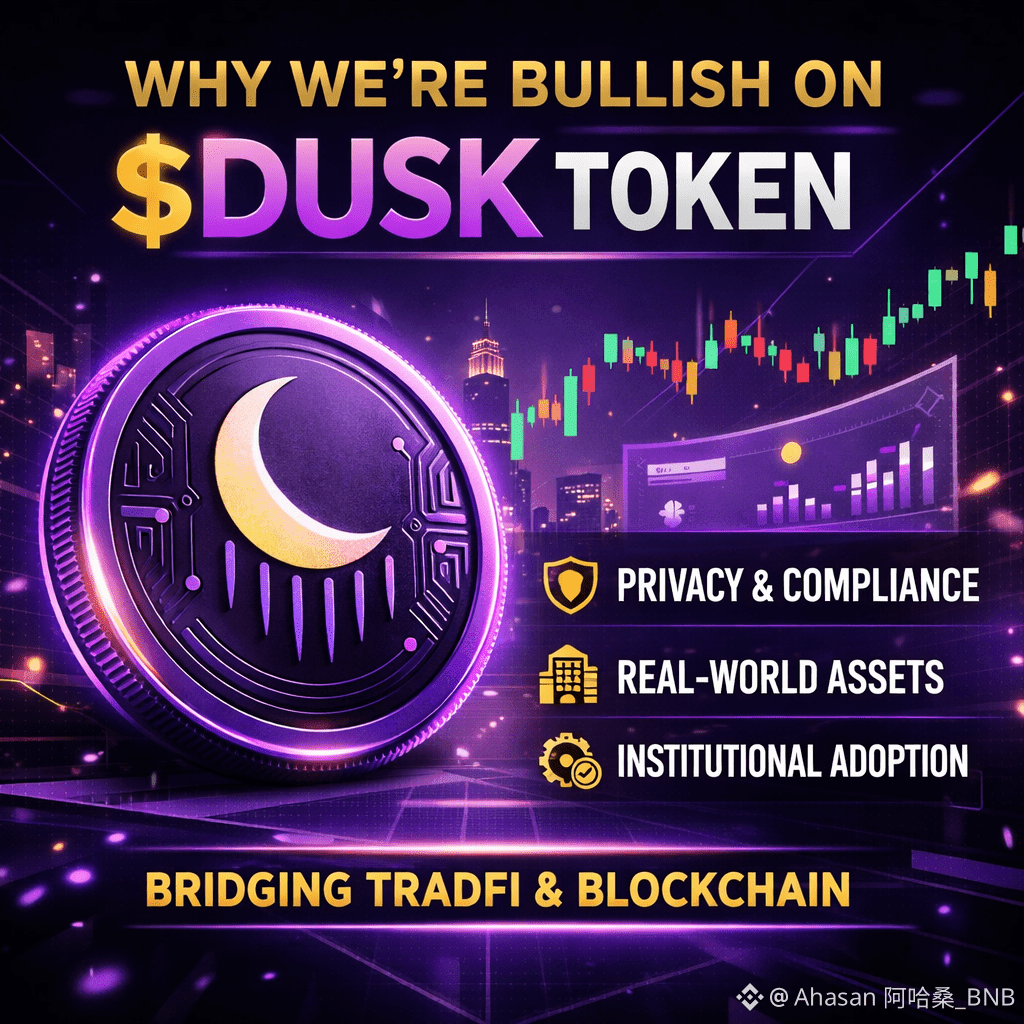

approach is not necessarily to be the loudest protocol, but to be the one that actually delivers institutional blockchain use cases at scale.
Risks and Long-Term View
It’s essential to acknowledge that projects targeting institutional and regulatory adoption inherently play a longer game. Progress may seem slower than hype-driven tokens, and real world institutional adoption always faces regulatory challenges and operational complexity.
However, long-term value accrues to infrastructure that solves real problems, not just speculative ones.