

Can Dusk Survive in a Regulation-Heavy World?
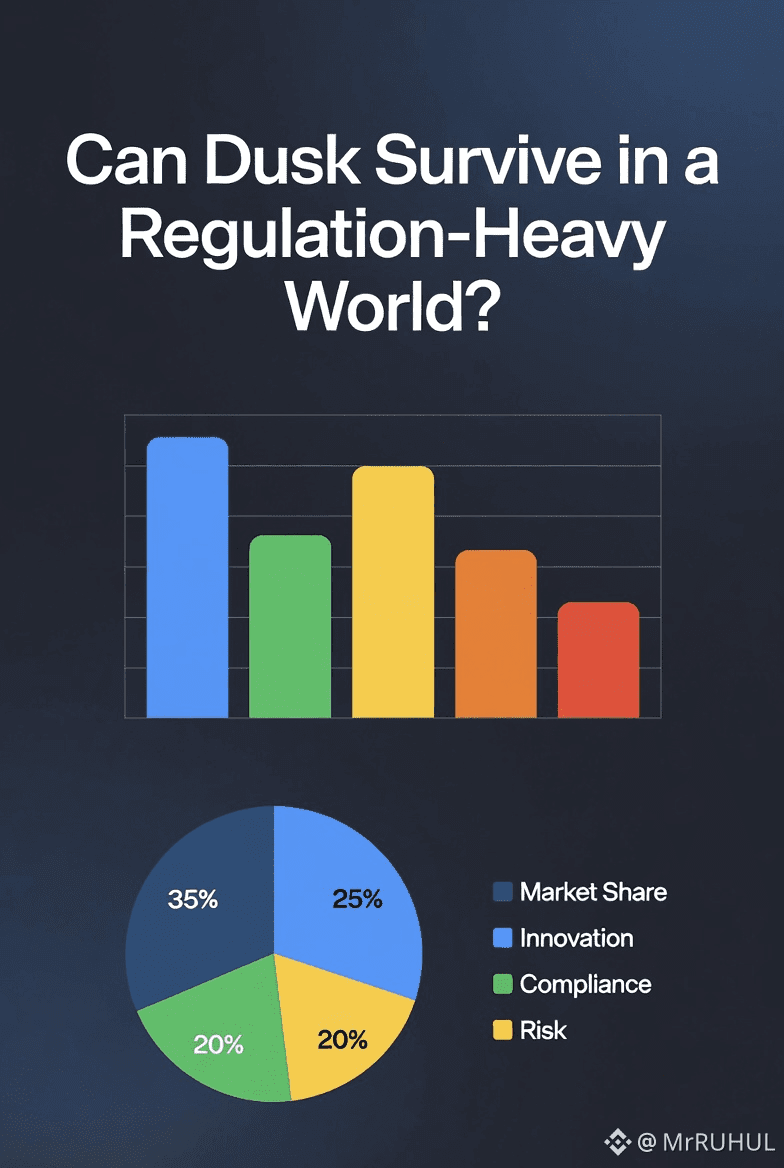
Every time regulators clamp down on crypto, privacy-focused blockchains get thrown into the spotlight. Can they stick to their ideals while still playing by the rules? For Dusk Network, this isn’t just a debate—it’s the whole point. Dusk wasn’t built as a rebellious answer to surveillance like some privacy chains. From the very beginning, the team designed it to work inside the system, not outside. That choice gives Dusk a real shot—not just at surviving, but maybe even thriving—when regulation gets tough.
Here’s the heart of the problem: transparency versus privacy. Regulators want to see what’s happening. They need audit trails, accountability, the works. But users and institutions? They want their business to stay private, especially when money’s involved. Most public blockchains lean too far into transparency, spilling way too much sensitive info. Privacy chains, on the other hand, often go all-in on anonymity—so much that regulators see them as a threat to anti-money laundering and know-your-customer rules. Dusk tries to walk the tightrope between those extremes.
Dusk’s secret sauce is selective disclosure. Zero-knowledge proofs let people keep transactions and smart contracts private by default. But when the law says someone has to check, authorized folks—regulators, auditors, compliance officers—can verify what’s going on. That’s a big deal. Dusk doesn’t promise “untraceable money.” It promises confidential finance with built-in compliance. In a world where total anonymity just won’t fly, this approach fits reality a whole lot better.
Dusk isn’t chasing retail anonymity, either. It’s aimed squarely at regulated financial instruments—things like tokenized securities, confidential trading platforms, compliant DeFi, and institutional settlement rails. These are areas already loaded with legal requirements. Dusk supports KYC’d users, permissioned disclosures, and rule-based execution. It speaks regulator, basically. That makes it much less likely to get shut out than privacy chains that only care about fighting censorship.
And just because Dusk plays nice with compliance, that doesn’t mean it gives up on decentralization. Its core is still a blockchain. Privacy is enforced with cryptography, not some middleman. That’s important. Regulators aren’t anti-decentralization—they just can’t stand systems where nobody’s accountable. Dusk doesn’t treat privacy as hiding; it’s more like controlled confidentiality. Honestly, that’s how traditional finance works already.
Narrative matters too. Most crypto projects act like regulation is the big bad wolf. Dusk treats regulation as a design challenge. That’s a subtle difference, but it changes everything. When regulators see you as a potential partner instead of an enemy, you get invited into the room—into sandboxes, pilot programs, and maybe even real institutional use. Privacy chains that fight the system rarely get that chance.
Of course, nothing’s guaranteed. Regulation moves slowly. Institutional adoption takes years, not months. Don’t expect Dusk to ride the same hype waves as meme coins. There’s always the risk that even Dusk’s selective disclosure won’t be enough for some regulators. And if Dusk slips up on its privacy or compliance tech, trust could evaporate—fast.
Still, if you look at the competition, Dusk’s approach makes sense. As regulators in Europe, Asia, and the U.S. get more involved, the crypto market’s going to split. Fully transparent chains won’t cut it for privacy, and fully anonymous ones will keep running into legal walls. There’s a real need for blockchains that offer programmable privacy within the rules. Not many projects can do that.
So, in the end, Dusk’s survival probably depends more on where regulation heads than on crypto’s usual boom-and-bust cycles. If the future of crypto involves regulated on-chain finance—and all signs point that way—then projects that can blend privacy with compliance won’t just be nice to have. They’ll be necessary.
Can Dusk survive in a regulation-heavy world? Honestly, not only can it survive—it might be one of the very few privacy-first blockchains actually built for that future. The bigger question isn’t whether regulation will hurt Dusk. It’s whether regulation will end up proving Dusk right all along.@Dusk #Dusk $DUSK
