

Walrus does so by creating user-centric data sovereignty, meaning that with self-custodial ownership of the blobs people own, they will be in charge of their access policy and monetization paths as well as their deletion schedule, without platform mediators extracting value through such pieces of data. Every blob works as a personal data vault controlled by the uploaders themselves, allowing them to decide in fine-control how data is accessed by employees--turning users into the platform getting the commodity treatment turned into individuals in charge of their assets, practically ending corporate usurpation at the press of a button. This type of model gives creators and researchers and consumers the ability to achieve complete economic surplus on their digital footprints in the AI training markets, social graph, and customized services.
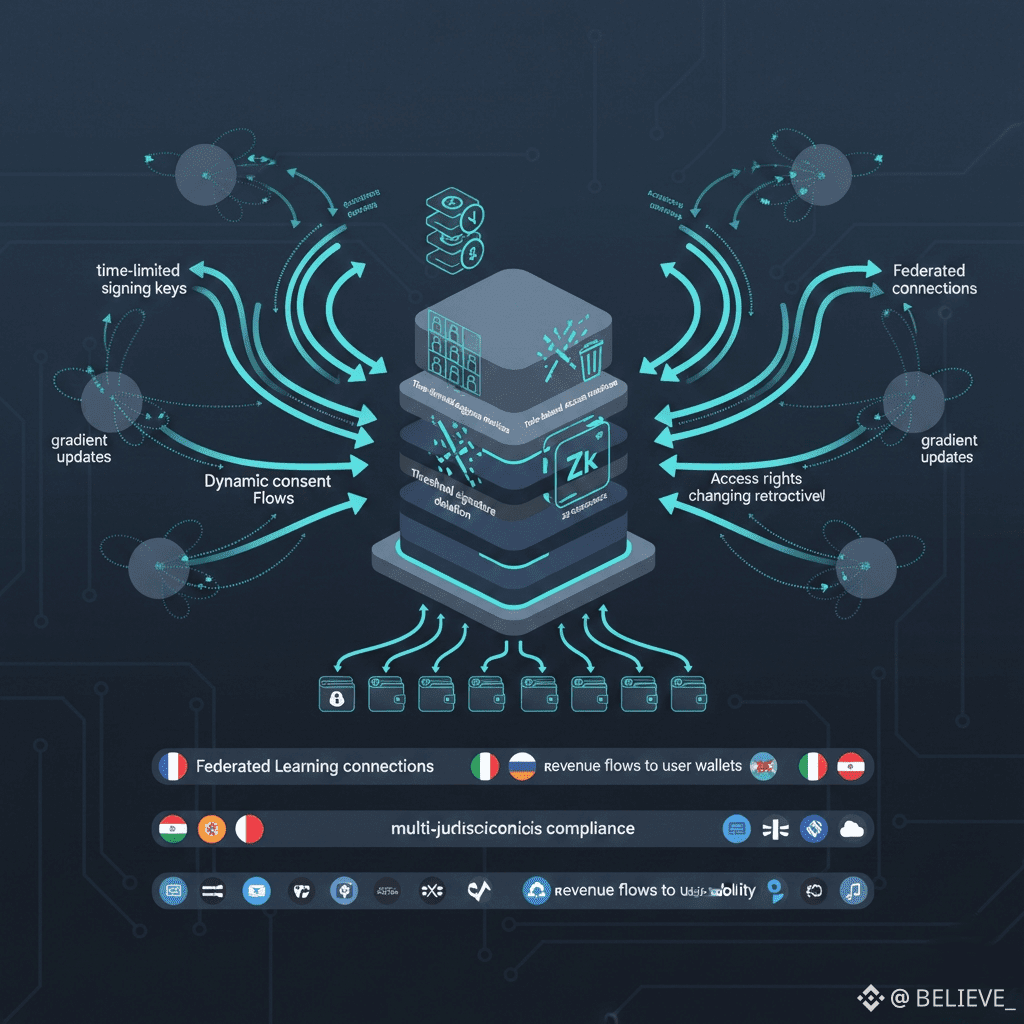
Fabrics of Self-Sovereignty.
Walrus uses key-rotation ceremonies whereby users create time-limited signing keys to blob policies, which can be revoked using the object upgradeability of Sui without interfering with availability proofs. Role-based access is represented as permission matrices, where family members get to query health records, the researchers license anonymized subsets on a zk-gated contract, all of which are done at the storage layer and prior to the reconstruction of slivers. Walrus policies are also user-hosted, unlike OAuth-dependent platforms, which means they move with service migrations using portable Sui object IDs, known everywhere in marketplaces.
Dynamic consent models allow owners to drop the access retroactively, an example of this is when the owner of a fitness tracker refines the granularity halfway through the year, and the sliver re-encryption happens across all the nodes without interrupting the system. The flow of revenue splits directly to the wallets in cases where AI firms inquire on personal dataset, where smart contracts regulate minimum pricing floors that are determined by the individual. This sovereignty is also applied to deletion supremacy - Article 17-compliant deletions spread on the basis of threshold signatures, and leave mathematical holes provable to regulators without invalidating the aggregate analytics to the benefit of society.
Personal Data Marketplaces
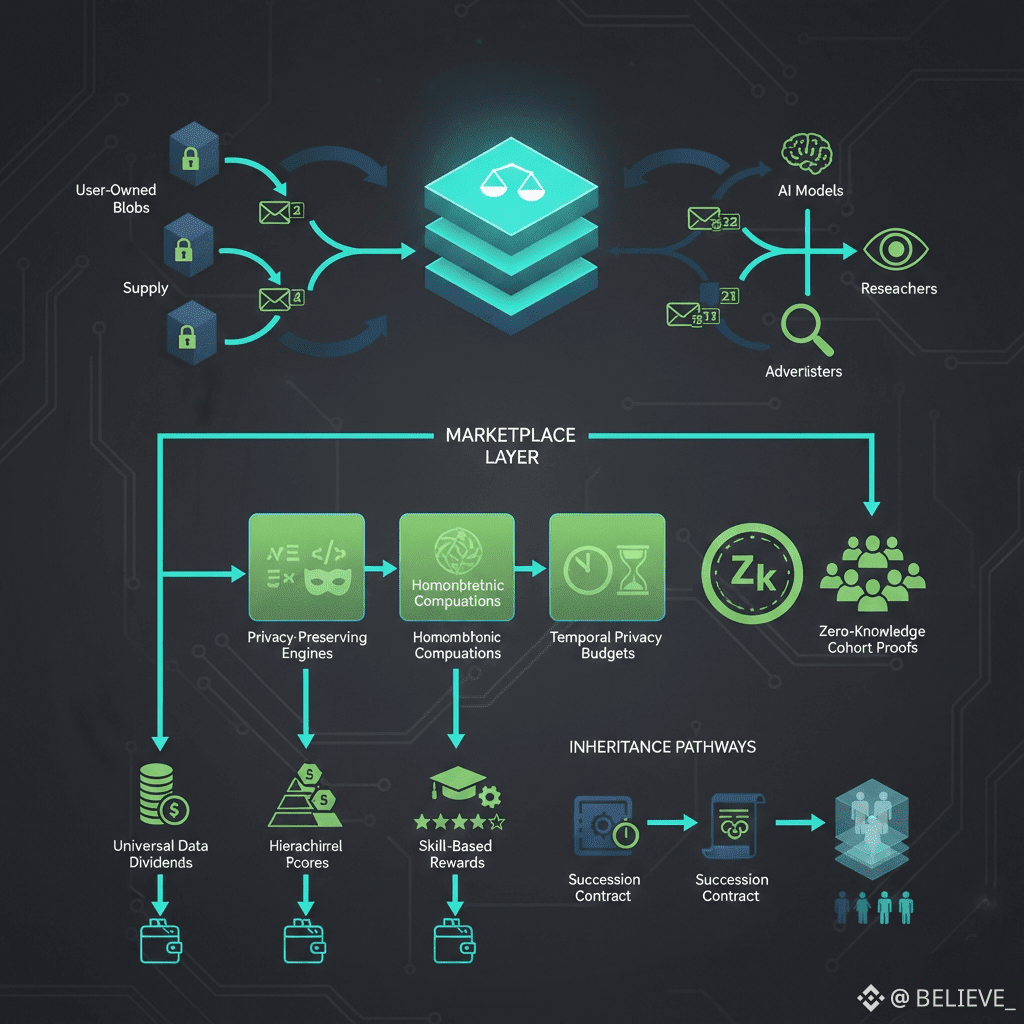
Walrus exchanges take advantage of owning user owned blobs, where the supply (individual datasets) is matched to demand (model trainers, advertisers, researchers) using sealed-bid auctions stored as metadata attached to the blobs. Owners stipulate conditions initially, such as limits to usage and geographic boundary and derivative work fees, which are checked on a query basis through concise proofs to avoid scope infringements. Breach insurance is insured at micro-insurance to provide cover to breach liabilities, with premiums varying negatively based on privacy scores calculated as the strength of encryption and history of access.
Federated learning: Invites manage communication between cyber vaults: people can send gradient updates but do not disclose actual slivers accumulating earned profit according to model improvement indicators using a metric of differential privacy. Social graph monetization opens up network effects--turns out having friends as your co-owners of photos of shared trips as joint blobs, ad revenue on travel suggestions and veto rights on individual exposures. This marketplace architecture is a scaling of personal economies between micropayments on pockets and business licensing transactions all over a peer to peer coordination.
Protocols of Continuity and Inheritance.
Walrus deals with mortality by using dead-man switches installing succession reasoning inblob governance rewards trusted contacts with graduated access when shown inactive, with final disposition implementing time-locked contracts. The family vaults are a multi-generational medical historical aggregated layer with no centralized EHR lock-in which enables longitudinal research opt-ins to benefit future generations with endless royalty. Probate workflows are enforced on-chain by legal primitives to transfer ownership hashes to executors without proofs of immutability to settle estate disputes.
The portability at cross-jurisdiction guarantees sovereignty does not die with the relocation: when crossing jurisdictions of CCPA, blobs consult regional compliance oracles to generate policies that will fit GDPR requirements. Diaspora people maintain cultural databanks in collective strong rooms, with the elders appointing cultural custodians by means of multisig evolution inaccessible to factional secession.
PPAE: Privacy-Preserving Analytics Engines.
Encryption Homomorphic layers on top of Red Stuff provide computation-over-encrypted slivers, which can be used to provide aggregate insights without the need to disclose information individually, such as creating personal health dashboards to show vaccination rates of millions of personal blobs without any questions about data deanonymization. Differential privacy adds controlled noise to query aggregation, which is proven to restrict the reidentification attacks at the cost of statistical utility to policy-makers.
Temporal privacy budgets allow owners to have a fixed amount of exposure set per year that will only allow the analytics to be accessed after quotas are hit. Zero-knowledge cohort memberships demonstrate inclusion in a cohort (e.g., age 25-34, urban) without self-identifying, which are used to drive precision-targeted services, which will pay off granularity of opt-in purchases. It is a privacy first analytics that are unlocking trillion dollar data economies which are currently locked in the silos of Big Tech.
Mechanisms of Economic Empowerment.
Universal basic data dividends share protocol revenue with all blob owners proportionately and generate baseline incomes streams of network effects instead of labor mining. Hierarchical price frameworks marginalize poor negative users but tax high frequency queriers, to make a trade-off between accessibility and sustainability. Skill based airdrops are a reward on privacy engineering work- privacy engineered advanced encryption input or new consent UX, which increases protocol maturity by distributing expertise.
Reputation systems increase the status of trusted owning as a compounding economic agency through premium query rates and multiplier governance. Mobile-first SDKs introduce sovereignty to billions and during offline signing ceremonies, it is possible to guarantee control even beyond great firewalls or even in times of connectivity outages.
Engaging in the interface of the Past.
Walrus exposes Web2 data exports using a uniform vault importer that can turn Facebook album of photos or Fitbit history into a self-sovereign counterpart, and no data is lost. The scaling paths of migration are shades on the current records, replicating the details of accessibility until users have entirely denounced reliance on the platform. Enterprise wrappers present as known APIs allowing Salesforce CRMs to query employee-owned contact blobs on the basis of rigid data processing deals.
Walrus rearchitects shift the relationships of data extracted to its exploitative seizure into the sovereign custodianship. Individual agency is reinstated in self-custodial vaults. Dynamic consent has taken on the economic surplus. The process of continuity is provided by the inheritance protocols. Population insights are uncovered through privacy analytics. Economic forces and mechanisms share protocol prosperity equally. People become the real sovereigns of the valuable resource of the AI age the sovereignty over their own data.