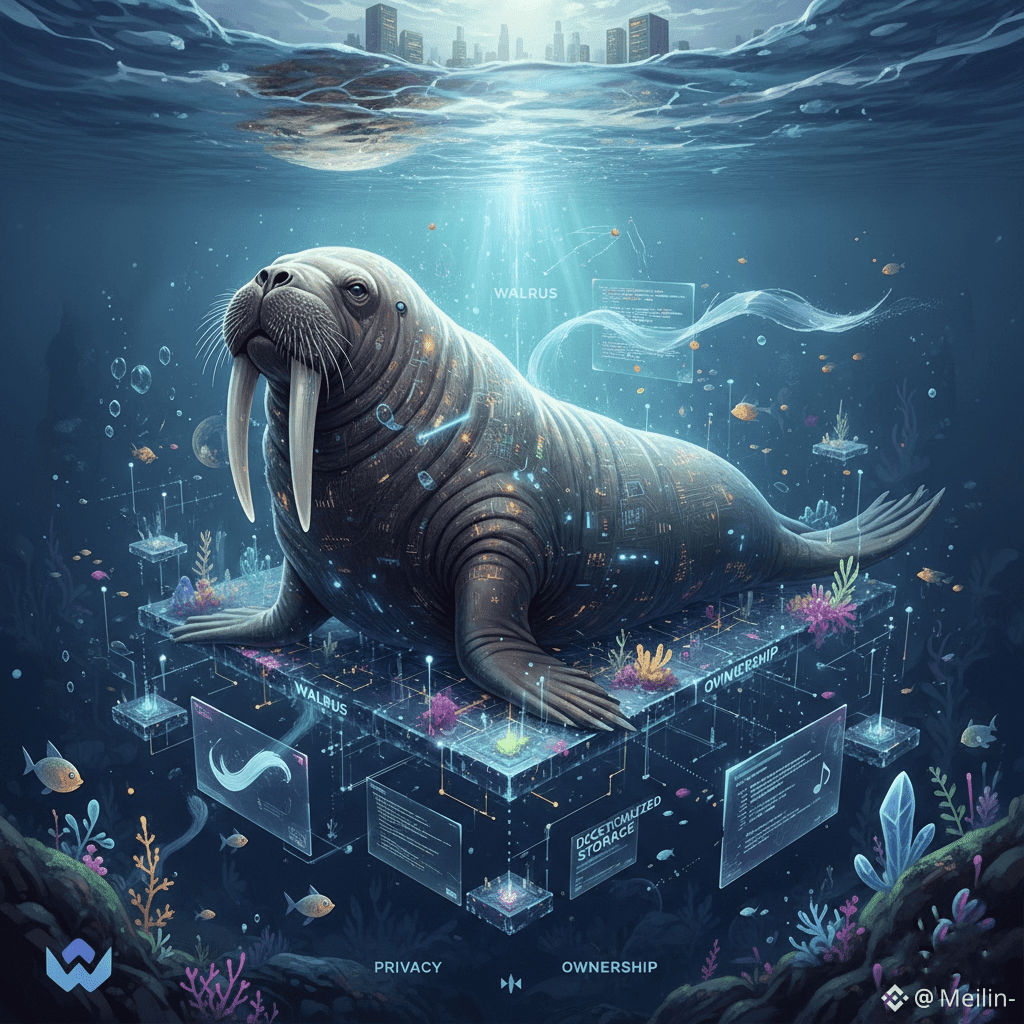
In an era where every click, message, and upload is quietly harvested, stored, and monetized by invisible intermediaries, a quiet rebellion is taking shape beneath the surface of the blockchain ocean. Walrus is not merely another protocol competing for attention in the crowded decentralized finance space. It is an assertion that privacy, ownership, and data permanence can coexist without compromise. Its presence signals a shift away from digital dependence on centralized guardians and toward a future where individuals reclaim authority over their assets, identities, and creations.
Walrus emerges from a growing realization that decentralization alone is not enough. Many blockchains succeeded in removing intermediaries from financial transactions, yet left data storage and privacy stranded in the hands of centralized infrastructure. Files remain hosted on servers owned by corporations. Sensitive interactions leave permanent public trails. Creative works can still vanish with a policy change or a takedown notice. Walrus confronts these contradictions directly by merging private transactions, decentralized storage, and economic incentives into a single cohesive architecture. The WAL token is the bloodstream of this organism, powering participation, governance, and network security while anchoring an ecosystem that is as functional as it is principled.
What sets Walrus apart is not just what it does, but how it does it. Instead of treating storage as an afterthought, it is built as a foundational layer. Large files are broken into coded fragments, scattered across independent nodes through erasure coding, and reassembled only when permitted. No single machine holds the complete picture, and no single authority can unilaterally erase it. This design transforms data into something resilient, borderless, and resistant to coercion. The technology is complex, but the outcome is simple: users gain durable, censorship-resistant storage without sacrificing affordability or accessibility.
Privacy within Walrus is not cosmetic. Transactions are structured to preserve confidentiality while still operating on a public blockchain. Users can engage in decentralized applications, staking mechanisms, and governance decisions without broadcasting their entire financial narrative to the world. This is a crucial evolution in decentralized finance, where transparency has often come at the cost of personal exposure. Walrus introduces discretion as a default rather than an add-on, allowing participants to interact freely without the anxiety of surveillance.
The protocol’s foundation on the Sui blockchain gives Walrus the performance and flexibility necessary to sustain this ambitious vision. Sui’s object-based architecture allows Walrus to manage data and state efficiently, enabling private interactions and large-scale storage without congestion or delay. The relationship between the two systems is symbiotic: Sui provides the speed and structure, while Walrus delivers privacy and permanence. Together they form an environment where decentralized applications can operate with the confidence that sensitive data and valuable content are not fragile liabilities.
For creators, this changes everything. Artists, researchers, journalists, developers, and enterprises can store critical or proprietary material without fearing sudden disappearance or unauthorized exposure. Ownership becomes meaningful when it is not tethered to a centralized host that can revoke access. Walrus offers a world where creative and intellectual assets remain under the control of their originators, preserved across time and geography, immune to institutional whims.
For participants in governance, WAL represents more than speculative value. It grants a voice in shaping the network’s evolution. Protocol upgrades, economic policies, and technical refinements are decided through community participation. Staking reinforces responsibility, ensuring that those who benefit from the system also contribute to its stability. This alignment of incentives transforms users into custodians of a shared infrastructure rather than passive consumers of a service.
There is a philosophical undertone to Walrus that resonates in an age defined by digital vulnerability. It asserts that privacy is not secrecy for its own sake, but a necessary condition for autonomy. It suggests that storage should not be an act of trust in distant corporations, but a cooperative act among peers. It recognizes that decentralized finance without decentralized data is only a partial revolution. By bridging these gaps, Walrus reframes the meaning of digital ownership in a networked world.
Every technological movement has its symbol. Walrus, a creature known for its calm presence and quiet strength beneath vast waters, captures the spirit of this protocol. It does not chase spectacle. It operates steadily, distributing weight, holding depth, enduring pressure. Beneath the noise of speculative markets and fleeting trends, it builds infrastructure designed to last.
The story of Walrus is still unfolding, but its direction is clear. It is constructing a domain where privacy and transparency coexist, where data is resilient rather than fragile, and where participation replaces permission. In a world increasingly shaped by invisible algorithms and centralized power, Walrus offers something rare: a system that trusts people with their own data and equips them to protect it.
This is not simply a technical innovation. It is a reimagining of how digital civilization can function when control, privacy, and ownership are returned to their rightful place in the hands of individuals. Beneath the waves of conventional infrastructure, Walrus is quietly redefining the architecture of freedom.