@Walrus 🦭/acc | #Walrus | $WAL
As you see Data keeps getting bigger, more valuable, and more sensitive. Decentralized storage isn’t just a nice-to-have anymore it’s essential. WALRUS steps in with a straightforward mission: deliver decentralized storage that’s secure, resilient, programmable, and actually usable in the real world. Instead of putting all your trust in a single cloud provider, WALRUS spreads your data across a web of independent storage nodes. Everything control, verification, management stays crystal clear onchain.
WALRUS is all about blob storage. That means handling massive, unstructured data: images, videos, documents, all the stuff that doesn’t fit neatly into rows and columns. Traditional databases want data in a rigid format. Blob storage doesn’t care. It treats data as raw objects, so it’s flexible and scales as your data grows. That flexibility matters today, when unstructured data is everywhere and swelling fast.
What really sets WALRUS apart is programmability. Storage here isn’t just about parking files somewhere. On WALRUS, data and storage space show up as objects living things that interact with smart contracts on Sui. Developers don’t just store and forget; they can own, manage, automate, and build entire applications around their data. Storage becomes a tool, not just a service humming in the background.
Why WALRUS Moves Beyond Centralized Storage
Centralized cloud storage comes with trade-offs big ones. It’s expensive. It has single points of failure. And you’re always at risk of censorship or getting locked out. WALRUS solves these problems by scattering data across independent nodes. No one company or server holds all the cards, and no outage or policy change can lock you out of your own data.
Older decentralized storage systems tried to tackle these issues, but WALRUS pushes further, focusing hard on performance and usability. It’s built to be affordable, robust, and ready to scale—fit for real apps and enterprises, not just tech demos.
Understanding Blob Storage in WALRUS
Blob storage is perfect for big, unruly datasets. In WALRUS, a blob has three key parts: the raw data, metadata, and a unique ID. This setup lets WALRUS store, verify, and pull data with real efficiency. The system is tuned for durability, availability, and the kind of scaling decentralized networks need.
Why does blob storage matter so much? Because most of the internet runs on unstructured data now images, videos, PDFs, app assets. WALRUS gives you a way to store all this outside the traditional cloud, while still keeping data safe and accessible.
The Role of Sui as a Secure Control Plane
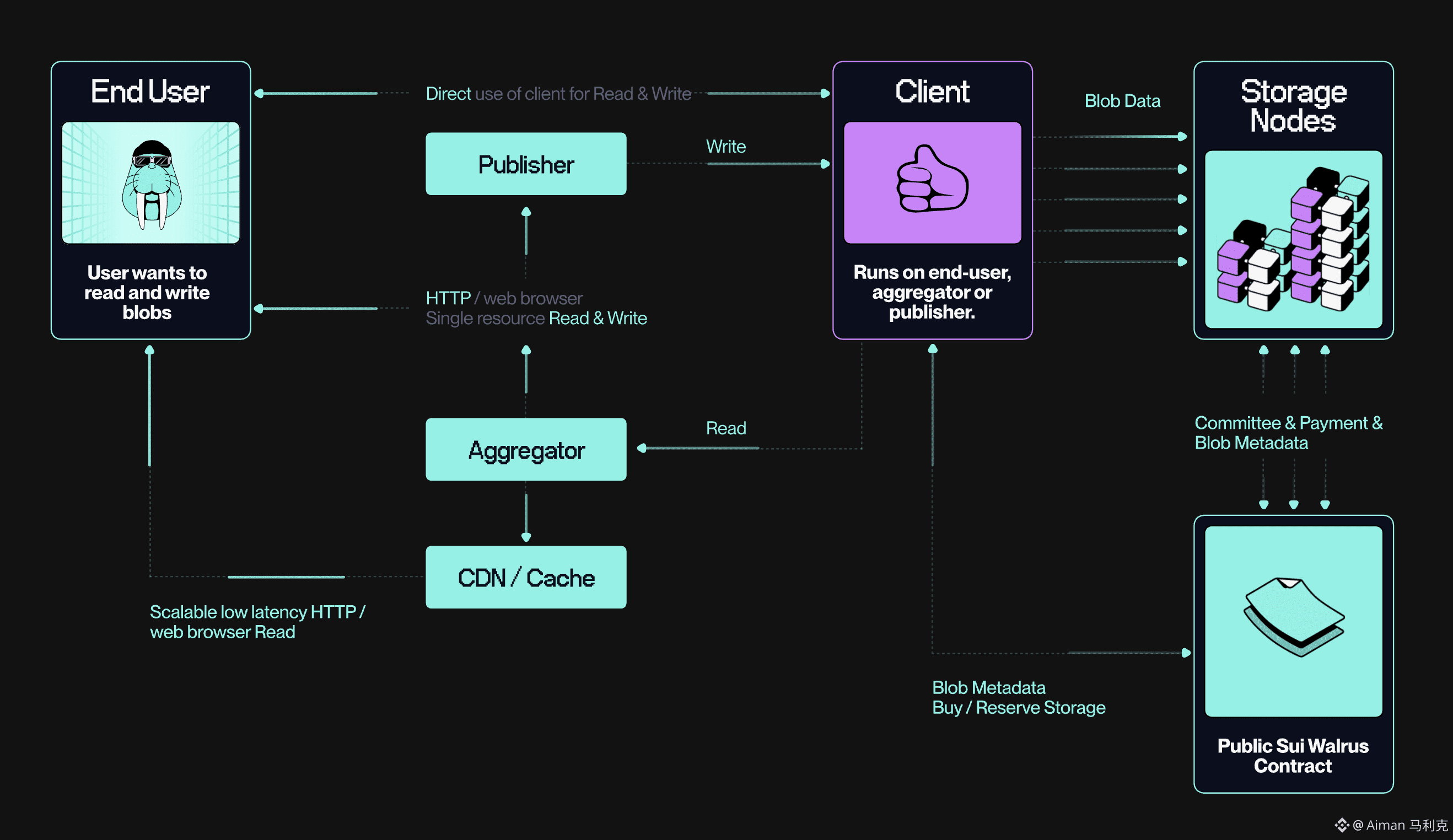
WALRUS teams up with the Sui blockchain, but it’s a division of labor. Sui isn’t where the data lives; instead, it acts as a secure control plane. It takes care of metadata, storage contracts, and verification. WALRUS handles the nuts and bolts of storing and retrieving the actual data.
This setup matters. WALRUS stays laser-focused on blob storage, while Sui brings security and programmability from the blockchain. Every stored blob gets an onchain Proof of Availability a solid guarantee that your data is actually there, maintained by the network under contract.
The Lifecycle of a Blob on WALRUS
To really get WALRUS, you need to see how a blob moves through the system. It’s a four-part journey: writing, storing, reading, and managing.
It all starts with the client. First, the client grabs a storage resource on Sui think of it as booking storage space for a set period. This storage resource is an object in itself, so it’s programmable and you can move it around. Next, WALRUS’s erasure coding chops the blob into smaller pieces called slivers. These slivers build in redundancy, so even if some nodes go offline, your data survives.
The client sends slivers out to storage nodes and waits for enough confirmations. Once there’s a quorum, WALRUS publishes a Proof of Availability certificate onchain. That’s the network’s official record: the blob is safely stored and locked in.
After that, storage nodes take over. Each node keeps its assigned slivers online and helps with recovery if anything goes wrong. The more stake a node gets, the bigger its responsibilities tying incentives for operators and token holders directly to network reliability. As the need for storage grows, so does the network’s strength.
Reading and retrieving a blob in WALRUS is built for resilience. When you want a blob, the client first pulls metadata from Sui, then grabs slivers from a group of storage nodes. You don’t need every single sliver to rebuild the original blob just a subset does the trick. Even if some nodes are down, you still get your data. That’s why WALRUS reads stay reliable, even when things go sideways.
Managing your blobs isn’t just set-and-forget. You’re in control for the long haul. Need more storage time? Just renew it, and you can keep your data effectively forever by making periodic payments. Or, if you’re done, you can break the link to a storage object and free up space for something else. This flexibility means WALRUS works for both short-term scratch space and data you want to keep around for years.
Programmability is where WALRUS really stands out. Storage here isn’t just a passive backend it’s programmable from the start. Blobs and storage resources live as Sui objects, so developers can automate renewals, set up custom access controls, or build applications that react to changes in stored data. Storage becomes part of your app’s core logic, not just a place to stash files.
This design opens the door for data-driven decentralized apps. With WALRUS, onchain code and offchain data connect seamlessly. Developers can plug WALRUS into different blockchains and ecosystems, since the protocol stays flexible and chain-agnostic. Builders aren’t boxed in.
WALRUS offers a decentralized alternative to traditional cloud storage without making you give up convenience. The protocol bakes in high availability, strong data integrity, and flexible management from the ground up. Decentralized storage here isn’t just about where your data sits. It’s about how you control it, verify it, and use it over time. That’s what sets WALRUS apart: a practical, future-ready foundation for decentralized data.