
Did you ever think Why @Dusk ? if its about Privacy or financial Infrastructure so there are many projects, let's me explain: tonight when Transactions began their journey without announcement. Not orders, not confirmations just movement. Each token representing a real-world asset carried its own invisible gravity, pressing against the ledger and against expectation. Corporate bonds, equity shares, property stakes they didn’t arrive as neutral data points. They arrived as responsibility.
The Dusk Foundation network hummed, modules acting like distant watchtowers. Institutional-grade applications aren’t forgiving. They measure not by success, but by friction. A single delay in verification rippled across layers, and suddenly a dividend payout wasn’t just late it was a question. “Did the contract even notice?” someone asked. The ledger said nothing. It just waited.
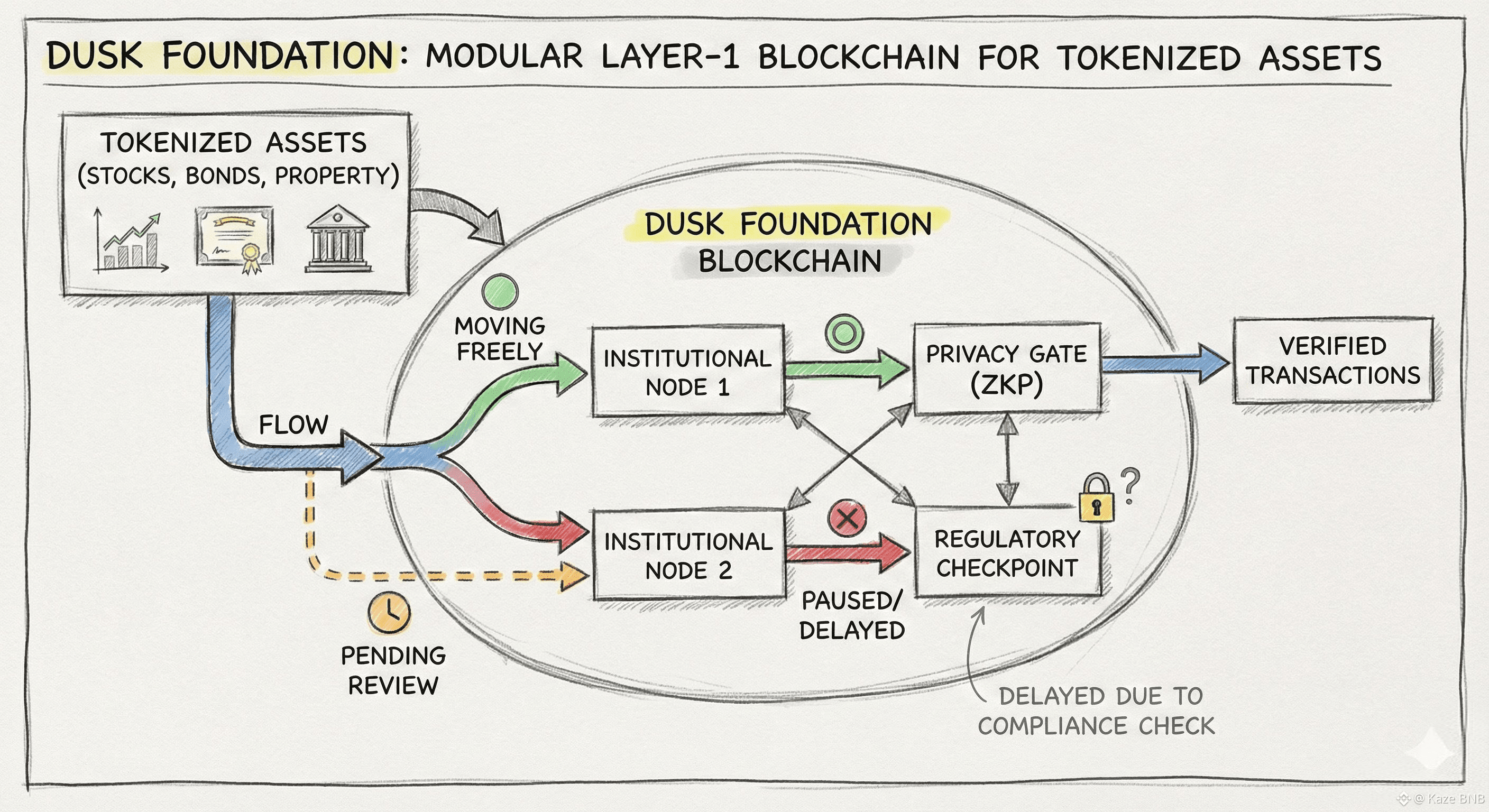
DeFi flows were no easier. Regulatory gates hung in the background, silent yet insistent. Every smart contract interacting with tokenized assets on the Dusk Foundation network had to navigate these invisible walls. The system didn’t intervene it exposed tension. Liquidity appeared and vanished in microseconds, not from error, but from the weight of compliance. Users noticed gaps, small misalignments that forced decisions, exposed trade-offs.
Tokenization introduced its own quiet complications. A parcel of real estate mapped on-chain isn’t a building it’s obligations, titles, and contingency encoded. Transfers happened, but not entirely. A module hesitated. Not failing. Not rejecting. Just unresolved. “Is ownership complete if part of the network doesn’t recognize the title yet?” whispered a validator. The ledger didn’t answer. It offered a shadow of certainty instead.
Institutional-grade applications ran as if on a tightrope. Force-transfers, voting rights, dividend logic everything executed with precision, but the precision carried weight. Every action measured against unseen constraints. Privacy wasn’t a convenience; it was friction. Every transaction exposed gaps in auditing. Compliance wasn’t a checkbox; it was a current pulling against speed and freedom.
Some modules absorbed load, others paused silently, letting time reveal the cost of each move. RWAs introduced layers of uncertainty. One observer noted, “A bond behaves differently when it’s a token than on paper, not because the code is flawed, but because responsibility isn’t abstract anymore it’s active, and unavoidable.”
Integration decisions surfaced stress points. Bridging DeFi with real-world compliance wasn’t smooth. Some liquidity routes froze, awaiting identity verification. Some contracts waited on regulatory acknowledgment that never came in real time. The Dusk Foundation system didn’t explain why. Participants only felt the effect. Decisions had consequences before they fully understood them.
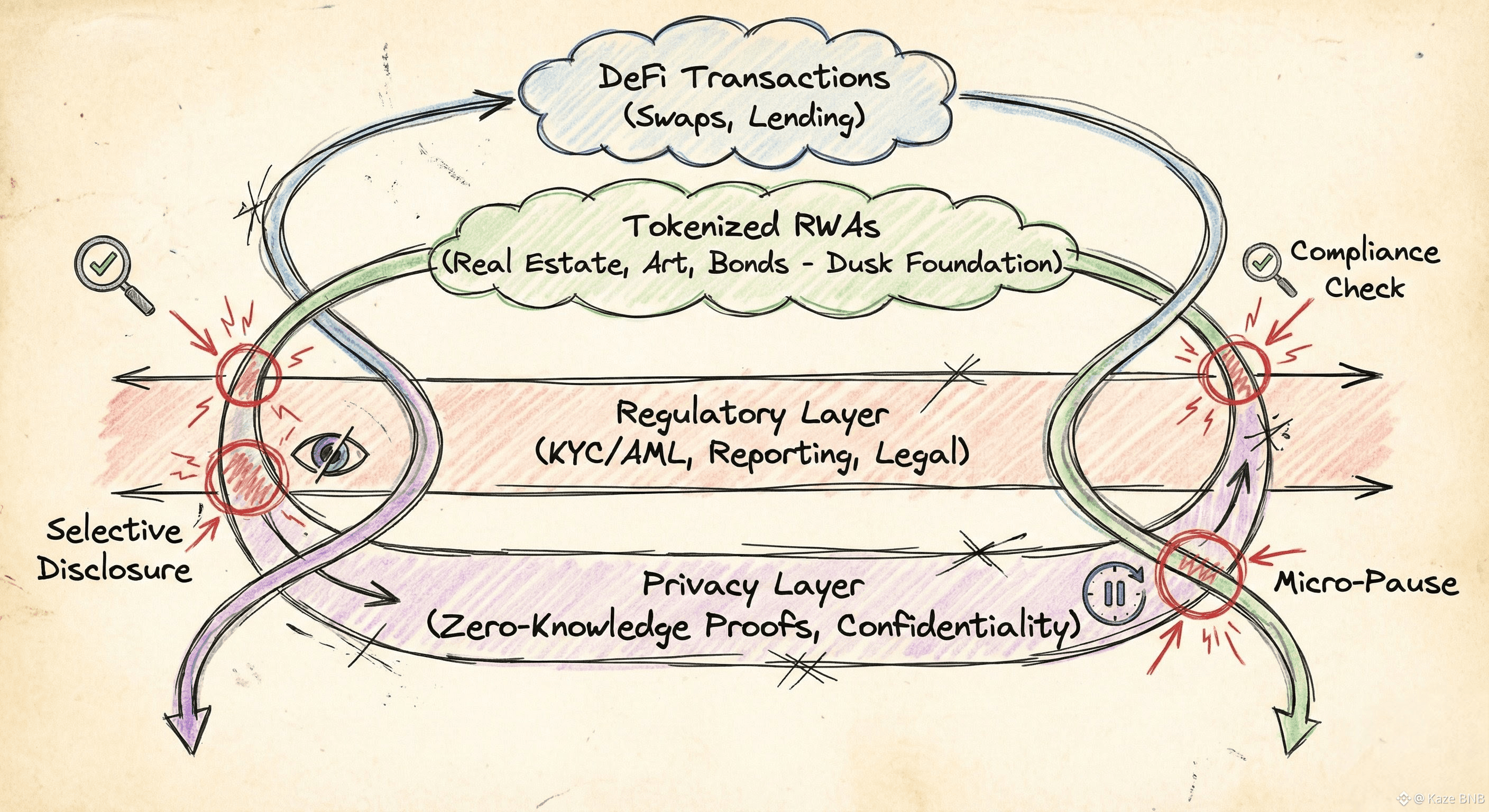
Quotes slipped into logs and conversation alike. “It feels like the ledger is asking, not telling,” someone remarked, tracing a stuck transfer. Another noted, “The token is passive until pressure comes then you realize ownership, compliance, and privacy aren’t just attributes they’re actors.” No one disagreed, though none could fully articulate the mechanisms.
The ledger allowed only glimpses. Tokens representing property lingered under multiple checks, partially visible, partially verified. DeFi liquidity pools shifted, as if sensing hesitation. Institutions learned patience the hard way. Every module revealed gaps where friction existed: timing, compliance, privacy, and the immutable record of responsibility.
At high load, RWAs brought tension to the surface. Multiple contracts reached for the same token simultaneously. Privacy shields and selective disclosure collided with institutional expectations. Nothing failed, but nothing was fully certain. The ledger recorded every choice, every pause, without judgment.
And in that uncertainty, decisions felt heavier. Should a tokenized bond be settled before regulatory approval? Can liquidity be released if privacy checks are pending? The questions had no final answer. Dusk Foundation didn’t hand clarity. It demanded observation, patience, and judgment, letting friction be the teacher.
