

In the world of Proof-of-Stake, we have been conditioned to believe that as long as the chain is finalizing and the attestations are green, the network is healthy. We look at the Dusk Foundation’s committee mechanics and see fast finality as a triumph of engineering.But there is a silent rot that fast finality can’t detect: Correlated Risk. The greatest threat to a decentralized network isn't a malicious actor or a massive hardware outage; it is the fact that every single validator is running the exact same playbook, on the same stack, using the same "best practices." We are building a system that is perfectly synchronized to fail all at once.
The Professionalism Trap
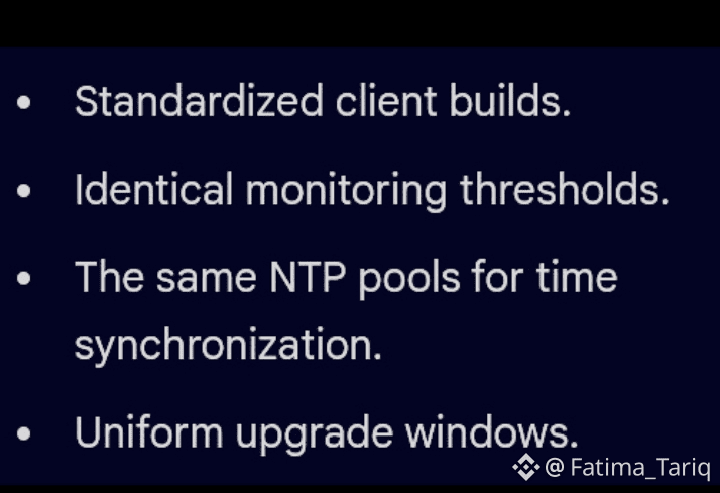
This is an operational monoculture. When we "standardize" the stack to reduce individual errors, we ensure that when a dependency hiccups or a clock drifts, the entire committee reacts with the same synchronized defensive behavior. We haven't built a resilient network; we’ve built a chorus that will all sing the wrong note at exactly the same time.
Finality is Not Robustness
There is a dangerous comfort in "no loss of liveness." Dusk’s deterministic sortition and rapid convergence are impressive, but convergence is a double-edged sword. You can finalize a block cleanly and still have a massive, shared blind spot.Finality proves that the committee agreed. It does not prove that the committee was right, nor does it prove that the decision-making process was independent. A system that converges instantly is a system where no one is questioning the input. In this environment, "health metrics" are a lagging indicator; they confirm agreement, not the independence of thought required for true censorship resistance and liveness.
Policy Drift and Silent Failures
Risk doesn't always start with a bug. It starts with policy drift. It’s the informal rule that says, "Stick to the standard stack or lose delegators." It’s the social penalty for a validator who experiments with a different OS or a non-standard network config for the sake of resilience.By the time the telemetry shows a problem, the risk has already been baked in by months of governance norms. We are optimizing for a legible, predictable committee at the expense of a robust one.
The Post-Mortem Theater
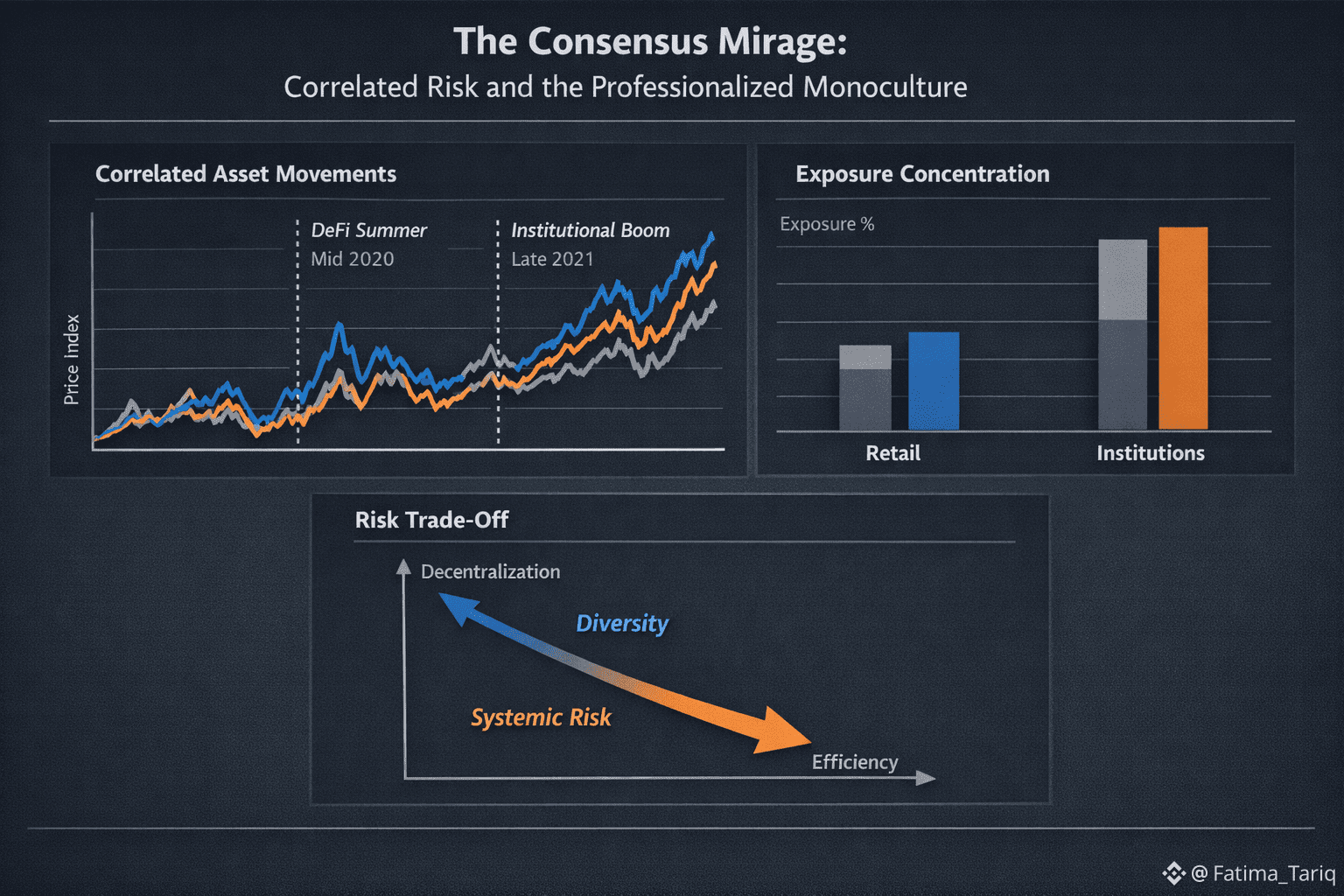 When this inevitably breaks—whether through a shared dependency failure or a network partition—the response will be a choreographed piece of theater. The post-mortems will say "procedures were followed" and "the committee responded correctly."But the "correct" response in a monoculture is just a synchronized retreat. If everyone followed the procedure and the system still failed, then the procedure is the failure. We are currently designing a system where the "incident call" will be 50 people realizing they all have the same broken dashboard for the same reason.
The Hard Truth
A decentralized network is supposed to be a messy, heterogeneous collection of independent actors. By "professionalizing" the validator set, we are quietly re-centralizing the point of failure.We need to stop asking if the committee is finalizing and start asking how much they look like each other. Because if they look identical, your decentralization is just a facade, and your finality is a mirage.
