

We often talk about privacy as if it’s a vault door. We argue over the thickness of the steel (the cryptographic primitives) and the complexity of the tumblers (the erasure coding). In the context of the Walrus Protocol, the vault is formidable. But as we move from theoretical architecture to lived reality, we find that privacy doesn’t usually fail because the door was blown off its hinges. It fails because we left the keys under the mat "just for a second" and then forgot they were there.
 The Illusion of "Solved" Privacy
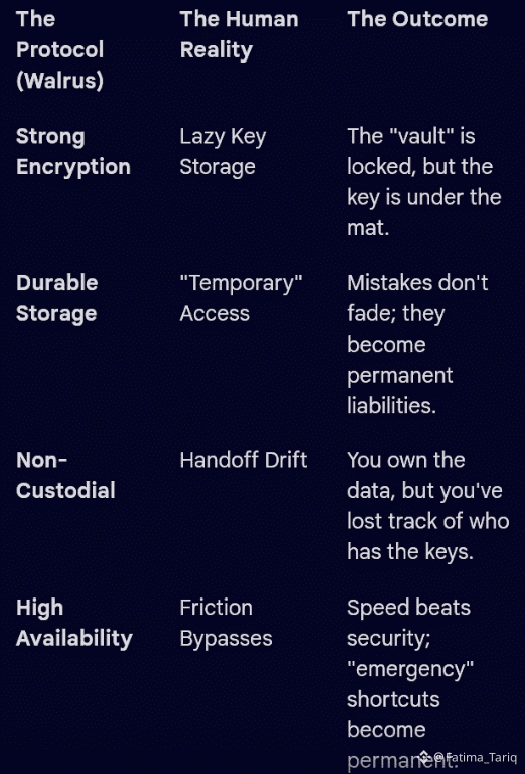
There is a dangerous comfort in durable, decentralized storage. Because Walrus ensures data availability and integrity through a robust decentralized network, we tend to treat the privacy aspect as a "set it and forget it" feature. If the blob is encrypted before it hits the storage nodes, we assume the mission is accomplished.However, we are witnessing a recurring failure mode: privacy erosion without cryptographic failure. The math remains unbroken, yet the data is exposed. This happens when we treat key management as a setup artifact—a hurdle to clear during deployment—rather than a living, breathing liability.
Operational Drift and the Efficiency Trap
Privacy rarely dies in a fire; it dies in a series of "small, sensible decisions."
An engineer copies a key to a local environment to unblock a production bug.
A "temporary" access token is granted to a partner for a 24-hour audit that never technically ends.
A private key is shared over a secure-but-persistent chat channel because the proper key management system was causing a deployment lag.This is operational drift. Under pressure, humans are wired to optimize for the immediate goal: make the system work. In the struggle between friction and efficiency, efficiency wins almost every time. No one is being malicious; they are simply being productive. But on a protocol like Walrus, where blobs are durable and long-lived, these shortcuts don't fade away. They accumulate.
The Burden of Longevity
The very strength of Walrus—its ability to preserve data across vast stretches of time—is what makes human error so much more potent. In traditional systems, data might be purged, or an old server might be decommissioned, taking its sloppy key hygiene with it.On Walrus, the encrypted blob outlives organizational memory. The person who made the "temporary" exception leaves the company. The documentation for that specific key rotation is lost. What remains is a permanent, immutable record of our past laziness, waiting for a future leak to turn an old shortcut into a modern catastrophe.
The Custody Mirage
We take pride in the non-custodial nature of the protocol. "We don't hold your data," we say. But while the storage nodes don't have custody of the plaintext, the effective custody over the keys often softens across handoffs. If three different services and five different team members have access to the decryption key through various "operational necessities," the "non-custodial" claim becomes a technicality. You may not hold the data, but you’ve effectively surrendered the gate.
The Audit Moment
The true test of your privacy posture isn't your uptime or your encryption overhead. It is the Audit Moment. It’s the moment you stop and ask: "Who can read this specific piece of data right now, and why?"
If the answer involves phrases like "I think," "it depends," or "we’ll have to check the legacy config," then the protocol has done its job, but the humans have failed theirs. Walrus enforces what it can see—the availability and the distribution of the bits—but it cannot see, or prevent, the drift of the human hands holding the keys.
Conclusion: Strengthening the Human Layer
Strong encryption + weak operational discipline still fails. It just fails later, and more quietly. As we build on Walrus, we must stop treating privacy as a cryptographic guarantee and start treating it as a continuous operational burden. The protocol provides the shield; it is up to us to ensure we don't simply hand the handle to whoever asks for it most persistently. #LearnWithFatima #Walrus $WAL @Walrus 🦭/acc

