

In the Walrus Protocol, the greatest risk isn’t losing your data—it’s the inability to prove you have it at the exact moment the world demands it. We are moving out of the era of "Belief" and into the era of "Challengeable Availability."
From Belief to Assertion
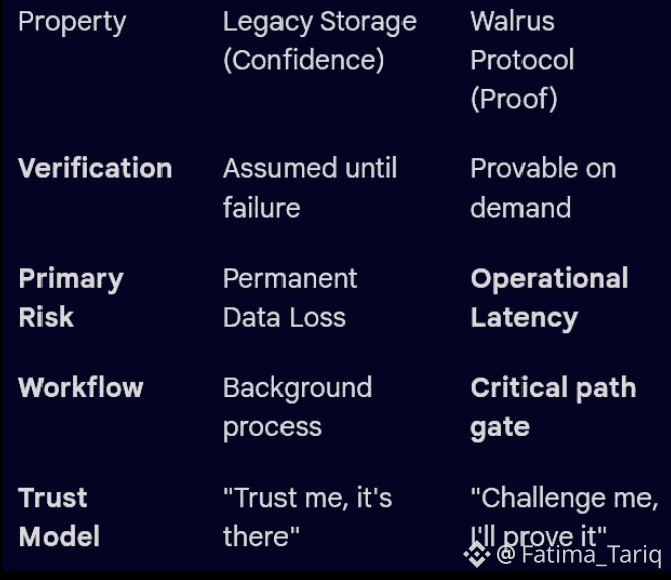
Most systems today operate on a dangerous substitute for truth: Confidence. We assume data is available because the dashboard is green. Walrus replaces confidence with Challengeable Availability. Once availability is provable, "it's probably there" is no longer a valid response. You are either holding the proof within the required window, or you are failing.
Late is the New "Missing"
 The real constraint in decentralized storage is Time, not cryptography.
Operational Gating: If a proof takes 10 minutes to generate but the settlement window is 2 minutes, the data is effectively gone for that transaction.
Critical Path: Proof generation has moved from a quiet background task to an execution-critical gate. Release cycles and sign-offs don’t wait for delayed verification.
The End of Plausible Deniability
Walrus doesn’t eliminate failure; it removes the ability to hide behind it. At scale, trust becomes a backlog. You can no longer hide behind "confidence" when verification lags. This creates a cultural shift: we must stop asking "Is the data safe?" and start asking "Can we defend it now?"
Core Thesis: Availability is only real if it can be stated, defended, and logged inside the required window.
Comparison: Confidence vs. Proof
The Operator’s Reality
Challenges Cluster: Expect proofs to be demanded during peak congestion and epoch transitions, not during quiet hours.
Resource Competition: Proof work competes for the same bandwidth and system resources as your primary transactions.
No Safety Net: Walrus removes the "plausible deniability" of network lag. If the proof is late, the system logs it as a failure.