
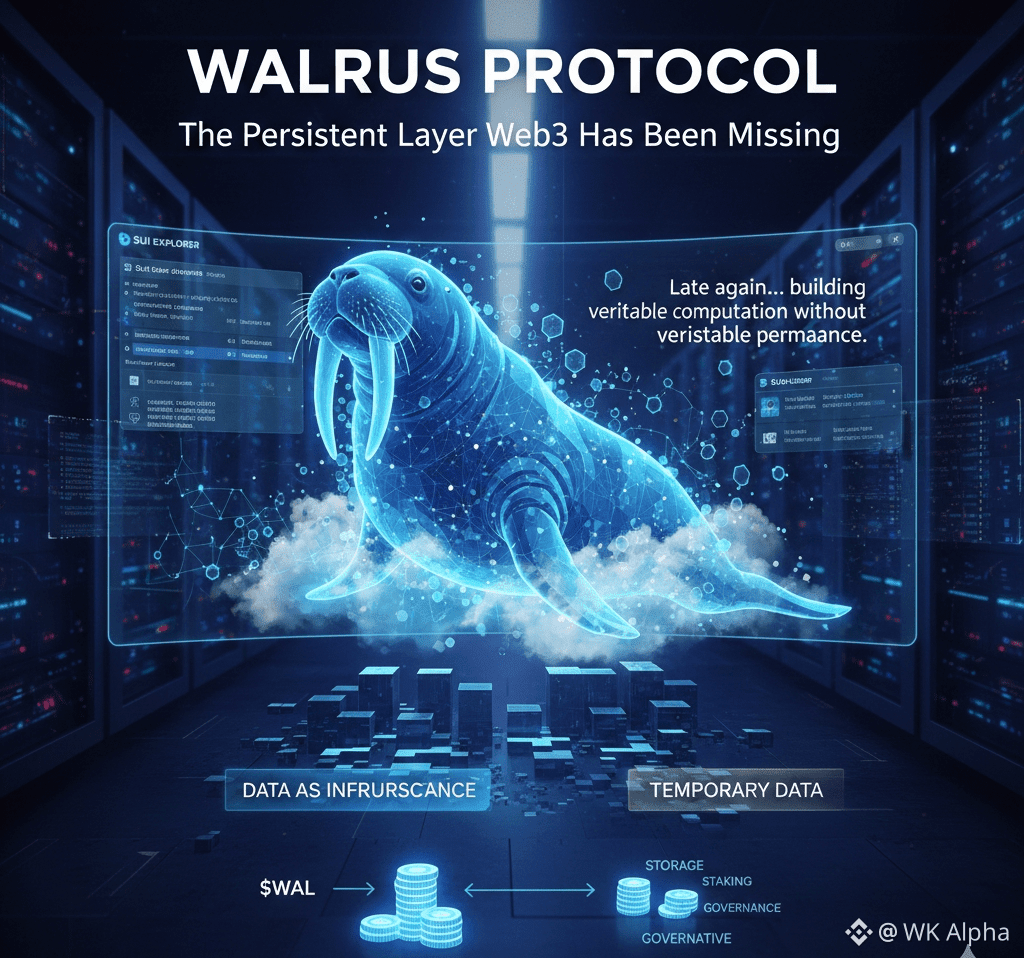
Late again staring at Sui explorer tabs and thinking about how chains are obsessed with finality in the moment but treat anything larger than a few kilobytes like an inconvenience. Walrus sits there quietly forcing the realization that we built verifiable computation without building verifiable permanence leaving most real-world use cases leaning on the same centralized servers they were supposed to escape. It is not a shiny new primitive it is the acknowledgment of a structural omission that has quietly limited what decentralized systems can actually sustain.
THE REAL PROBLEM
Execution-focused blockchains are engineered for rapid state updates and consensus on small structured payloads yet they buckle under the weight of unstructured data at any meaningful scale. Storing a single large dataset onchain becomes prohibitively expensive while sharding it offchain reintroduces single points of failure and removes the trustless guarantees the chain was meant to provide. The outcome is a world where apps promise decentralization but deliver only partial sovereignty over the information that matters most.
WHAT WALRUS IS
Walrus is a decentralized storage and availability network that uses erasure coding to break blobs into shards distributed across nodes with replication kept deliberately low usually four to five times the original size. Durability comes from cryptographic proofs and repeated availability challenges that force nodes to demonstrate possession without transmitting the entire file. Built by Mysten Labs the design prioritizes long-term retention engineered for efficiency rather than maximum redundancy.
WHY SUI MAKES SENSE
Sui's object model already treats everything as programmable owned resources which makes it natural to represent Walrus blobs as first-class objects with onchain metadata and attestations. Sui takes care of coordination payments and governance logic while Walrus shoulders the offchain distribution and proof generation avoiding congestion in the execution environment. The combination allows data to be composed referenced and verified in the same expressive way as tokens or smart contracts creating a stack that feels internally consiste.
DATA AS INFRASTRUCTURE
Reliable data availability should not be an optional service layered on top it should be as fundamental as consensus itself. Walrus embeds this responsibility through epoch-based node rotations staking penalties for liveness failures and reward structures that favor consistent performance. When over one billion WAL remains staked into early 2026 it shows participants are already treating persistence as infrastructure worth securing over years not quarters.
ROLE OF $WAL
WAL exists to make the system self-sustaining paying for storage staking nodes and voting on protocol parameters such as epoch length or fee curves. Payments are spread across epochs creating predictable cash flows to operators while usage burns add a deflationary pressure tied to actual demand. The token stays structural utility first economic security second never allowed to float purely on narrative.
WHAT WALRUS IS BECOMING
Walrus does not aim to displace centralized clouds or replace general-purpose chains it is quietly becoming the default memory component that privacy-preserving and AI-driven protocols lean on for verifiable longevity. As integrations deepen within the Sui ecosystem and reach outward to other networks it supports the kind of data markets where provenance and availability are no longer afterthoughts. Sitting here in the small hours WalrusProtocol feels like one of those rare pieces that quietly fixes what everyone else pretended was already solved.

