
For a long time, blockchain finance tried to solve problems by going to extremes. Everything had to be public. Every transaction visible. Every balance traceable by anyone. In theory, this radical transparency was supposed to replace trust with math. In practice, it worked only in narrow environments where participants were comfortable exposing everything. As soon as blockchain started approaching real financial use cases, the cracks became visible. Finance does not work in full public view, and it never has. This realization is where Dusk truly begins.
When people talk about finance, they often confuse transparency with accountability. They are not the same thing. Accountability means the right parties can verify actions and enforce rules. Transparency means everyone sees everything. Traditional finance has always relied on selective disclosure. Salaries are private. Corporate positions are confidential. Trades are reported under specific rules, not broadcast in real time to the entire world. Blockchain ignored this reality early on, and adoption suffered as a result.
Dusk is built on a different assumption. It accepts how finance already operates and asks how blockchain can support it instead of fighting it. Privacy on Dusk is not about hiding activity. It is about structuring access. Transactions can remain confidential while still being verifiable. Regulators can audit without exposing sensitive data to the public. Institutions can comply without sacrificing confidentiality. This balance is not an add-on. It is embedded into the protocol itself.
One of the most important decisions behind Dusk was choosing to build a layer one blockchain specifically for regulated and privacy-focused finance. Many projects attempt to retrofit privacy onto existing public chains. That approach often creates fragile systems where confidentiality breaks under scrutiny. Dusk took a slower and more deliberate path by designing privacy and auditability at the base layer. This allowed the network to define how transactions behave, how information is revealed, and how oversight functions from the start.
I’m seeing that this design choice shapes everything about Dusk’s pace and perception. It does not move quickly because finance does not move quickly. Legal review, regulatory alignment, and institutional onboarding take time. Infrastructure that aims to support these processes cannot be built on hype cycles. It must be resilient before it is popular. Dusk appears comfortable with that reality, even when it means less attention in speculative markets.
As blockchain technology matures, interest is shifting toward use cases that interact directly with real-world systems. Compliant DeFi and tokenized real-world assets are part of this shift. These applications cannot exist in environments where everything is fully public and uncontrolled. They require confidentiality, reporting, and legal alignment. Dusk provides a foundation where these requirements are not obstacles but design principles. Developers can build financial logic without reinventing compliance frameworks. Institutions can participate without abandoning oversight.
Another important aspect of Dusk is how it treats privacy as a tool rather than an ideology. Privacy is not framed as opposition to regulation. It is framed as a way to make regulation workable onchain. By allowing selective disclosure, Dusk enables audits and compliance checks without exposing unnecessary information. This mirrors how financial systems already operate and lowers the barrier for institutional adoption.
The role of the DUSK token reflects this seriousness. It exists to support network security, participation, and governance, but it is not positioned as the identity of the project. This restraint matters. Financial infrastructure is judged by predictability and stability, not excitement. Tokens that dominate attention often undermine trust in regulated contexts. Dusk avoids that trap by keeping the focus on functionality rather than speculation.
Governance on Dusk follows the same philosophy. It is not designed for constant change or rapid experimentation. Decisions are deliberate. Upgrades are cautious. The goal is continuity rather than reinvention. This approach may feel slow in crypto culture, but it aligns with how financial infrastructure actually evolves. Systems that handle real value cannot afford sudden shifts driven by sentiment.
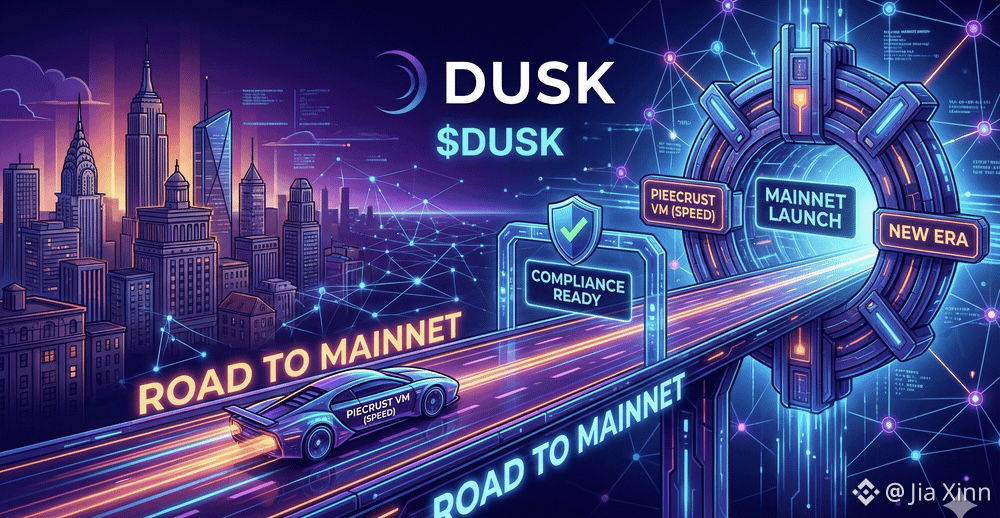
What stands out to me is how Dusk treats compatibility as a form of progress. Instead of trying to replace existing financial systems overnight, it positions itself as infrastructure that can integrate with them. Blockchain does not need to destroy finance to improve it. It needs to fit into legal, operational, and regulatory realities. Dusk is built with that understanding at its core.
Looking forward, the role of blockchain in finance is likely to be quieter than many expect. It will not arrive as a dramatic disruption. It will arrive as an improvement layer, gradually adopted where it makes sense. Privacy, compliance, and auditability will remain non-negotiable. Dusk is designed for that future, not by making noise, but by making itself usable.
If blockchain becomes part of mainstream finance, it will be because projects like Dusk chose realism over ideology. They accepted that trust is not created by exposure alone, but by systems that respect how people and institutions actually operate. In the long run, that respect may matter more than any technical breakthrough.
