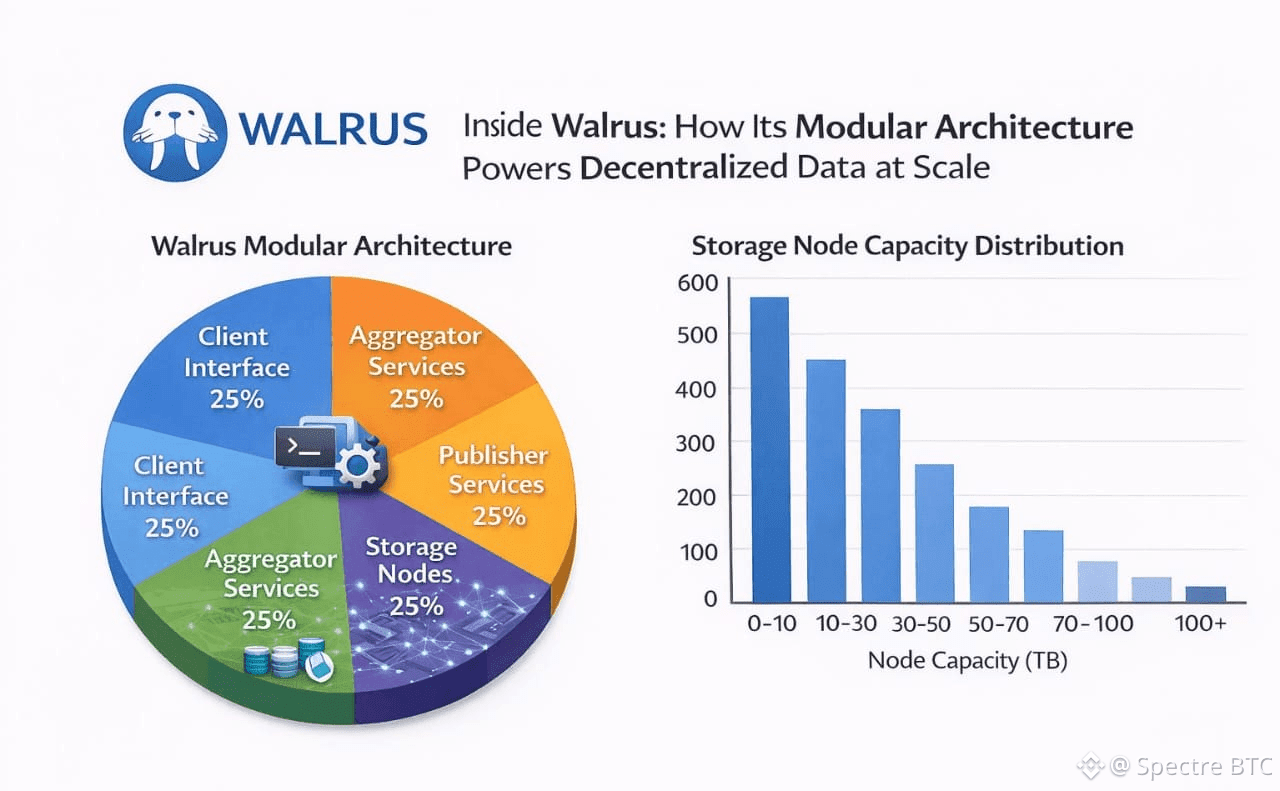
 Walrus is designed as a purpose-built decentralized data availability and storage network, and its real strength comes from how its components work together rather than relying on a single, monolithic system. Instead of forcing every user or application to interact directly with raw infrastructure, Walrus uses a layered architecture that balances flexibility, performance, and decentralization. This makes it suitable not only for developers, but also for everyday users who may never even realize they are using decentralized storage under the hood.
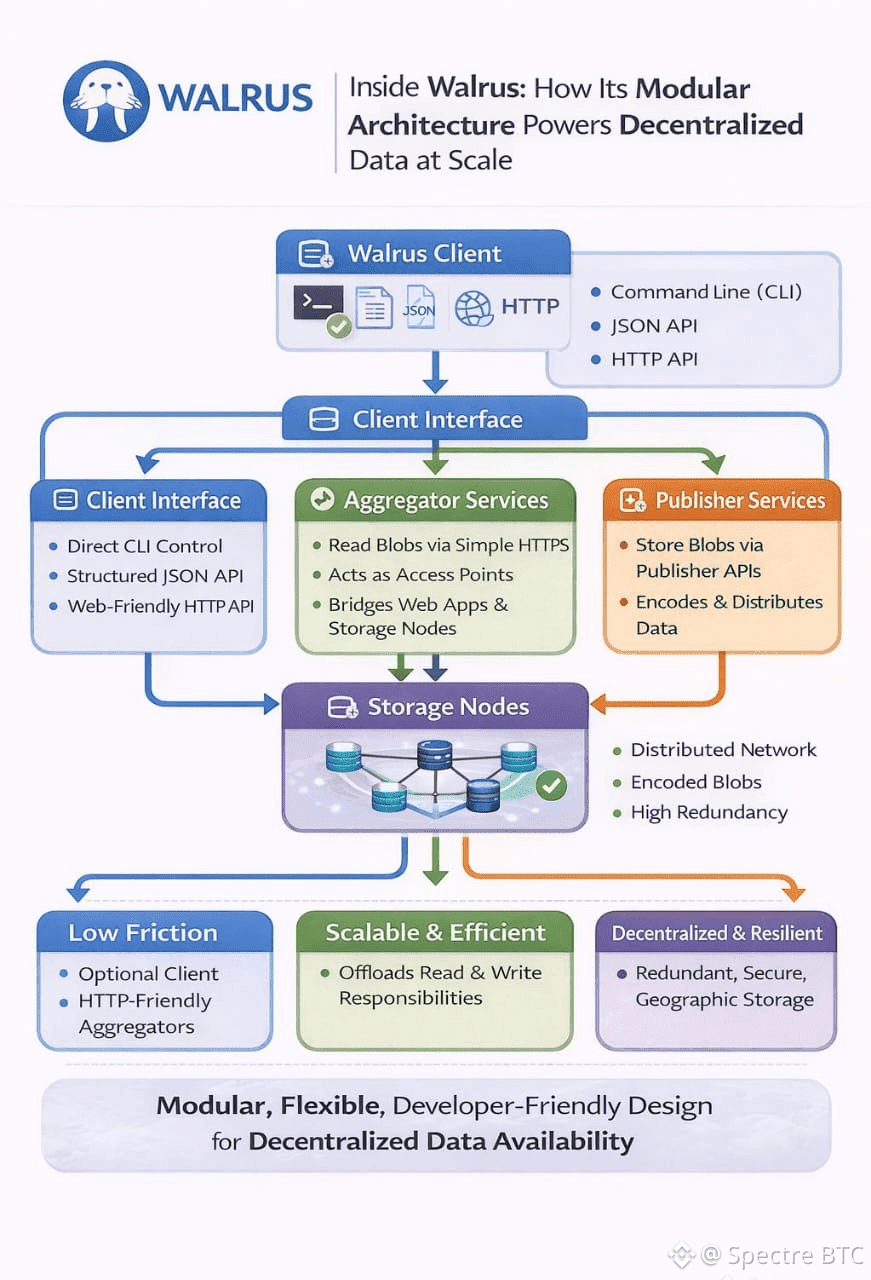
At the center of the Walrus ecosystem is the Walrus client, a locally executable binary that serves as the main interface to the network. It is intentionally built to support multiple access methods, giving developers control over how deeply they integrate. For low-level automation and backend workflows, the command-line interface (CLI) offers direct access to Walrus operations, making it ideal for scripting and testing. For application-level integration, the JSON API enables structured, programmatic interaction, allowing Walrus to be embedded into services seamlessly. On top of that, the HTTP API provides a web-friendly option, enabling standard HTTP requests and significantly lowering the barrier for web-based applications.
Importantly, Walrus does not require every user to run a local client. This is where aggregator services become essential. Aggregators allow stored blobs to be accessed through simple HTTP requests, acting as a bridge between decentralized storage and traditional web infrastructure. From an application’s perspective, aggregators make Walrus feel similar to interacting with a centralized server, while still preserving decentralization behind the scenes. This abstraction is critical for adoption, as it allows developers to build user-facing products without forcing users to manage keys, nodes, or binaries.
Alongside aggregators are publisher services, which handle the process of writing data to Walrus. Publishers act as entry points for data submission, receiving content and coordinating its encoding and distribution across the network. Separating read and write services improves scalability and reliability. By isolating these responsibilities, Walrus ensures that heavy write activity does not degrade read performance—an important property for data-intensive use cases such as rollups, decentralized applications, and content distribution systems.
Underneath these services are the storage nodes, which form the foundation of the network. These nodes store encoded blobs and collectively provide Walrus’s decentralized storage capacity. Instead of keeping raw data in one place, Walrus encodes blobs and spreads them across many nodes. This design greatly improves resilience, since data availability does not depend on any single node remaining online. Storage nodes are the backbone of the system, ensuring data stays accessible, verifiable, and resistant to censorship or localized failures.
A key design choice is how all Walrus services interact. Aggregators, publishers, and other components communicate through the same client APIs. This unified interface reduces complexity, improves maintainability, and makes the system easier to extend over time. It also enforces consistency across the ecosystem, since every service follows the same rules when reading from or writing to the network.
For end users, this architecture results in a smooth and familiar experience. Most users interact with Walrus indirectly through applications, aggregators, or publishers that expose simple HTTP endpoints. There is no need to install or manage a local client, yet users still benefit from decentralized storage in the background. Developers gain flexibility in choosing their level of abstraction, while users enjoy fast, conventional access patterns.
Overall, Walrus’s component-based design reflects a strong focus on real-world usability. By separating concerns across clients, services, and storage nodes, Walrus delivers a modular, scalable, and developer-friendly system. This thoughtful architecture positions Walrus as a practical foundation for decentralized data availability, capable of supporting modern blockchain applications without sacrificing performance or accessibility.