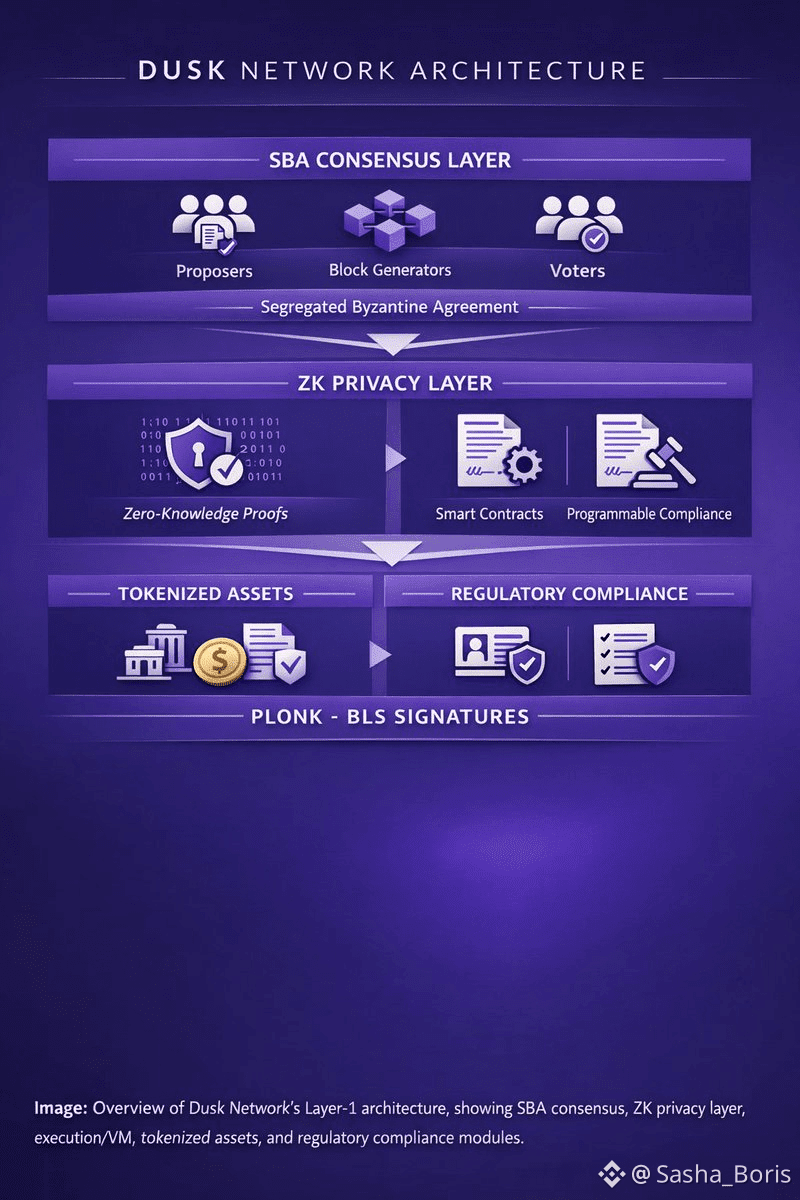
Dusk was created to solve a problem that most public blockchains were never designed to handle: enabling real, regulated financial markets to operate on-chain without sacrificing confidentiality. Traditional finance depends on privacy around counterparties, pricing, volumes, and contractual terms, while regulators demand transparency, auditability, and legal accountability. Dusk positions itself precisely at this intersection, building a Layer-1 blockchain purpose-built for compliant, privacy-preserving financial infrastructure rather than speculative or purely permissionless use cases.
From its earliest design choices, Dusk focused on tokenized securities, regulated assets, and institutional-grade smart contracts. Instead of treating regulation as an external constraint, the network treats it as a core design requirement. This philosophy shapes every layer of the protocol, from cryptographic primitives to developer tooling and governance structures.
The transition from research to production marked a defining phase for Dusk. Through a carefully staged mainnet rollout spanning late 2024 into early 2025, the project demonstrated a commitment to operational stability and institutional readiness. Rather than rushing deployment, Dusk introduced controlled on-ramps, hardened validator infrastructure, and production-ready developer libraries. This deliberate rollout model reflects how financial institutions actually operate, prioritizing predictability, auditability, and risk mitigation over rapid experimentation.
At the technical core of Dusk lies confidential smart contract execution. Unlike fully transparent blockchains where every transaction detail is permanently exposed, Dusk enables selective privacy. Sensitive data such as identities, transaction sizes, and private contractual clauses can remain confidential, while cryptographic proofs ensure that state transitions are valid and enforceable. This approach allows financial actors to protect commercially sensitive information without compromising the integrity of the ledger.
Equally important is Dusk’s emphasis on auditable privacy. The network does not aim to obscure activity, but to compartmentalize information so that authorized parties can verify compliance when required. This makes Dusk particularly suitable for environments where regulators, custodians, or courts may need to inspect transactions under defined legal conditions. Privacy becomes a controlled feature rather than an absolute shield.
Developer experience plays a major role in Dusk’s adoption strategy. Financial applications cannot rely on experimental tooling or informal standards. Dusk provides structured SDKs, institutional wallet flows, and contract templates designed for regulated issuance and settlement. These tools reduce friction for teams moving from legal documentation to deployed, enforceable smart contracts.
Interoperability is another pillar of Dusk’s evolution. By introducing an EVM-compatible execution layer, the network significantly lowers the barrier for developers already familiar with Ethereum-based tooling. This compatibility allows teams to reuse audited contracts, established development workflows, and existing security practices while benefiting from Dusk’s privacy-focused execution environment. Rather than isolating itself, Dusk integrates into the broader smart contract ecosystem.
Dusk’s strategy extends beyond technology into market infrastructure. The project actively aligns itself with established financial standards, oracle frameworks, and regulated venues. By working with compliant exchanges, custodians, and data providers, Dusk bridges on-chain logic with off-chain legal and financial systems. This integration is essential for tokenized securities and real-world assets, which must operate across both digital and legal domains.
Exchange access and broader market availability of the DUSK token further support the ecosystem’s growth. Liquidity, custody solutions, and institutional access are prerequisites for any network aiming to support regulated financial instruments. Dusk’s expanding market presence strengthens its ability to host viable secondary markets for tokenized assets.
In terms of positioning, Dusk differentiates itself by treating privacy and compliance as complementary rather than conflicting goals. While many privacy-focused chains emphasize anonymity, Dusk focuses on confidentiality with accountability. This distinction matters for banks, asset issuers, and financial institutions that require privacy for operational reasons but cannot operate outside regulatory frameworks.
Looking forward, the true measure of Dusk’s success will be real-world deployment. Pilot issuances of tokenized equity, debt, or private market instruments, deeper custodian integrations, and audited production applications will determine whether Dusk becomes a foundational layer for regulated finance. Continued expansion of EVM-compatible deployments and standardized compliance workflows will further define its trajectory.
Dusk is ultimately best understood as financial infrastructure rather than a general-purpose blockchain. Its ambition is not to replace existing markets overnight, but to provide a secure, confidential, and legally compatible settlement layer for the next generation of digital finance. If tokenization is to move from experimentation to normal operation, platforms like Dusk may become essential building blocks rather than niche alternatives.