
@Plasma chains were introduced to solve a fundamental problem in blockchain design: a single chain cannot efficiently handle unlimited activity. As blockchains grew in popularity, congestion, rising fees, and slow confirmation times became unavoidable. Plasma proposed a practical solution move most activity off the main chain while still anchoring security to it.
At the core of this model is the relationship between parent chains and child chains. Understanding how these layers interact explains why Plasma became one of the earliest and most influential scalability frameworks in blockchain history.
The Role of the Parent Chain
The parent chain is the foundation of trust in a Plasma system. Typically, this is a well-established Layer 1 blockchain such as Ethereum. Rather than processing every transaction, the parent chain acts as a security anchor.
Smart contracts deployed on the parent chain define the rules governing the Plasma network. These contracts handle deposits and withdrawals, record periodic state commitments from child chains, and enforce dispute resolution. By offloading execution while retaining oversight, the parent chain remains decentralized and secure without being overwhelmed by transaction volume.
What Child Chains Do
Child chains are where most activity takes place. They operate independently from the parent chain for daily operations, enabling faster transactions and significantly lower fees.
Each child chain can be tailored to specific use cases payments, gaming, NFT marketplaces, or decentralized exchanges. This specialization allows different applications to scale without competing for limited block space on the parent chain, a major bottleneck in monolithic blockchain designs.
How Parent and Child Chains Communicate
#plasma chains do not constantly synchronize with the parent chain. Instead, communication occurs through periodic cryptographic commitments. Child chains submit summaries of their state commonly Merkle roots to the parent chain at regular intervals.
These commitments allow the parent chain to verify that the child chain is operating correctly without storing every transaction. This design balances independence with accountability, making large-scale execution possible without sacrificing security.
Security Through Exit Mechanisms
A defining feature of Plasma is its exit mechanism. While child chains process transactions, ultimate enforcement happens on the parent chain. If a child chain behaves maliciously or becomes unavailable, users can exit back to the parent chain by submitting cryptographic proof of ownership.
This ability to withdraw funds independently creates a powerful security guarantee. Child chain operators are incentivized to act honestly, knowing users always retain a secure fallback. In Plasma, trust is minimized not by constant oversight, but by the threat of enforceable exits.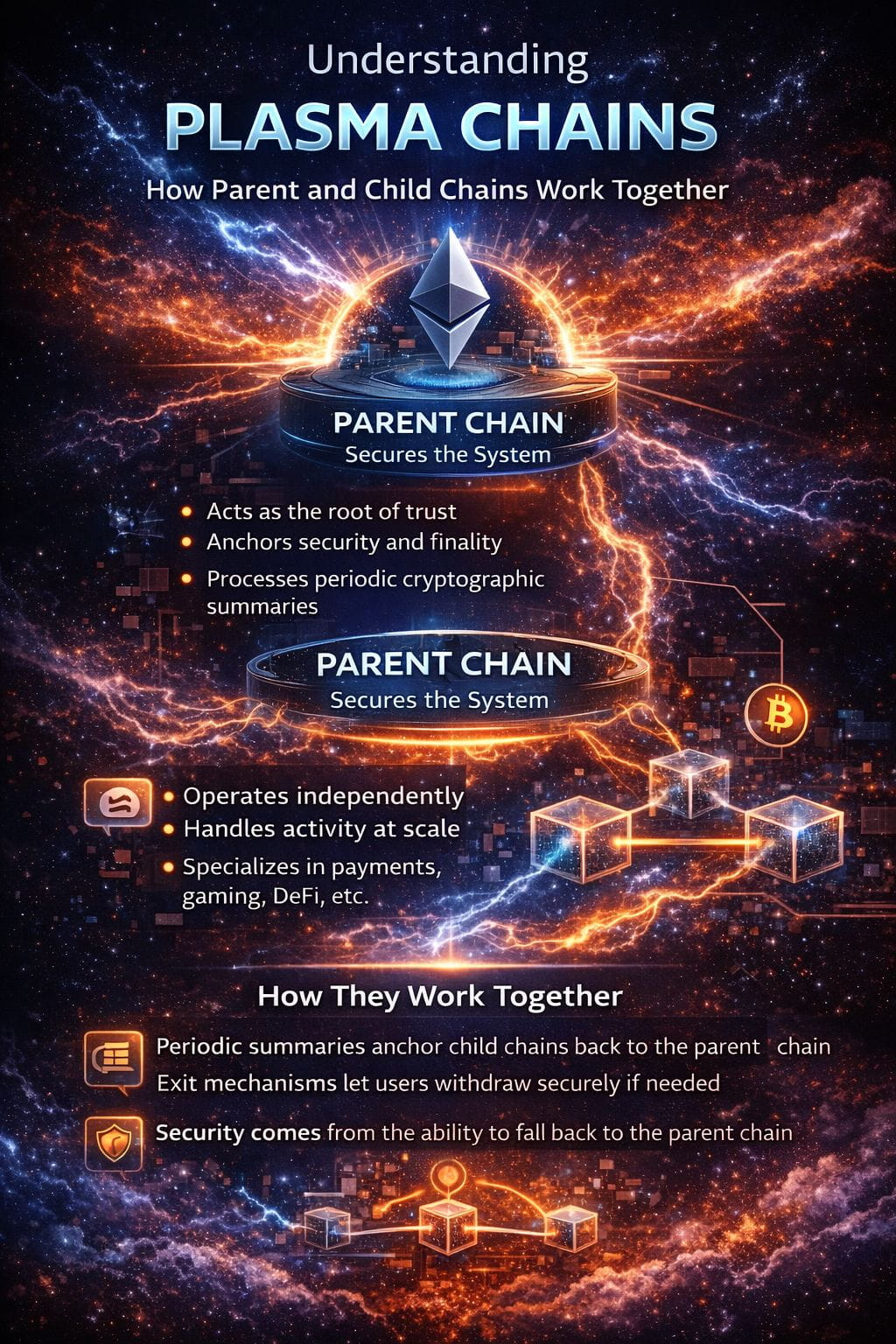
Trade-Offs in Finality and Complexity
Exits in Plasma are not instantaneous. To prevent fraud, users must often wait through challenge periods during which invalid claims can be disputed. This introduces complexity and delayed settlement at the base layer.
However, Plasma intentionally prioritizes scalability and security over instant finality. For many applications such as high-volume payments or gaming this trade-off is acceptable, as most interactions never require exiting to the parent chain.
Data Availability Considerations
Data availability is a critical component of Plasma’s design. While the parent chain stores commitments, child chains are responsible for making transaction data accessible. If data becomes unavailable, users may struggle to prove ownership during an exit.
To mitigate this risk, Plasma implementations often encourage transparency through data publication requirements, redundancy, or multiple validators maintaining copies of the state. The parent chain acts as the final arbitrator when disputes arise, even if it does not store all transaction data itself.
Hierarchical Plasma Chains
Plasma supports hierarchical scaling. A child chain can itself become the parent of another child chain, creating multiple layers of execution. This structure allows the system to scale theoretically without bound, with each layer handling a portion of total activity.
While this increases architectural complexity, it also highlights Plasma’s flexibility. Innovation and experimentation can occur at the edges, while the base layer remains secure and stable.
A Modular Philosophy for Blockchain Scaling
Plasma represents a shift away from monolithic blockchain design toward a modular architecture. The parent chain focuses on decentralization, security, and settlement. Child chains focus on speed, execution, and user experience.
This separation of responsibilities mirrors how traditional systems scale and has influenced many modern blockchain architectures.
Plasma’s Lasting Influence
Although newer scaling approaches such as rollups have gained prominence, Plasma’s ideas remain foundational. The principle that users must always be able to exit to a secure base layer has shaped how the industry thinks about trust minimization.
Even as implementations evolve, the parent-child chain relationship pioneered by Plasma continues to inform today’s Layer 2 designs.
Final Thoughts
Plasma chains demonstrate how blockchains can grow beyond their original limits without abandoning core principles. The parent chain provides guarantees, while child chains deliver performance. Neither layer works in isolation.
Understanding this relationship helps clarify not only how Plasma works, but why scalability solutions are essential for the future of decentralized systems. As adoption increases, revisiting these foundational concepts enables more informed discussions about where blockchain infrastructure is heading next.$XPL

