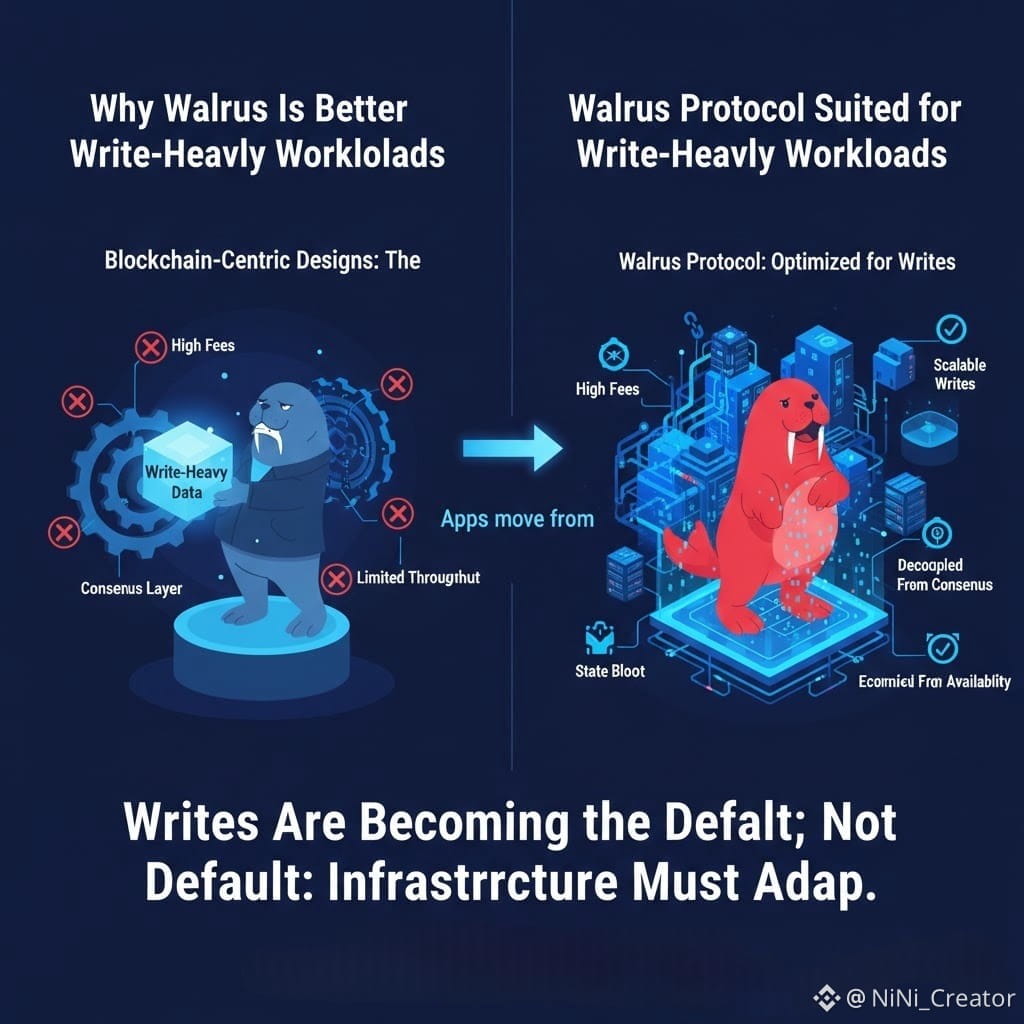
In decentralized systems, most discussions around storage focus on persistence and permanence. Far less attention is paid to write patterns—how often data is updated, appended, or replaced. Yet for many real-world Web3 applications, write-heavy workloads are the norm rather than the exception. This is where traditional on-chain storage models begin to break down, and where Walrus shows a structurally stronger fit.
The Hidden Cost of Writes in Blockchain-Centric Designs
Blockchains are optimized for consensus and verification, not for frequent data mutation. Every write operation competes for block space, increases state size, and imposes long-term costs on the network. As write frequency increases, these costs grow non-linearly. This is why most chains implicitly discourage write-heavy behavior through high fees or strict limits.
As a result, developers often contort application logic to reduce writes: batching updates, pruning data aggressively, or moving complexity off-chain in ad hoc ways. These workarounds are signals that the underlying architecture is misaligned with the workload.
Write-Heavy Workloads Are Becoming the Default
Modern Web3 applications increasingly rely on continuous data generation:
Games produce frequent state updates.
DeFi protocols generate large volumes of intermediate data.
AI-integrated dApps rely on iterative datasets and model outputs.
Social and content applications evolve constantly rather than remaining static.
These workloads are not anomalies—they represent the direction Web3 is moving. Infrastructure designed primarily for infrequent, high-value writes is ill-suited for this future.
Walrus and the Decoupling of Writes From Consensus
Walrus approaches the problem from a different angle. Instead of forcing every write into blockchain state, it decouples data availability from execution and settlement. Writes can occur frequently without directly burdening the consensus layer, while still remaining verifiable and retrievable.
This architectural separation is critical. It allows applications to write data at the pace dictated by user behavior, not by block times or gas markets. At the same time, Walrus maintains Web3-native guarantees through cryptographic proofs and economic incentives, rather than relying on trusted intermediaries.
Economic Alignment for High-Frequency Data
Write-heavy systems are as much an economic challenge as a technical one. If each write is expensive, usage naturally stagnates. Walrus is designed to amortize storage and availability costs across scale, making frequent writes economically viable rather than prohibitive.
This shifts developer incentives. Instead of optimizing primarily for cost avoidance, teams can optimize for product quality and responsiveness. Over time, this difference compounds into better applications and higher usage, reinforcing the value of the underlying infrastructure.
Reliability Over Permanence
Another key insight is that write-heavy workloads often value reliability over permanence. Many data updates matter intensely for short periods and lose relevance quickly. Forcing permanent on-chain storage for such data is inefficient. Walrus supports this reality by enabling data to be available when it is needed most, without assuming that all writes must be immortal.
This aligns storage guarantees with actual application requirements, rather than ideological assumptions about decentralization.
Conclusion
As Web3 applications mature, write-heavy workloads will no longer be edge cases—they will be the baseline. Infrastructure that cannot handle frequent, scalable, and economically viable writes will quietly limit innovation.
Walrus is better suited for this future not because it stores more data, but because it treats writes as a first-class concern. By separating data availability from consensus and aligning costs with usage patterns, Walrus enables applications to grow without being throttled by their own data generation.
In a world where applications write constantly, infrastructure that assumes they should not is simply out of step.