

Bitcoin’s network hashrate briefly fell to its lowest level in seven months over the weekend after a powerful winter storm swept across the United States, forcing large mining operations to curtail activity to stabilize regional power grids.
According to data from CoinWarz, Bitcoin’s network hashrate began declining on Friday and fell to roughly 663 exahashes per second (EH/s) by Sunday — a drop of more than 40% in just two days, returning hashrate levels to those last seen in mid-2025.
The hashrate has since partially recovered and was hovering near 854 EH/s by Monday.
Extreme weather disrupts US mining operations
The sharp decline coincided with a massive winter storm that impacted more than three dozen US states, bringing widespread snow, ice accumulation and power outages.
Weather data from AccuWeather showed that nearly one million energy customers were affected as utilities prioritized residential and critical infrastructure demand.
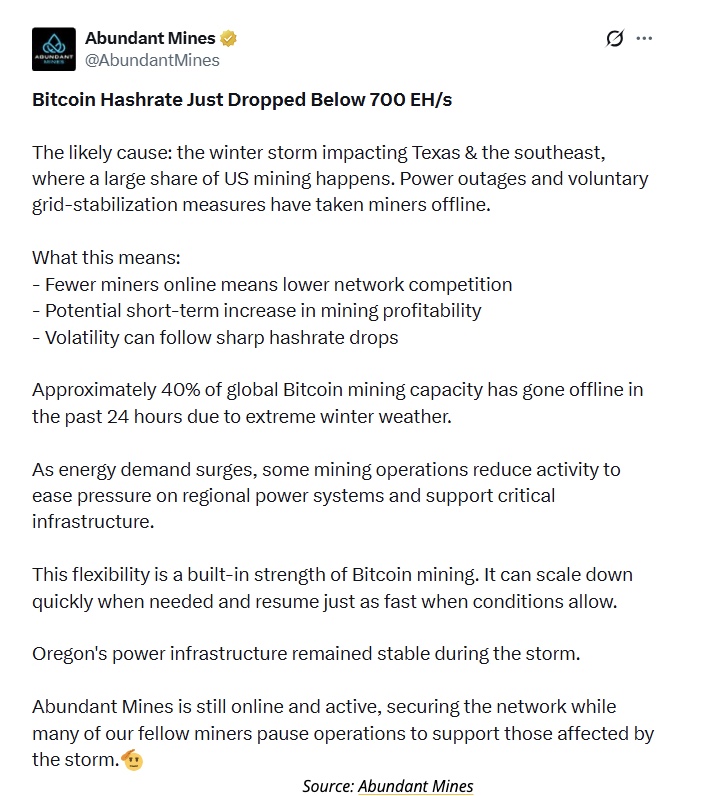
Bitcoin miner Abundant Mines said approximately 40% of global mining capacity temporarily went offline as operators reduced power consumption to relieve pressure on regional grids.
“As energy demand surges, some mining operations reduce activity to ease stress on power systems,” the company said. “This flexibility is a built-in strength of Bitcoin mining — it can shut down quickly and restart just as fast when conditions normalize.”
US accounts for nearly 38% of global Bitcoin hashrate
The impact was amplified by the United States’ dominant role in Bitcoin mining.
According to data from Hashrate Index, the US contributes nearly 38% of global Bitcoin mining power, making weather-related disruptions particularly influential on network metrics.
A 2024 report from the US Energy Information Administration identified more than 137 crypto-mining facilities operating nationwide, many concentrated in Texas and other energy-intensive regions.
Miners assist grid stability through demand response
Industry participants noted that the event highlighted one of Bitcoin mining’s key structural features — grid demand response.
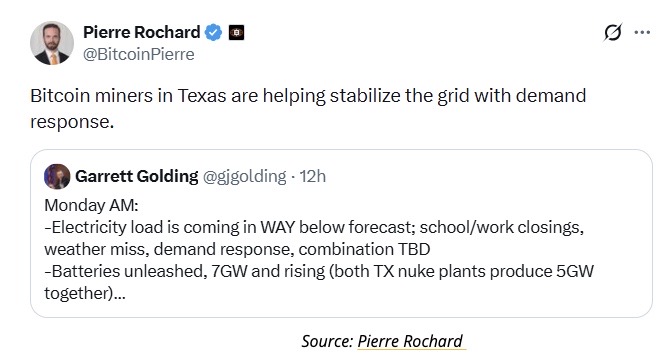
By rapidly adjusting electricity consumption, miners can help stabilize grids during periods of peak demand. Operations located near wind and solar installations often absorb excess power during low demand and curtail activity when grids tighten.
Bitcoin ESG researcher Daniel Batten said on X that mining operations in Texas again coordinated with grid operators during the storm, helping prevent wider system instability.
Bitcoin production temporarily slows
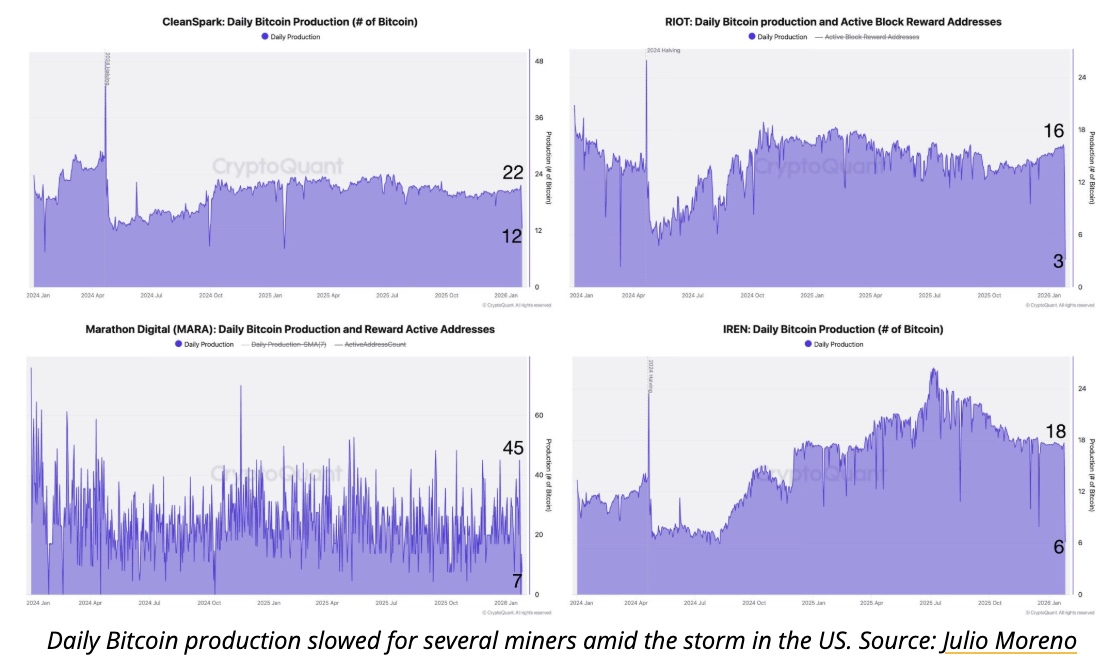
The storm also disrupted daily Bitcoin production at several major mining firms.
According to CryptoQuant data cited by analyst Julio Moreno, some of the largest US miners saw sharp declines in output:
Marathon Digital fell from producing 45 BTC per day to just 7
IREN dropped from 18 BTC to 6
Production levels are expected to normalize as mining operations gradually resume full capacity.
Hashrate recovery underway
Despite the short-term disruption, analysts emphasized that the network showed resilience, with hashrate rebounding quickly as weather conditions improved.
Historically, similar weather-related drawdowns — including prior winter storms in Texas — have resulted in temporary volatility but minimal long-term impact on Bitcoin’s network security.
The episode reinforces Bitcoin mining’s growing integration with energy markets, particularly in the US, where flexible load management has become a defining feature of large-scale operations.
