

One of the main promises of blockchain was freedom — freedom from central control and freedom to own what belongs to you. But today, even in crypto, our data is still scattered, locked, and difficult to move. This is why the Plasma project caught my attention.
Plasma is not just another DeFi token or scaling solution. It is trying to solve a deeper problem: who really owns blockchain data, and how freely can it move?
This article explains Plasma in simple terms, the problem it tackles, how it works, and why it matters for the future of a decentralized internet.
The Core Problem: Fragmented Data and Expensive Storage
Blockchains have grown fast, but they created new limitations.
Data on Ethereum cannot easily be used on Solana or Avalanche
Storing large amounts of data on-chain is extremely expensive
Users rely on external storage like IPFS or Arweave, which still doesn’t solve cross-chain access
Apps cannot easily share user data
Users end up managing many wallets, chains, and bridges
The result is a broken user experience and a system where data freedom is still limited.
Plasma’s Idea: One Neutral Storage Layer for All Chains
Plasma introduces a chain-agnostic storage network that works underneath all blockchains.
Instead of storing data separately on each chain, developers and users can store data once on Plasma and access it from any supported blockchain.
Plasma runs on a decentralized physical infrastructure, where anyone can contribute storage and bandwidth by running a validator node. Validators stake XPL tokens to participate, aligning incentives with network security.
This makes Plasma a neutral layer — it does not favor Ethereum, Solana, or any single ecosystem.
How Plasma Keeps Data Honest and Secure
Plasma uses a system known as proof of spacetime.
In simple terms:
Validators must regularly prove that they still store the data they are paid to keep
These proofs are cryptographic and verifiable
If a validator fails to provide proof, they lose part of their staked tokens
This design rewards honest behavior and discourages cheating, without trusting any single party.
True Cross-Chain Freedom for Users and Developers
This is where Plasma becomes powerful.
A developer can:
Store user profiles on Plasma
Access the same data from smart contracts on different blockchains
For users:
A gamer could own items on one chain and use them in a game on another
No need for risky bridges or custodial services
Your data moves with you, not the platform
Plasma turns data into something portable, not locked.
Tokenomics Designed for Long-Term Stability
Plasma’s native token is XPL, with a fixed maximum supply of 10 billion tokens.
Key points:
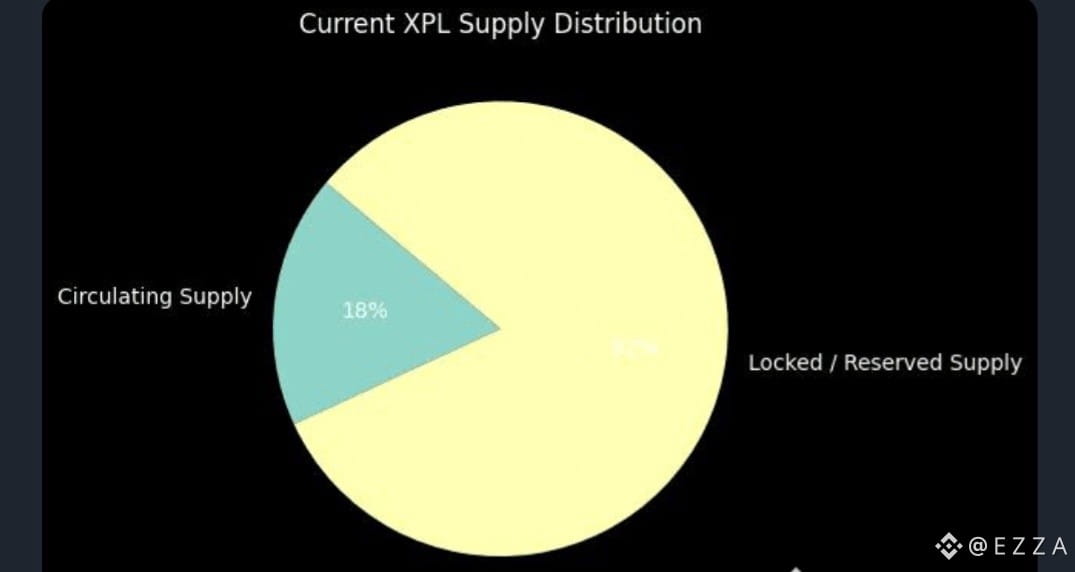
Around 1.8 billion XPL is currently in circulation
No new tokens are minted in the first three years
After that, inflation starts slowly and trends toward ~2% annually
New tokens reward validators
A portion of fees is burned, helping offset inflation
This structure aims to protect long-term holders while still securing the network.
Transparent Token Distribution
The total XPL supply is clearly allocated:
Early partners to help bootstrap adoption
Team and core contributors with long lock-up periods
Investors
Community grants to fund development and growth
Transparency here matters. Anyone can see how tokens are distributed and unlocked over time, which helps investors understand future supply changes.
Circulating vs Total Supply: Why It Matters
Right now:
Circulating supply: ~1.8 billion XPL
Total supply: 10 billion XPL
Most tokens are still locked and will unlock gradually. This means investors should stay aware of future unlock schedules and supply increases.
Understanding this difference helps avoid unrealistic valuations.
Beyond Technology: Digital Sovereignty
What excites me most about Plasma is not just the tech — it’s the philosophy.
Today:
Big tech controls user data
Even in crypto, data is often locked to one chain
Plasma offers something different: data sovereignty.
Your identity, assets, and history can exist independently of any single platform or chain. It’s like a digital passport that works everywhere in the decentralized world.
Easier Life for Builders
From a developer’s perspective, Plasma simplifies everything:
Store data once instead of rebuilding for each chain
Lower maintenance costs
Faster development cycles
New possibilities for cross-chain applications
A shared data layer unlocks innovation that isolated blockchains cannot achieve alone.
Why the Timing Makes Sense
Crypto adoption keeps growing. Millions of users now own digital assets across multiple chains.
As this grows:
Multi-chain applications become the norm
Cross-chain data access becomes essential
Infrastructure that connects ecosystems gains value
Plasma sits at the center of this trend.
Use Cases Beyond Simple Storage
Plasma’s architecture enables much more than files:
Decentralized identity with private, portable credentials
Cross-chain gaming with real asset ownership
DeFi and stablecoins storing metadata and records
Decentralized social networks preserving user history across chains
These are real-world use cases, not theory.
Final Thoughts: Why I’m Optimistic
Plasma is not risk-free:
Token unlocks will increase supply
Competition in decentralized storage is strong
Execution and security matter greatly
But the positives stand out.
Plasma solves a real problem, aligns incentives properly, and supports a future where people — not platforms — control their digital lives.
If it delivers on its vision, Plasma could become a foundational layer of the decentralized internet.
That is why I’m watching it closely.



