
There are moments in technology when progress does not come from adding more features, but from questioning the foundation itself. Plasma XPL was born from one of those moments. Instead of asking how to make blockchains faster or more complex, the team behind Plasma asked something far simpler and far more important. Why are stablecoins running on infrastructure that was never designed for them?
As stablecoins quietly grew into one of the most used financial tools in the world, surpassing hundreds of billions in circulation and moving trillions in value annually, the gap between usage and infrastructure became impossible to ignore. Plasma XPL emerges from that gap. It is not a general-purpose blockchain trying to serve every narrative at once. It is a Layer 1 network built with one clear purpose: to become the most efficient, predictable, and scalable home for stablecoin-based finance.
I’m walking through Plasma’s full story here, from the earliest idea to where it may be heading years from now, weaving together insights from technical documentation, ecosystem developments, market behavior, and infrastructure design choices. What unfolds is not a loud revolution, but something quieter and potentially far more lasting.
The Idea That Sparked Plasma
Plasma did not begin as a typical crypto experiment chasing trends. Its origin lies in a simple observation that became increasingly obvious as stablecoins matured. Stablecoins were no longer speculative tools. They had become money.
People were using USDT and similar assets for remittances, payroll, savings, cross-border trade, and settlement between businesses. In many parts of the world, stablecoins were already functioning as digital dollars. Yet every time someone tried to move that dollar, they had to interact with systems designed for something else.
Ethereum required ETH for gas. Other chains demanded their own native tokens. Fees fluctuated wildly. Transaction costs changed minute by minute. The experience was fragmented and confusing, especially for users who were not crypto-native.
Plasma’s founding vision was to treat stablecoins not as an application running on a blockchain, but as the reason the blockchain exists at all.
This shift in thinking changes everything.
Instead of forcing stablecoins to adapt to existing infrastructure, Plasma would design infrastructure around stablecoins themselves. The goal was not speculation or complexity, but reliability. If stablecoins were to become global money rails, they needed a chain that behaved like financial infrastructure rather than a marketplace.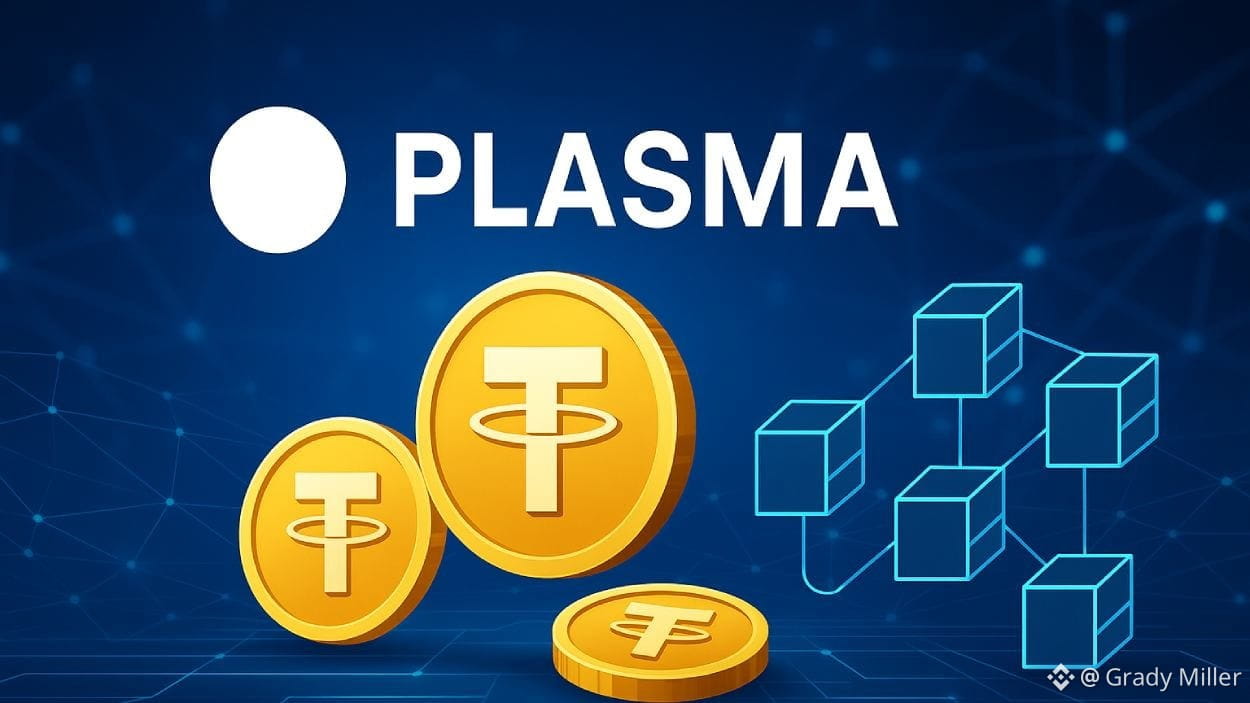
Building a Stablecoin-Native Layer 1
From the beginning, Plasma positioned itself as a Layer 1 network purpose-built for stablecoins. This distinction matters deeply. Layer 2 solutions and sidechains often inherit limitations from the chains they depend on. Plasma chose independence.
At its core, Plasma is an EVM-compatible blockchain, meaning developers can deploy existing Ethereum smart contracts without rewriting code. This ensures immediate familiarity and lowers friction for adoption. Tools like MetaMask, Foundry, and Hardhat work naturally within the ecosystem.
But beneath that familiarity lies a radically different design philosophy.
Plasma does not treat gas fees as an auction. It does not assume users want to speculate on transaction priority. Instead, it aims for deterministic behavior. Fees are predictable. Transaction ordering is stable. Costs are anchored to real-world value rather than volatile token prices.
This approach is critical when finance becomes automated.
As AI agents, payment routers, and background financial systems begin executing transactions continuously, unpredictability becomes risk. Plasma’s architecture was shaped with machines in mind as much as humans.
Zero-Fee USDT and the Paymaster System
One of Plasma’s most discussed features is its ability to support zero-fee USDT transfers at the protocol level. This is not a marketing subsidy or temporary incentive. It is built directly into the network through a native paymaster system.
Users can send USDT without holding XPL or any other native gas token. The protocol sponsors the transaction fees transparently.
This removes one of the largest barriers in crypto. For someone who only wants to move dollars, there is no need to buy another asset first. The experience becomes closer to digital cash.
If it becomes widely adopted, this single design choice could reshape how stablecoins are perceived globally. Sending money should not require understanding blockchain mechanics. Plasma moves toward that ideal.
Consensus and Speed Designed for Payments
Plasma operates using PlasmaBFT, a customized Byzantine Fault Tolerant consensus model inspired by HotStuff. The design emphasizes speed, determinism, and finality.
Transactions reach finality in under one second. There is no probabilistic waiting. Once confirmed, settlement is complete.
Throughput exceeds one thousand transactions per second under current configurations, with scalability paths designed specifically around payment-heavy usage rather than complex computation.
This matters because payments are fundamentally different from DeFi strategies or NFT minting. They require reliability above all else. Plasma optimizes for that reality.
Execution Layer Powered by Reth
On the execution side, Plasma uses Reth, a Rust-based Ethereum client. Reth brings performance efficiency while maintaining full EVM equivalence.
This choice reflects Plasma’s philosophy again. Instead of inventing new languages or experimental virtual machines, Plasma leverages proven developer ecosystems while improving performance under the hood.
Developers gain familiarity. Users gain speed. The network avoids isolation.
We’re seeing how this balance allows Plasma to scale without fragmenting the ecosystem.
Anchoring to Bitcoin Security
One of Plasma’s more ambitious components is its Bitcoin anchoring model. Plasma periodically commits state roots to the Bitcoin blockchain, inheriting the security guarantees of Bitcoin’s proof-of-work without sacrificing speed.
This approach creates a layered trust model. Plasma handles high-frequency activity, while Bitcoin serves as a final settlement reference.
Over time, this hybrid design may allow institutions to view Plasma as both fast and secure, bridging the gap between modern blockchain usability and Bitcoin’s reputation as the ultimate ledger.
The Native Bitcoin Bridge and pBTC
Plasma is also developing a trust-minimized Bitcoin bridge that enables BTC to enter the Plasma ecosystem as pBTC. Unlike traditional wrapped Bitcoin models that rely on centralized custodians, Plasma’s design uses decentralized verification and cryptographic guarantees.
This allows Bitcoin to become productive capital within stablecoin-based DeFi systems.
If it becomes fully operational at scale, this could unlock enormous liquidity. Bitcoin holders gain access to yield, lending, and stablecoin liquidity without relinquishing security.
The combination of Bitcoin liquidity and stablecoin efficiency remains rare in the industry. Plasma aims to make it native.
XPL Token and Economic Design
XPL is the native token of the Plasma network. Its role is not to compete with stablecoins, but to secure the network and coordinate incentives.
The total supply is capped at ten billion tokens. Distribution is structured to support long-term growth rather than short-term speculation.
A large portion is allocated to ecosystem development, liquidity incentives, partnerships, and network expansion. Team and investor allocations follow multi-year vesting schedules with cliffs to reduce immediate selling pressure.
Inflation begins modestly and tapers over time. Base transaction fees are burned using an EIP-1559-style mechanism, meaning increased network usage can offset inflation and potentially lead to deflationary dynamics.
Validators stake XPL to participate in consensus and earn rewards. Importantly, Plasma implements soft slashing rather than punitive slashing. Validators who misbehave lose rewards rather than principal, encouraging participation without catastrophic risk.
This approach aligns with Plasma’s infrastructure-first mindset. Stability matters more than punishment.
Mainnet Launch and Immediate Traction
Plasma’s mainnet launch in September 2025 marked a defining moment.
Instead of a slow rollout, Plasma launched with approximately two billion dollars in stablecoin liquidity on day one. Over one hundred DeFi protocols were integrated immediately, including major names in lending, liquidity, and synthetic assets.
Within the first week, total value locked surged beyond five billion dollars. For comparison, networks that had dominated stablecoin settlement for years took far longer to reach similar levels.
This was not speculative liquidity chasing incentives alone. A significant portion of capital bridged in because users wanted to use Plasma’s fee-free stablecoin rails.
We’re seeing how infrastructure demand behaves differently from hype cycles.
Institutional Backing and Strategic Alignment
Plasma’s funding history reflects its positioning. Backers include major venture firms and trading institutions known for infrastructure investments rather than speculative bets.
Notably, leadership figures from the stablecoin ecosystem itself participated personally. This alignment matters. Stablecoin issuers do not invest lightly in infrastructure that could shape their future distribution.
The presence of market makers and liquidity providers ensured deep markets from launch, reducing volatility and enabling real usage rather than thin trading.
This foundation contributes to Plasma’s credibility as long-term financial plumbing rather than an experimental chain.
Plasma One and the Path to Real Users
Beyond infrastructure, Plasma has begun building consumer-facing applications through Plasma One, a neobank-style platform built on Plasma rails.
The vision is straightforward. Users access dollar-denominated accounts, earn yield, send money instantly, and spend globally through cards. The blockchain layer remains invisible.
This approach acknowledges a critical truth. Most people do not want to use crypto. They want better financial services.
By abstracting complexity away, Plasma One targets users in regions with inflation, limited banking access, or high remittance costs.
If successful, this could bring millions of non-crypto-native users onto Plasma without them ever realizing they are interacting with a blockchain.
Competition and Market Position
Plasma enters a competitive landscape dominated by chains like TRON and Ethereum, both of which process enormous stablecoin volume.
However, Plasma differentiates through specialization.
TRON is a general-purpose chain that happens to be cheap. Ethereum is a settlement layer with high security but high cost. Plasma is built exclusively for stablecoins.
Zero-fee transfers, deterministic costs, and machine-readable predictability are not add-ons. They are foundational.
As financial automation increases, these characteristics may matter more than brand recognition.
Risks and Realistic Challenges
No deep dive would be honest without addressing risk.
Plasma must decentralize validator participation carefully without compromising performance. Its Bitcoin bridge must meet extremely high security standards. Token unlock schedules must be absorbed by real usage rather than speculation alone.
Regulatory uncertainty around stablecoins remains a global concern. Infrastructure that handles money inevitably attracts scrutiny.
Competition will not stand still. Other chains may attempt to replicate Plasma’s ideas.
Execution remains the ultimate test.
The Long-Term Vision
Looking years ahead, Plasma is positioning itself not as a destination for traders, but as the invisible layer beneath automated finance.
As AI agents handle payroll, treasury management, settlements, and compliance, they will require predictable rails.
Plasma’s fixed-fee structure, deterministic ordering, and stablecoin-native design align directly with that future.
If the world moves toward autonomous finance, Plasma could become one of the rails those systems rely on quietly, continuously, and without spectacle.
A Closing Reflection
Plasma XPL does not shout. It does not promise the next cultural wave or viral trend. Instead, it builds patiently, focusing on money as infrastructure rather than entertainment.
I’m increasingly drawn to projects like this because history shows that the systems that last longest are rarely the loudest.
They are the ones that work.
As stablecoins continue reshaping global finance, the question is no longer whether they will be used, but where they will live.
Plasma is making a clear bet on that answer.
And as the world moves toward programmable money, automated agents, and borderless value exchange, the quiet architecture being built today may one day power transactions no one notices, yet everyone depends on.
That future is approaching faster than most realize.