
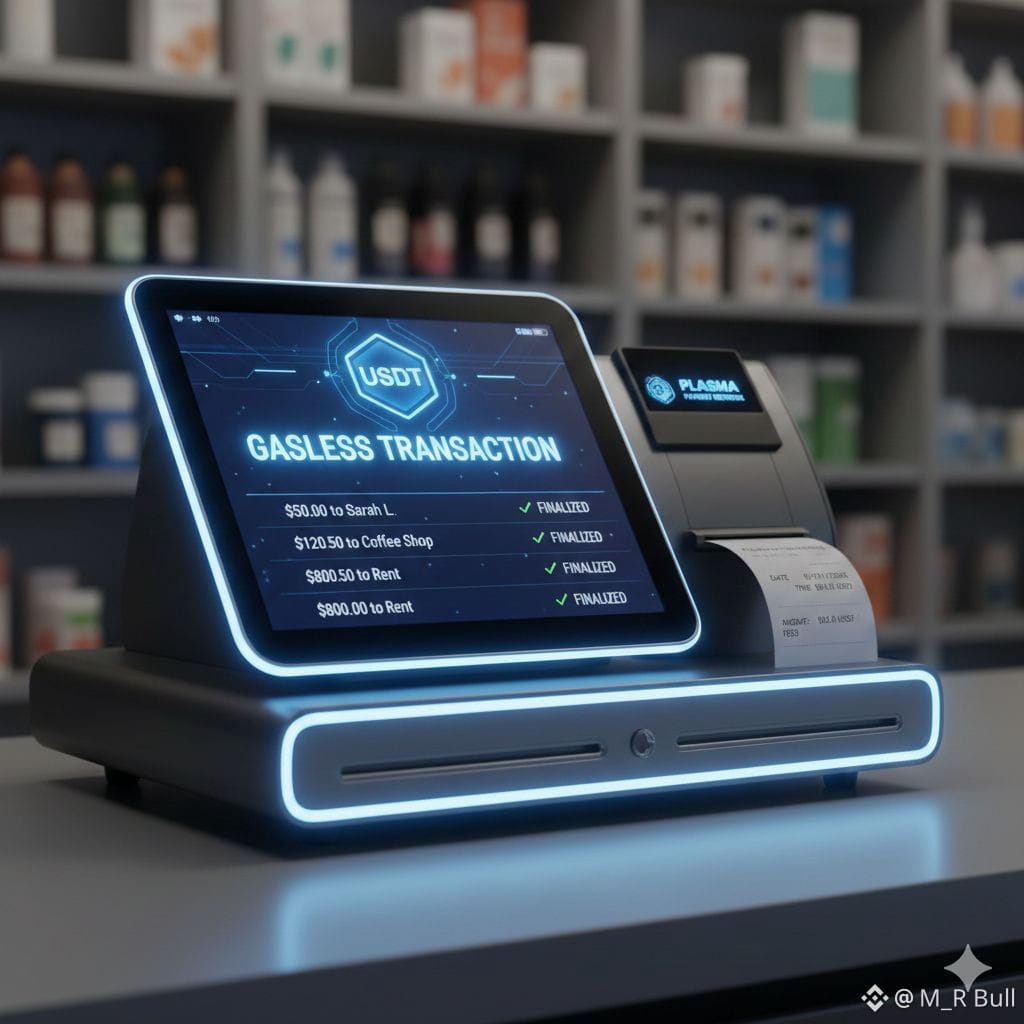
When I explain Plasma to people who aren’t immersed in crypto, I don’t lead with technical details like consensus algorithms or block intervals. Instead, I ask them to imagine a basic cash register—the kind you find in any store. It runs all day, processes payments smoothly, prints receipts, and doesn’t lock up mid-transaction. It’s not flashy; it’s dependable. That’s the lens through which Plasma makes sense. Once you view it that way, its design choices feel intentional rather than abstract.
Most blockchains aim to be everything at once. Plasma deliberately avoids that path. Its focus is narrow, almost to a fault. The core use case is stablecoin settlement—particularly USDT because that’s how crypto is already used in everyday life. People send stablecoins to relatives, vendors, employees, and exchanges. These transfers aren’t exciting, but they happen constantly, and they require infrastructure that behaves predictably. Plasma treats stablecoins as the primary workload, not as an afterthought layered onto a general-purpose chain.
Gasless USDT transfers are one of the clearest expressions of this mindset. At first glance, it sounds like a marketing gimmick. In reality, it removes a major usability barrier: the need to hold a separate token just to move your own money. Many users hit the “you need ETH for gas” message and simply stop there. Plasma eliminates that friction entirely. And crucially, this isn’t framed as unlimited free usage. The system is carefully constrained, showing that the team understands the difference between making payments easy and opening the door to abuse. Free transactions are helpful; free spam is not.
When fees do apply, Plasma allows them to be paid directly in stablecoins. This is a small but powerful design decision. For years, users have accepted that moving stable assets requires holding volatile ones. Plasma challenges that assumption. If your balance is in USDT, you stay in USDT—no extra tokens, no conversions, no added cognitive load. In regions where stablecoins function as practical money, that simplicity goes a long way toward building trust.
Under the hood, Plasma still resembles a serious blockchain. It’s fully EVM-compatible via Reth, so developers can deploy existing contracts and tools without friction. That familiarity is paired with PlasmaBFT, a consensus system designed for fast, deterministic finality. The priority is clear: transactions should feel settled immediately. For payments and commerce, ambiguity is unacceptable. “Final soon” doesn’t cut it.
The network is already live and busy. Mainnet explorers show hundreds of millions of transactions processed, with blocks produced roughly every second. The testnet has also handled millions of transactions, suggesting real load testing rather than a quiet showcase. This doesn’t guarantee widespread adoption, but it does demonstrate that Plasma is operational, not theoretical.
Plasma becomes even more interesting when you look at its relationship with Bitcoin. By anchoring security to Bitcoin and building a native BTC bridge, Plasma is aiming for long-term credibility and neutrality. Bitcoin still commands unmatched trust among institutions and payment providers, and Plasma is trying to borrow from that reputation. That said, bridges are notoriously difficult. Verifiers, multi-party signing, and withdrawal mechanics are where designs are truly tested. If Plasma executes well here, it reinforces the entire system. If not, this is where critics will focus.
The question of the XPL token naturally comes up. If USDT transfers are often free, why does the token exist at all? Plasma’s answer is understated. XPL isn’t meant for everyday users. It’s used by validators, secures the network, captures fees from transactions that aren’t subsidized, and supports governance. In other words, it operates in the background. That’s unusual for a Layer 1 token, but it aligns with Plasma’s philosophy. Nobody thinks about what powers a cash register—they just expect it to function.
Integrations matter more than hype in this context. Wallet support and infrastructure partnerships are far more important than splashy DeFi launches. If Plasma becomes the easiest way to move USDT within tools people already use, adoption won’t need aggressive marketing. Payment systems usually win through convenience, not ideology.

It also helps that Plasma is open about being in beta. Public RPCs are rate-limited, and gasless features are rolled out carefully. That may not generate excitement, but it signals an understanding of what financial infrastructure demands. When money is involved, mistakes aren’t easily forgiven.
In the end, Plasma won’t succeed because of narratives or online buzz. Its success will be determined by quiet metrics: how quickly transactions feel final, how rarely users hit friction, and how many transfers are simple, uneventful payments. If Plasma becomes the place where stablecoins move smoothly, cheaply, and without surprises, it won’t feel revolutionary. It will feel ordinary. And in payments, ordinary is the real win.