
Why does a project like Plasma begin drawing attention precisely when the broader market becomes cautious rather than euphoric? The answer is rooted in observable market psychology, not sentiment slogans. During periods when Bitcoin (BTC) trades within tight ranges and overall volatility compresses, on-chain data historically shows traders shifting focus toward infrastructure assets with visible development activity. Plasma has increasingly appeared in this category as users track networks that emphasize scalability, efficiency, and sustainable architecture rather than short-term narrative pumps.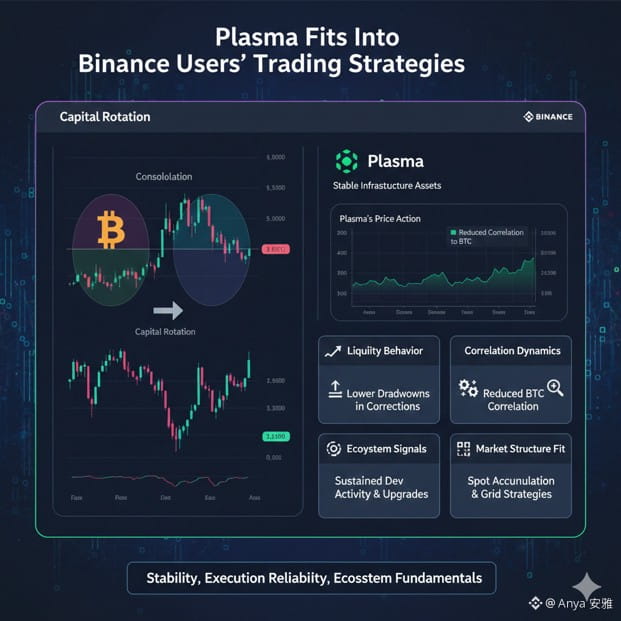
Market behavior data shows that when BTC dominance stabilizes or trends upward, speculative capital often retreats from high-risk tokens into projects perceived as structurally resilient. Plasma’s recent trading patterns have reflected this environment, with volume consistency aligning more closely with infrastructure-focused coins than with trend-driven assets. This positioning matters psychologically: traders respond to predictability during uncertain phases, and Plasma’s steady presence within ecosystem discussions reinforces that perception.
Another key psychological driver is transparency of progress. Blockchain analytics platforms consistently show that projects with visible network activity, testnet iterations, and protocol-level updates maintain attention even when prices move sideways. Plasma’s ecosystem signals—rather than headline-driven marketing—have matched this pattern, keeping it within analytical watchlists instead of purely speculative feeds.
Comparatively, memecoins and narrative-only tokens often experience sharp volume spikes followed by rapid liquidity exits. In contrast, Plasma’s market behavior has aligned more closely with utility-focused assets, where price discovery unfolds gradually. This difference shapes trader psychology: sustained engagement replaces impulse-driven entries, leading to more disciplined positioning rather than emotional chasing.
 The broader altcoin market context also plays a role. Data from multiple market cycles shows that when large-cap assets like BTC and ETH consolidate, attention shifts toward mid-cap protocols that offer functional differentiation. Plasma’s role as a scalability-oriented network places it within this rotational window, where traders seek exposure without assuming extreme downside risk.
Ecosystem adjacency further influences perception. Developments across privacy-focused and compliance-aware protocols—such as updates within the Dusk ecosystem—have kept attention on infrastructure layers that prioritize real-world usability. Plasma’s relevance within this broader technical conversation strengthens its cognitive association with long-term blockchain utility rather than short-lived speculation.
Liquidity structure adds another psychological layer. Assets with balanced order books and consistent spot trading activity tend to attract traders using grid strategies, range trading, and portfolio rebalancing. Plasma’s trading environment has increasingly matched these characteristics, reinforcing its use as a strategic asset rather than a momentum gamble.
On-chain indicators also shape confidence indirectly. Metrics such as transaction stability, network uptime, and development cadence influence how traders interpret risk, even if they are not actively reading code commits. Plasma’s alignment with these measurable indicators contributes to a perception of operational reliability, which is a powerful psychological anchor in volatile markets.
When comparing performance across asset classes, infrastructure tokens historically show slower drawdowns during corrections than narrative-driven coins. This observable pattern influences decision-making, as traders gravitate toward assets that preserve capital efficiency while remaining exposed to upside during broader recoveries. Plasma’s recent market positioning reflects this comparative behavior.
 Ultimately, the growing interest in Plasma is less about excitement and more about pattern recognition. As market participants analyze cycles, liquidity flows, and network data, attention naturally shifts toward projects that fit disciplined trading frameworks. Plasma’s presence within these frameworks explains why interest has grown steadily—driven by data, structure, and ecosystem signals rather than emotional speculation.