
There’s a certain calm you feel when you realize a system was built with the future in mind, not retrofitted after the fact. That’s the feeling I get when spending time with Vanar Chain. Not because it promises faster blocks or louder narratives, but because Vanar Chain seems to understand something many networks are only starting to notice: AI changes the shape of infrastructure itself.
For a long time, blockchains were built around human users. Wallets, signatures, interfaces, clicks. Speed mattered, fees mattered, but everything assumed a person on the other side of the screen. Vanar Chain steps slightly to the side of that assumption. It treats intelligence as native, not decorative. And that single choice ripples through everything else.
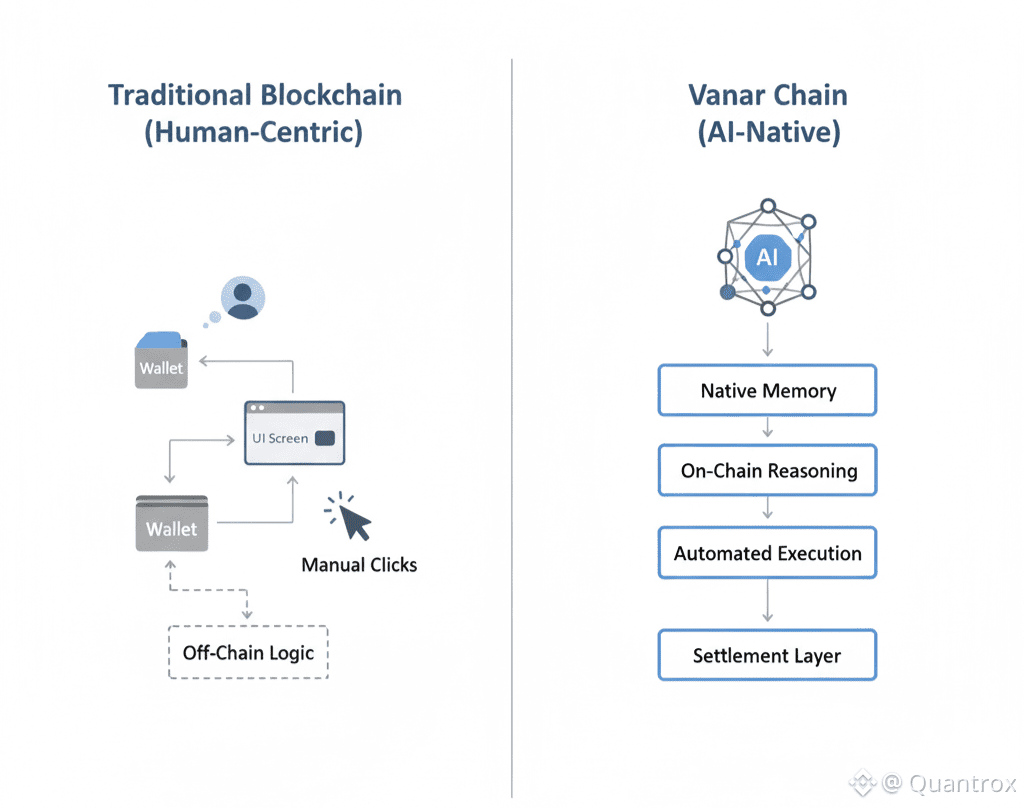
Most chains today talk about AI as a feature. An integration here, an assistant there. It works, until it doesn’t. Retrofitting AI onto legacy infrastructure often feels like adding a turbo engine to a bicycle. It moves, but the frame wasn’t designed for it. Vanar Chain took a different route. From the beginning, Vanar Chain was shaped around what intelligent systems actually need to function reliably, without friction or constant workarounds.
When people say “AI-ready,” it’s easy to assume they mean speed. More TPS, lower latency, bigger numbers on dashboards. But AI doesn’t really care about that. AI systems need memory that persists, reasoning that can be inspected, automation that doesn’t break under edge cases, and settlement that works quietly in the background. Vanar Chain treats these as first principles. That’s why Vanar Chain keeps returning to the idea of native memory, native reasoning, and native execution.
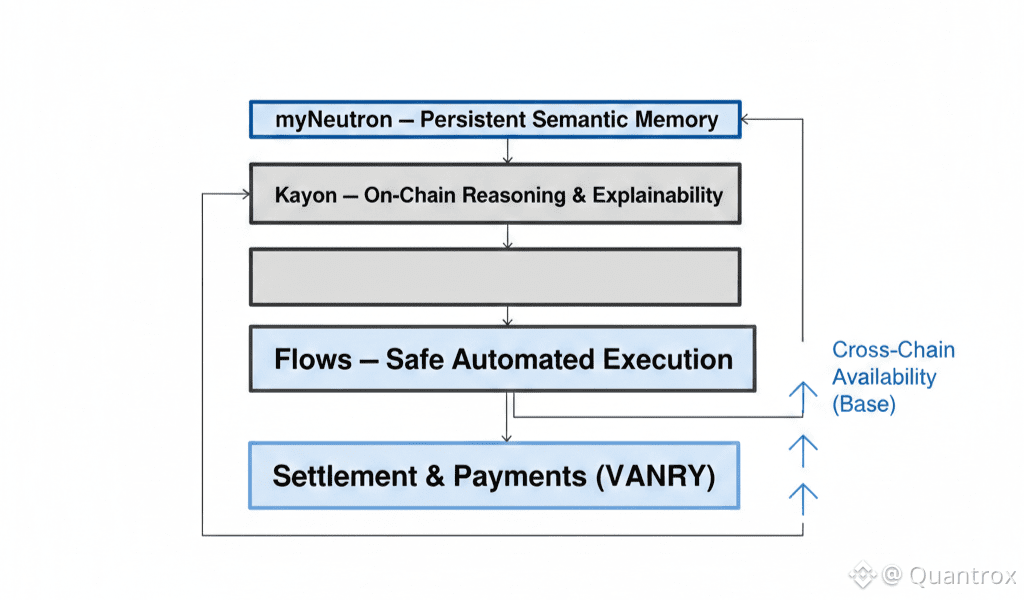
A simple way to think about it is this: imagine trying to hold a long conversation with someone who forgets everything you said five minutes ago. That’s how most blockchains feel to AI. Vanar Chain addresses this through tools like myNeutron, where semantic memory exists at the infrastructure level. Vanar Chain doesn’t just store data, it preserves context. Over time, that difference compounds.
Then there’s reasoning. On many networks, logic lives off-chain, hidden behind opaque systems you’re expected to trust. Vanar Chain does the opposite. Through Kayon, reasoning and explainability live on-chain. Decisions can be traced, inspected, and understood. Vanar Chain treats transparency not as a slogan but as a structural requirement, especially when intelligence is involved.
Automation is the next piece. AI that can think but not act is unfinished. Vanar Chain approaches this with Flows, where intelligent decisions translate into safe, controlled execution. No dramatic leaps, no magic. Just a quiet bridge between insight and action. Vanar Chain seems comfortable operating in that understated space, where reliability matters more than flash.
All of this infrastructure still needs settlement. AI agents don’t open wallets or click buttons. They operate continuously, across environments, under constraints humans rarely notice. Payments, in this context, aren’t a feature. They’re a primitive. Vanar Chain treats payments as part of the base layer, not an add-on demo. That’s where vanry quietly comes in, aligning usage with real economic activity rather than staged interactions.
One of the more interesting choices Vanar Chain has made is stepping beyond a single network. AI systems don’t stay put. They move where users, liquidity, and data already exist. By making Vanar Chain technology available cross-chain, starting with Base, Vanar Chain acknowledges a simple truth: isolation limits intelligence. Cross-chain availability lets Vanar Chain meet developers and agents where they already are, instead of asking them to migrate their entire world.
This matters for scale, but also for relevance. Vanar Chain on Base isn’t about expansion for its own sake. It’s about allowing intelligent systems to operate across ecosystems without friction. That broader reach naturally increases the surface area where vanry can be used, not through incentives, but through necessity.
It also highlights why launching yet another general-purpose L1 is becoming harder. Web3 already has enough blockspace. What it lacks is proof that infrastructure can support intelligent behavior at scale. Vanar Chain doesn’t argue this point loudly. It demonstrates it. myNeutron shows memory. Kayon shows reasoning. Flows shows execution. Vanar Chain builds the case quietly, product by product.
There’s something refreshing about that approach. No rush to dominate narratives. No attempt to win every cycle. Vanar Chain feels more like a system being assembled carefully, piece by piece, with an eye on durability. The role of vanry fits naturally into this picture, underpinning usage across the intelligent stack without pretending to be the story itself.
Crypto narratives tend to rotate quickly. AI today, something else tomorrow. Readiness doesn’t rotate. Infrastructure that works keeps working. Vanar Chain seems aligned with that slower, steadier path. It’s built for agents that don’t sleep, enterprises that need predictability, and real-world systems that can’t afford surprises.
When I think about Vanar Chain, I don’t picture a launch event or a chart. I picture a background system doing its job, day after day, while more visible layers come and go. Vanar Chain isn’t trying to impress you in the first five minutes. It’s trying to still make sense five years from now.
That’s where vanry finds its footing, not as a narrative token, but as exposure to infrastructure that assumes intelligence will be everywhere, quietly running the world in the background. Vanar Chain doesn’t shout that future into existence. It prepares for it, patiently, one layer at a time.
