
The crypto market is entering a new phase. After years of experimentation, speculation, and infrastructure stress tests, attention is shifting away from hype-driven narratives toward blockchains that can support real usage at scale. Traders and investors are increasingly focused on one critical question: which networks are actually built for adoption, not just innovation? This shift in mindset is happening against a backdrop of growing demand for gaming, AI-driven applications, digital ownership, and on-chain economies that must function smoothly under real-world conditions.
In this environment, @Vanarchain has positioned Vanar Chain as a Layer-1 infrastructure designed to solve one of Web3’s most persistent problems: friction. High fees, slow confirmations, complex wallets, and poor user experience have limited blockchain adoption far more than a lack of ideas. Vanar Chain approaches the market from a different angle, prioritizing execution speed, usability, and scalability while keeping decentralization intact. With $VANRY at the center of its ecosystem, Vanar Chain reflects a broader trend where infrastructure quality is becoming the primary differentiator in the next market cycle.

The Market Shift Toward Infrastructure-First Blockchains
Crypto cycles often begin with bold ideas and end with practical constraints. In previous cycles, innovation moved faster than infrastructure, resulting in congested networks, rising fees, and inconsistent performance during peak demand. According to recent industry data, more than 70% of users who abandoned blockchain-based applications cited complexity and transaction costs as the main reasons. This highlights a fundamental issue: adoption does not fail because of lack of innovation, but because of poor execution at scale.
Infrastructure-first blockchains are emerging as the response to this problem. Instead of focusing solely on theoretical decentralization or experimental features, these networks emphasize reliability, throughput, and seamless interaction. Vanar Chain aligns closely with this market demand by optimizing for low-latency execution and a smoother user journey. This approach resonates strongly with developers and enterprises looking to build products that can operate under real-world traffic conditions.
Why User Experience Is Becoming a Competitive Advantage
User experience has quietly become the most valuable asset in blockchain design. In traditional technology markets, superior UX consistently outperforms technically superior but harder-to-use products. The same principle is now being applied to Web3. Wallet abstractions, predictable fees, and fast settlement are no longer optional features; they are prerequisites for mass adoption.
Vanar Chain’s architecture is designed to minimize friction at every interaction point. Faster block finality reduces waiting times, while predictable transaction costs allow developers to design applications without fear of sudden fee spikes. This is particularly important for gaming and microtransaction-heavy applications, where delays of even a few seconds can break immersion and reduce engagement. From an investor’s perspective, networks that prioritize UX are better positioned to attract sustained usage rather than short-lived speculation.
Gaming, AI, and Digital Ownership as Demand Drivers
Three sectors are driving blockchain infrastructure demand in 2025 and beyond: gaming, AI, and digital ownership. Blockchain gaming alone is projected to surpass $65 billion in market value within the next five years, but only if networks can handle high-frequency transactions without congestion. AI-driven applications introduce additional complexity, requiring fast data interactions and reliable execution layers. Digital ownership, including NFTs and tokenized assets, demands permanence, security, and cost efficiency.
Vanar Chain is strategically positioned at the intersection of these trends. Its design supports high transaction throughput while maintaining consistency, making it suitable for applications that require both speed and stability. This combination is difficult to achieve and often forces trade-offs on other networks. By focusing on a balanced architecture, Vanar Chain aims to serve as a foundational layer for next-generation applications rather than a niche solution.
Token Utility and Ecosystem Economics of $VANRY
For investors, infrastructure quality must be reflected in token utility. $VANRY plays a central role in the Vanar Chain ecosystem, functioning as the economic backbone that aligns incentives between users, developers, and validators. Unlike speculative tokens with limited on-chain use, infrastructure tokens derive value from network activity and demand for block space.
As more applications deploy on Vanar Chain, transaction fees, staking participation, and ecosystem growth contribute directly to the utility of $VANRY. This creates a feedback loop where increased usage strengthens the network’s economic security and long-term sustainability. From a market perspective, such utility-driven models are increasingly favored over purely narrative-based valuations.
Market Implications for Traders and Long-Term Investors
The broader crypto market is becoming more selective. Capital is rotating away from experimental projects toward networks that demonstrate tangible progress and real usage metrics. This shift is evident in on-chain data, where activity concentration is increasing around chains that offer consistent performance.
For traders, infrastructure-focused narratives often unfold over longer time horizons but provide more stable trend structures. Instead of sudden pumps driven by speculation, these projects tend to experience gradual appreciation as adoption grows. For long-term investors, this translates into lower volatility relative to hype-driven assets and stronger alignment with fundamental growth.
Vanar Chain’s focus on usability and scalability positions it well within this evolving market framework. As regulatory scrutiny increases globally, networks that emphasize transparency, reliability, and predictable performance are more likely to attract institutional interest. This dynamic could significantly influence how capital flows into infrastructure tokens over the next cycle.
Real-World Examples of Infrastructure Winning the Market
History offers clear examples of infrastructure outperforming novelty. In traditional technology markets, operating systems, payment rails, and cloud platforms consistently capture more value than consumer-facing applications built on top of them. Blockchain is following a similar trajectory. The networks that quietly power applications often generate the most sustained value.
Vanar Chain reflects this principle by prioritizing foundational capabilities over short-term hype. Its focus on execution efficiency mirrors successful infrastructure plays in other industries, where long-term relevance is driven by reliability rather than marketing. This strategy may not produce immediate viral attention, but it aligns closely with how lasting value is built in technology ecosystems.
Risks, Challenges, and Competitive Landscape
No infrastructure project operates in isolation. The Layer-1 landscape remains competitive, with multiple networks pursuing scalability and UX improvements. Vanar Chain must continue to execute consistently, expand its developer ecosystem, and maintain performance under increasing demand. Adoption is not guaranteed, and market sentiment can shift rapidly.
However, the key differentiator lies in strategic focus. By targeting real usage scenarios rather than abstract metrics, Vanar Chain reduces the risk of misalignment between technology and market needs. Continuous ecosystem development and partnerships will be critical in translating technical advantages into sustained network activity.
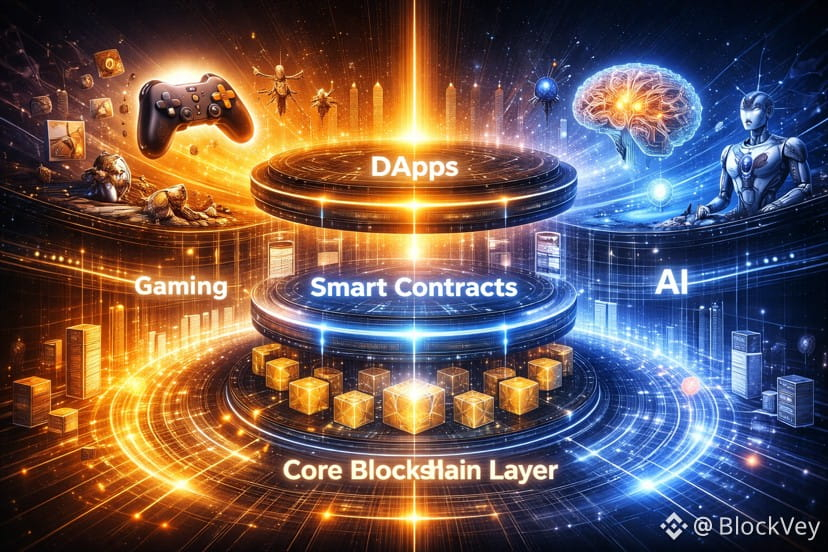
The next phase of crypto growth will not be driven by speculation alone. It will be shaped by infrastructure that works seamlessly under real-world conditions and supports applications people actually use. Vanar Chain represents this shift toward practicality, usability, and scalable design. By focusing on low friction, predictable performance, and developer-friendly architecture, @vanar is positioning itself as a foundational layer for gaming, AI, and digital ownership in the years ahead.
For traders, Vanar Chain offers exposure to an infrastructure narrative that aligns with long-term market trends rather than short-term hype. For investors, $VANRY reflects a utility-driven model tied directly to network adoption and ecosystem growth. As the market matures, projects that prioritize execution over experimentation are likely to define the next cycle. The key question now is not whether infrastructure matters, but which networks will successfully deliver it at scale.
