

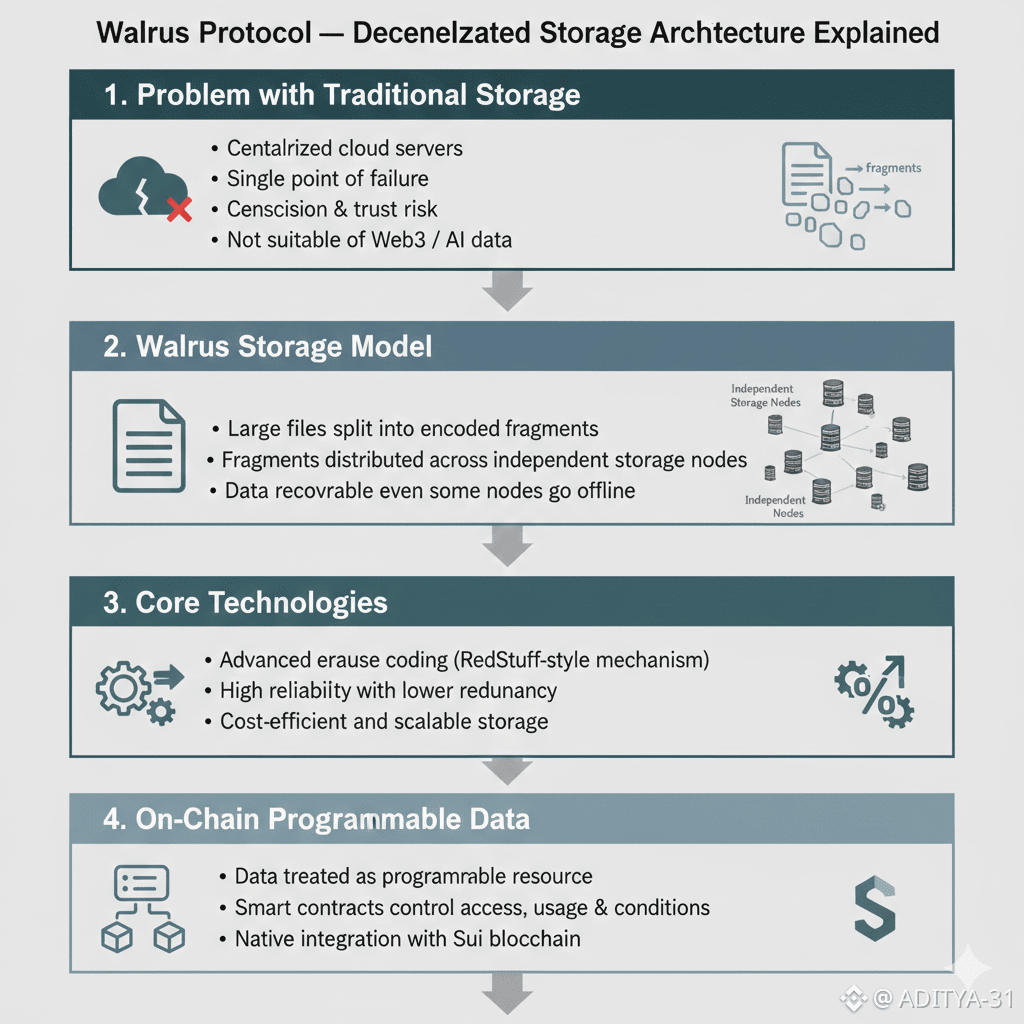
Web3 ka ek silent lekin critical problem hamesha se raha hai: data ko kaise store kiya jaaye. Tokens aur smart contracts par kaafi focus raha, lekin large files, media, AI datasets aur application data ke liye ecosystem kaafi time tak centralized services par depend karta raha. Walrus Protocol isi gap ko target karta hai — ek aisa decentralized storage layer jo sirf theory me nahi, balki real usage ke liye design kiya gaya hai.
Walrus ko Sui blockchain ke upar build kiya gaya hai, jiska matlab ye hai ki storage layer ko high throughput aur fast execution ka direct benefit milta hai. Traditional cloud providers ke comparison me, Walrus ka approach censorship-resistant hai, single point of failure se free hai, aur economic incentives ke through long-term sustainability par focus karta hai.
Walrus ka basic idea simple hai, lekin execution complex aur thoughtful hai. Data ko centralized servers me store karne ke bajaye, files ko multiple encoded fragments me tod diya jaata hai. Ye fragments independent storage nodes ke across distribute hote hain. Agar kuch nodes offline bhi ho jaate hain, tab bhi data reconstruct ho sakta hai. Is approach se reliability aur resilience dono improve hoti hain.
Is model ka ek important aspect ye hai ki Walrus data ko sirf “storage” nahi maanta. Data ko on-chain programmable resource ki tarah treat kiya jaata hai. Matlab applications sirf files upload aur download nahi karti, balki smart contracts ke through ye decide kar sakti hain ki data ka access kaun kare, kab kare, aur kis condition me kare. Ye cheez Web3 ke liye kaafi important shift hai.
Architecture ki baat karein to Walrus advanced erasure-coding techniques ka use karta hai, jisme RedStuff jaise mechanisms shamil hain. Ye approach older decentralized storage systems ke comparison me kam redundancy ke saath better recovery allow karti hai. Result ye hota hai ki storage cost kam hoti hai aur network efficiency better rehti hai, jo large-scale adoption ke liye zaroori hai.
Walrus ka Sui ke saath native integration bhi ek strong point hai. Developers jo Move-based smart contracts par kaam kar rahe hain, unke liye storage ko integrate karna relatively smooth ho jaata hai. Alag-alag off-chain services ko stitch karne ki zarurat kam padti hai, jisse application architecture simple rehti hai.
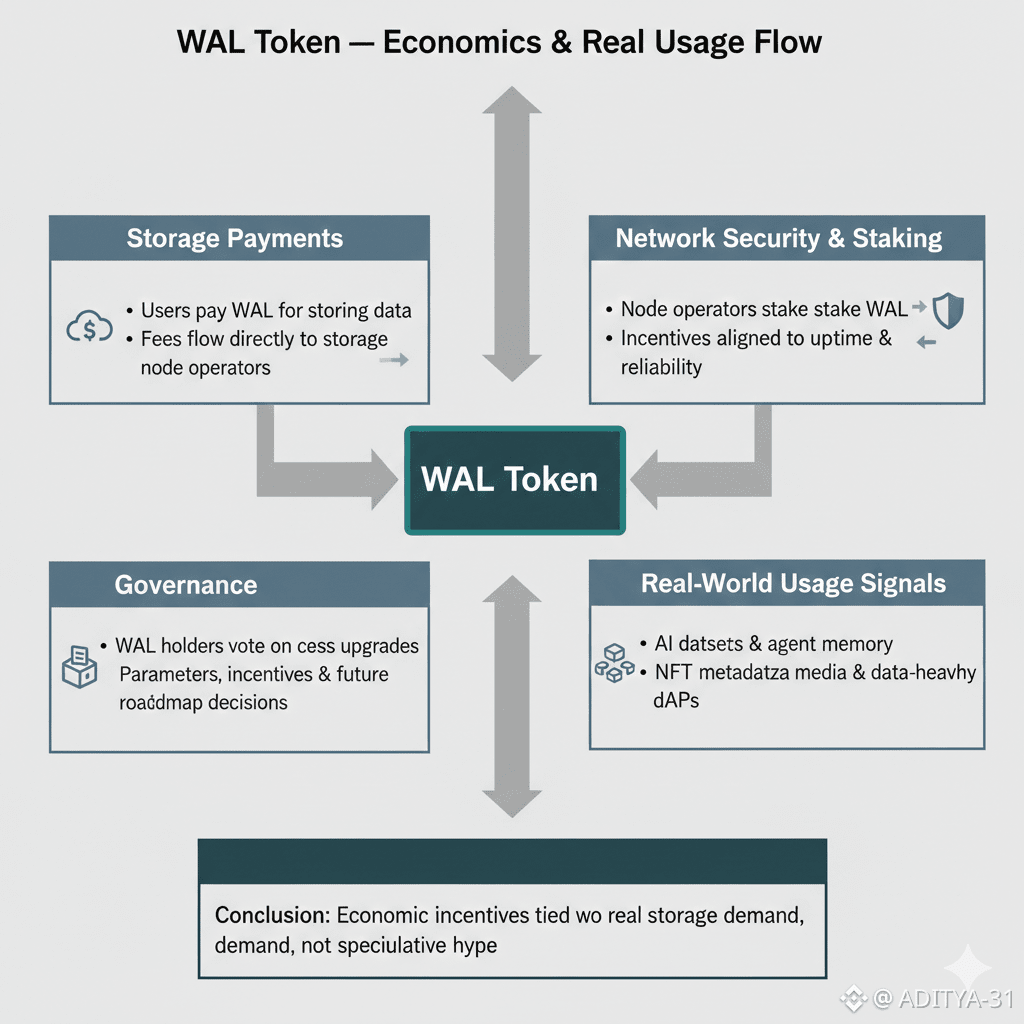
Token WAL ecosystem ka economic backbone hai. Storage use karne ke liye fees WAL me pay ki jaati hain, jo directly storage node operators aur stakers ko milti hain. Isse ek clear incentive structure banta hai jahan network usage aur rewards directly linked rehte hain. Ye model speculative hype ke bajaye actual usage ko reward karta hai.
Governance ke level par bhi WAL ka role important hai. Token holders protocol upgrades, parameters aur future changes par influence rakhte hain. Staking ke through network security bhi ensure hoti hai, jisse participation aur responsibility dono align ho jaate hain.
Ecosystem signals dekhe jaayein to Walrus sirf ek experimental project nahi lagta. Strong venture backing, experienced contributors aur growing integrations ye indicate karte hain ki decentralized storage ko ek foundational infrastructure layer ke roop me treat kiya ja raha hai. AI workflows, prediction markets, decentralized media platforms aur on-chain data-heavy applications jaise areas me Walrus ka use dikhne laga hai.
Real-world use cases me Walrus ka role kaafi practical lagta hai. NFT metadata aur game assets jaise use cases obvious hain, lekin AI datasets aur persistent agent memory jaise newer areas me bhi Walrus ka fit strong lagta hai. Data integrity aur availability smart contracts ke through enforce hone ki wajah se trust assumptions kaafi kam ho jaati hain.
Competition obviously exist karta hai. Filecoin, Arweave aur doosre storage protocols apne-apne models ke saath market me hain. Walrus ko yahan execution, developer adoption aur cost-efficiency ke through differentiate karna hoga. Saath hi regulatory uncertainty bhi ek factor hai, kyunki decentralized storage aur content governance ka topic globally sensitive hai.
Future ki baat karein to Walrus ka roadmap Web3 infrastructure ke core ke aur paas jaata hua dikhta hai. Sui ecosystem ke saath deeper integration, better developer tooling aur AI-driven applications ke liye optimized storage primitives ye suggest karte hain ki focus sirf short-term traction par nahi, balki long-term relevance par hai.
Agar Walrus network real storage demand attract kar paata hai aur economic incentives usage ke saath aligned rehte hain, to ye protocol Web3 stack ka ek permanent layer ban sakta hai — sirf ek storage solution nahi, balki data coordination layer ke roop me.
Final Take
Walrus Protocol quietly ek important problem solve kar raha hai. Ye flashy narratives ya short-term hype par depend nahi karta. Focus zyada foundational hai — data ko decentralized, verifiable aur programmable banana. Jaise-jaise Web3 applications zyada complex aur data-heavy hoti jaayengi, aise infrastructure layers ki importance aur badhegi. Walrus isi direction me apni jagah bana raha hai, step by step, without noise.