
Why complex smart contracts need more than “just gas”
As decentralized applications mature, smart contracts are no longer simple, isolated scripts. Real-world dApps require multi-step logic, conditional execution, cross-module coordination, and economic guarantees.
In most traditional ecosystems, this complexity leads to trade-offs: higher gas costs, fragile composability, or security risks hidden inside opaque execution flows.
This is exactly where $XPL becomes structurally relevant.
XPL as an execution-grade utility token
XPL is not designed as a passive governance or speculative asset. It functions as an economic execution layer for complex smart-contract systems, aligning incentives across computation, validation, and risk.
In advanced smart-contract environments, $XPL enables:
• Native composability between independent logic modules
• Economic guarantees for execution correctness
• Predictable cost structures for multi-step and conditional flows
Instead of treating complexity as an external cost, XPL internalizes it.
Modular logic requires modular economics
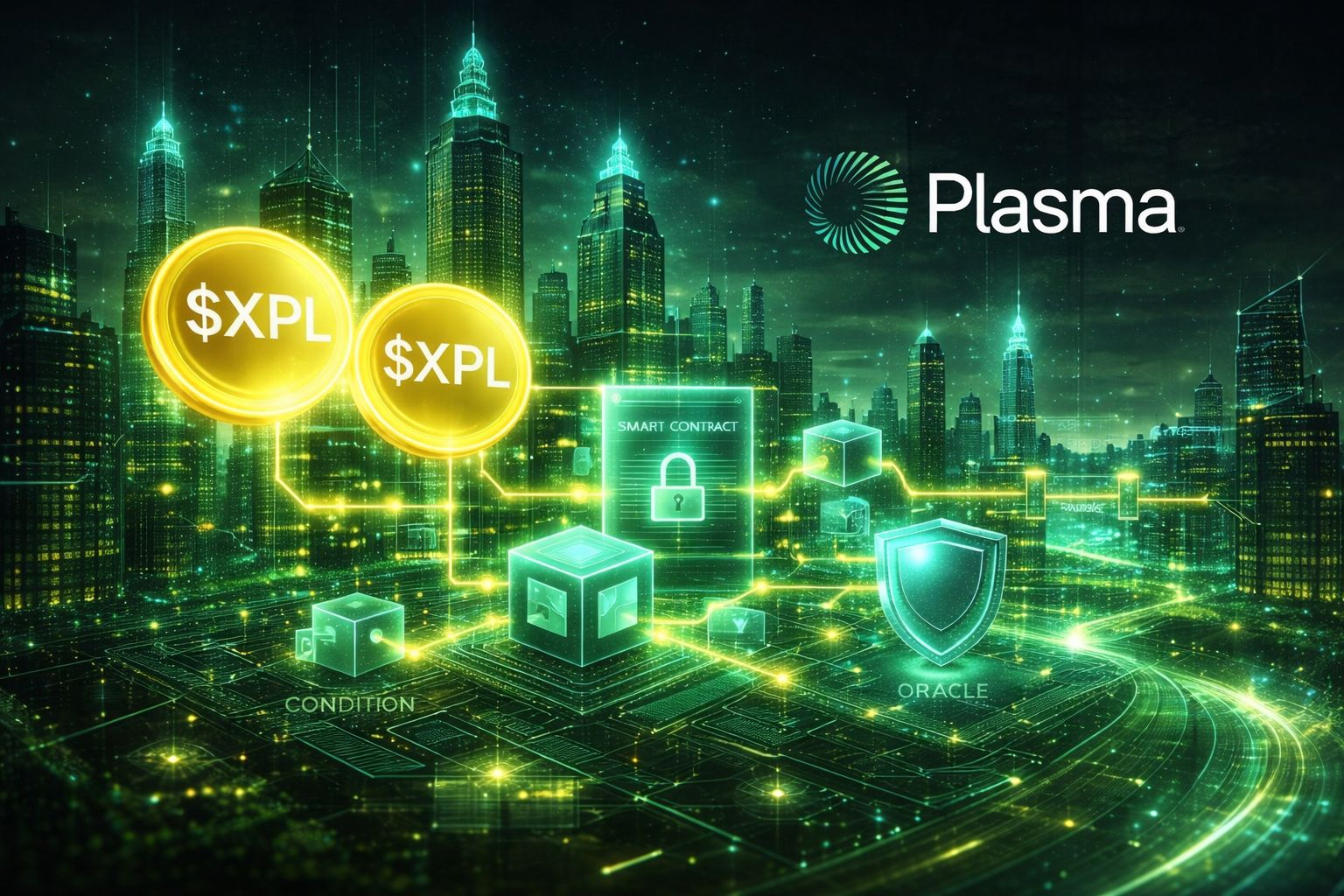
Modern smart contracts are increasingly built as networks of micro-contracts rather than monolithic code blocks. Each module performs a specific function: validation, condition checking, settlement, or routing.
$XPL supports this architecture by:
Assigning differentiated execution costs to each logic segment, based on risk and computational weight
Enabling bonding and slashing mechanisms, where faulty or insecure logic can be economically penalized
Creating incentives for reusable, audited logic modules, rather than one-off implementations
This transforms smart-contract design from pure code engineering into economic system design.
Advanced use cases powered by $XPL
• Conditional DAO workflows — treasury actions executed only when predefined governance, oracle, or market conditions are met
• Multi-step DeFi strategies — where each stage (routing, leverage, settlement) is economically isolated and verifiable
• Dynamic NFTs and programmable assets — whose behavior or metadata evolves based on external signals, secured by $XPL-backed logic
In all these cases, XPL acts as the economic glue that keeps complex execution paths reliable.
Why this matters versus traditional models
Compared to gas-only or flat-fee systems, XPL introduces:
• Transparent execution costs instead of unpredictable congestion pricing
• Economic security layered on top of technical security
• Fine-grained composability without execution bloat
This makes complexity scalable rather than fragile.
Final takeaway
The future of smart contracts is not about writing bigger contracts — it’s about orchestrating interoperable, conditional, and economically secured logic systems.
XPL provides the missing layer:
cost, risk, and incentive alignment for complex smart-contract execution.
It’s not just a token.
It’s the economic engine behind scalable smart-contract architecture.
#Plasma $XPL @Plasma