
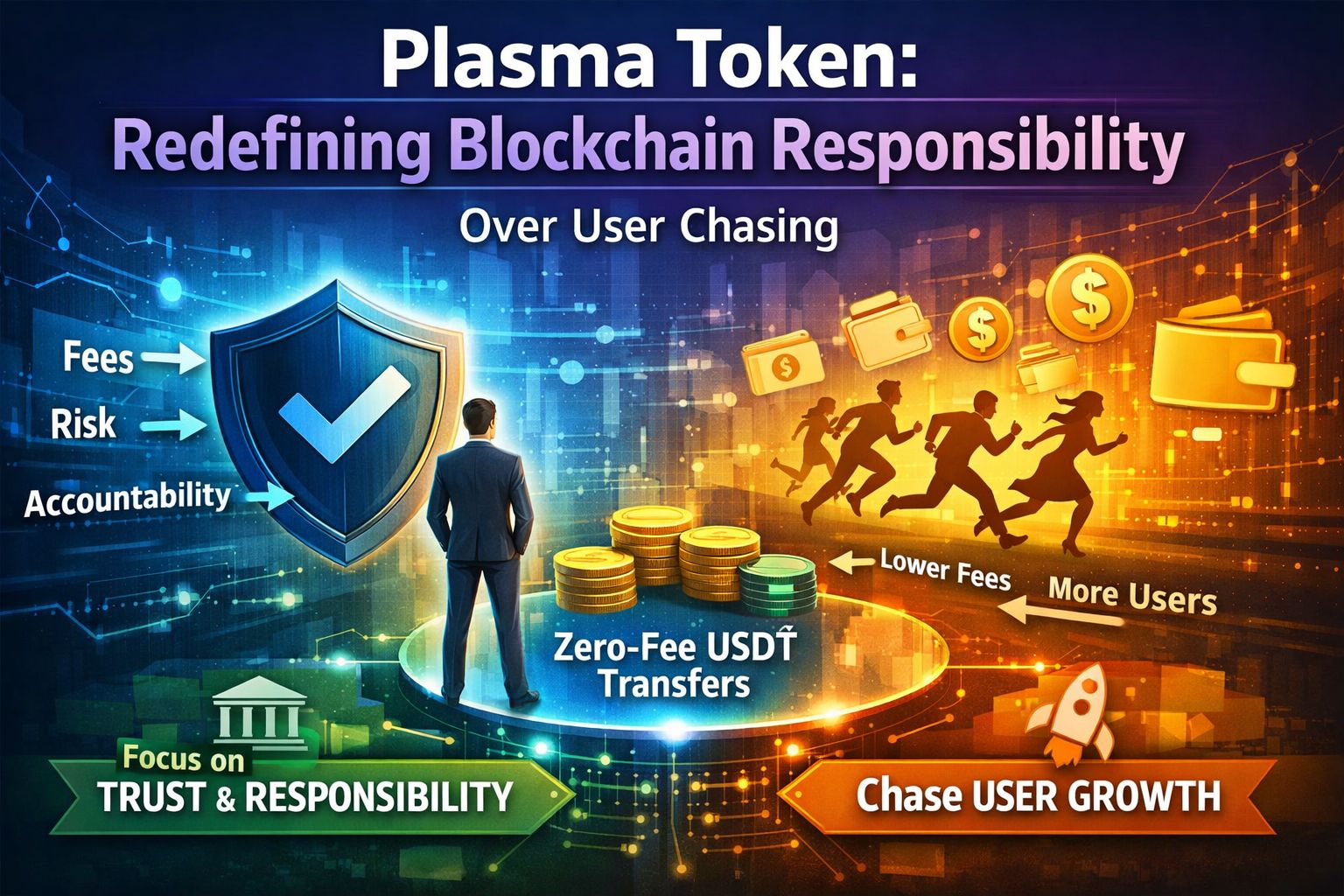
When I first explored Plasma, I expected the usual buzz about growth metrics—daily users, wallet adoption, viral traction. Surprisingly, that narrative never arrived. Instead, the conversation kept circling around accountability: who takes the cost, who bears the risk, and who is liable when systems fail. At first, it seemed unusual, but the focus quickly revealed itself as deliberate.
Unlike most chains chasing user numbers with lower fees or faster confirmations, Plasma is focused on responsibility. That distinction becomes clear when we look at on-chain stablecoins, which now dominate over 70% of transaction volumes. These are not speculative tools—they are used for payments, treasuries, and settlements. When a stablecoin transaction fails, the question isn’t speed; it’s who is answerable.
Plasma’s design embodies that principle. It appears conventional on the surface—EVM compatibility, familiar tooling—but beneath lies a fundamental shift. Fees are not automatically passed to users. Instead, applications absorb costs through paymasters. This subtle choice changes behavior in profound ways. Users conducting USD₮ transfers experience zero friction. The system communicates a simple message: operating costs are the responsibility of the application, not the end user.
This mirrors traditional finance. Swipe a card, and the merchant covers the fees, not the customer. Plasma imports that logic on-chain. With stablecoins settling trillions annually, yet blockchain UX often treating payments like experiments, Plasma’s approach feels essential. It is not designed to attract casual wallets but to support businesses and payment-heavy applications that cannot avoid accountability.
Technically, Plasma remains conservative. Dual execution—EVM layered over a stablecoin-native settlement engine—prioritizes predictable, reliable flows over flashy speed. Even Bitcoin is treated as a reference point for settlement gravity, acknowledging trust hierarchies instead of attempting to replace them.
Critics may point to hidden centralization, since someone must ultimately cover fees. Plasma embraces that reality. Applications choose how much friction to absorb, how much cost to sponsor. Risks exist—mispriced usage, potential abuse—but they are managed through rate limits, sponsorship rules, and application-level controls. This is responsibility made explicit rather than ignored.
In contrast to chains chasing growth through fee wars, Plasma bets on quality and reliability. Applications willing to carry responsibility naturally design safer, smoother flows. Developers building payment-centric products are noticing, and the market is responding. Regulatory alignment adds another advantage. Frameworks like Europe’s MiCA emphasize accountability over decentralization of experience. Plasma positions itself as a bridge, enabling compliance without disrupting usability.
The takeaway is clear: blockchains that truly scale value don’t compete for attention. They compete for responsibility. Plasma isn’t asking for more users—it’s asking who is willing to stand behind the system. The chains that matter in the long run will be those businesses trust enough to carry the weight.$XPL @Plasma #Plasma