
Plasma is built around a pretty simple idea: let people move stablecoins like they move money in normal apps—fast, cheap, and without ever needing to learn what “gas” is. But even if the user never sees XPL, the chain still has to price blockspace and computation somehow, and that’s where token demand actually comes from. Plasma doesn’t remove the cost of execution; it shifts who carries it and how it gets settled.
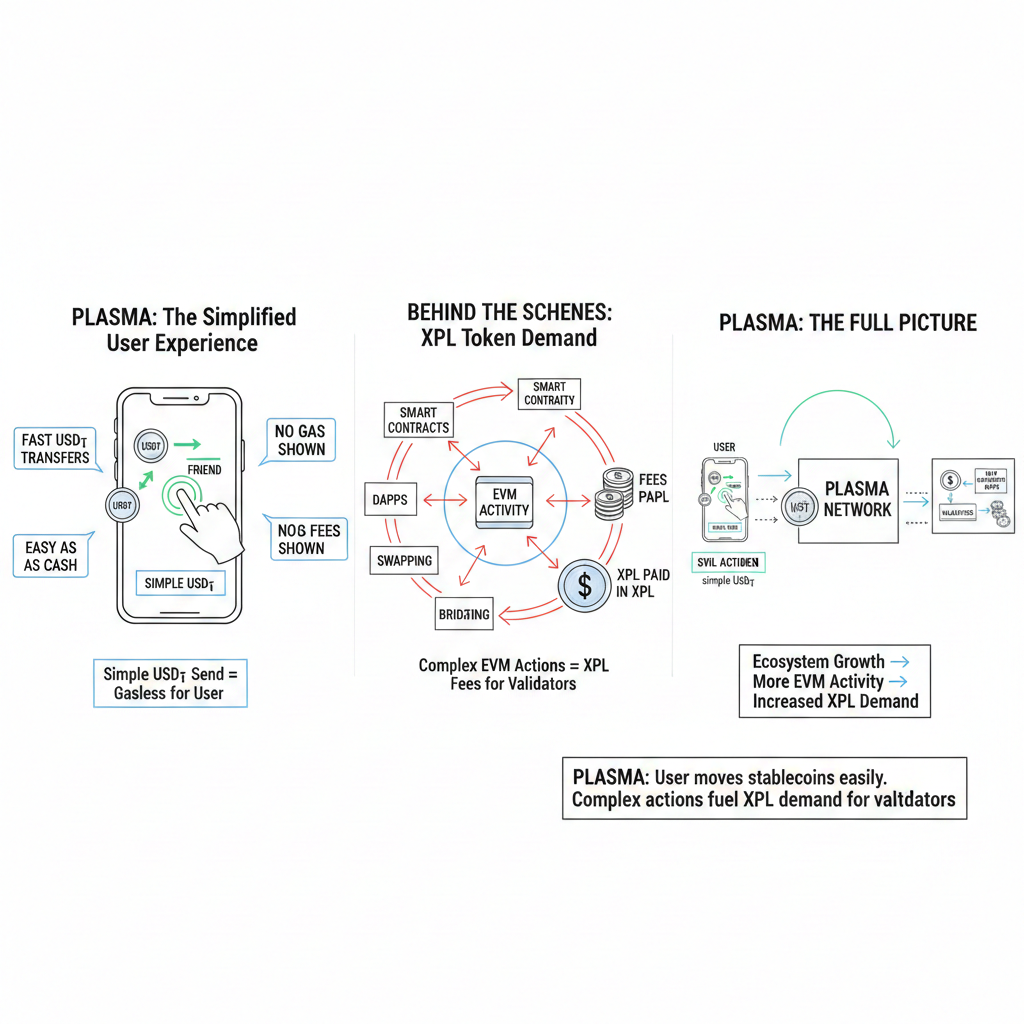
The most direct reason anyone needs XPL is that real EVM activity still has a meter running. As soon as you go beyond a basic USD₮ send—using a smart contract, interacting with a dapp, swapping, minting, bridging, anything with logic—fees exist and validators need to be paid for the work of ordering and finalizing transactions. Plasma’s own materials make it clear that the “gasless” promise is scoped to simple USD₮ transfers, while other transactions still incur fees that ultimately get paid to validators in XPL. That alone creates consistent demand as the ecosystem grows, because more useful stuff happening on-chain means more gas consumed.
Where Plasma gets clever is stablecoin-first gas. You can pay fees in a stablecoin like USD₮ through a paymaster, so users don’t have to keep a separate gas balance. But this doesn’t magically erase XPL from the system. Execution still needs a native settlement path behind the scenes. If a user pays a fee in USD₮, something has to convert and fund the actual gas payment at the protocol level, and that means someone—usually the protocol paymaster layer, apps, or integrators—has to keep XPL inventory available. So the demand doesn’t disappear; it becomes more “infrastructure-shaped.” Instead of millions of small retail wallets buying tiny amounts of XPL, you get fewer but heavier participants who need XPL continuously to keep transactions flowing smoothly.
The gasless USD₮ transfer feature works the same way economically. “Free” to the user doesn’t mean “free” to the chain. Those transfers still take blockspace, still get executed, and still have a gas bill—Plasma is just sponsoring it through a controlled paymaster setup (with verification and rate limits because sponsorship has to be managed). That sponsorship budget has to be funded. Practically, this makes gasless USD₮ a very strong adoption hook: it pulls in volume from payment use cases first, and once that volume exists, a lot of it naturally spills into higher-value activity that isn’t just a plain transfer. The moment people start using apps, merchants, payroll flows, onchain settlement logic, or anything composable, the “paid” transaction surface expands and you’re back to steady XPL fee demand.
Then there’s staking, which is a different kind of demand: not transactional, but structural. Plasma is PoS, so validators have to stake XPL to participate. That creates sticky holding because the token isn’t just a fee chip—it’s the chain’s security collateral. As the network settles more value, the incentive to secure it grows, which tends to pull more stake into the system over time. Even if retail users never touch XPL, validators and (eventually) delegators are natural buyers because staking is what lets them earn protocol rewards and take part in consensus.
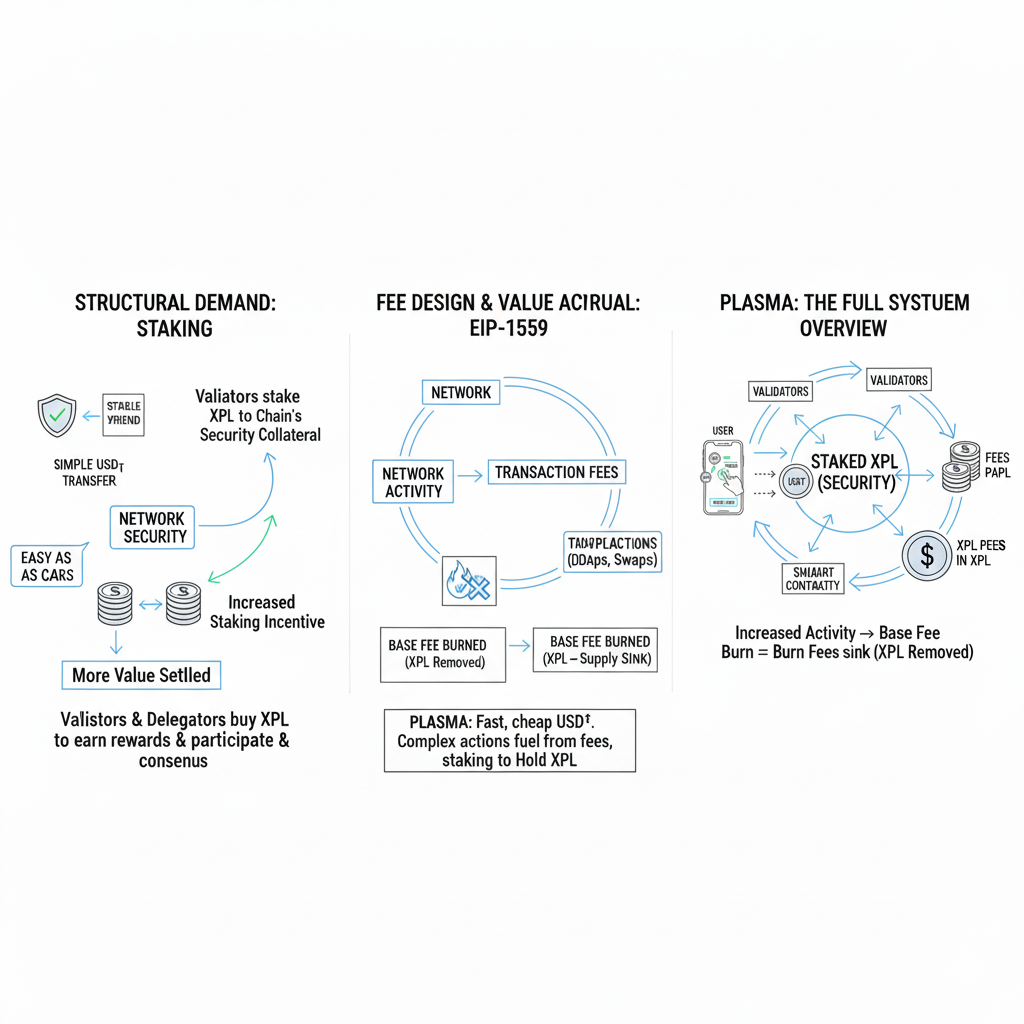
Finally, Plasma’s fee design matters because it turns usage into something that can feel like value accrual. With an EIP-1559-style model, the base fee is burned, so increased network activity can translate into a real supply sink. That doesn’t create demand on its own, but it amplifies it: when activity rises, not only is XPL being used to run the chain, some of it can be removed from circulation. In a payments-focused chain that aims for high throughput, that “usage → burn” link becomes an important part of why people may choose to hold XPL rather than treat it as a pass-through asset.
If you step back, Plasma’s demand engine is basically this: make stablecoin payments frictionless so volume can grow, route the real execution costs through a backend system that still settles in XPL, and anchor security to XPL staking while burning a portion of fees. Users might not need to buy XPL to send USD₮, but the network, the validators, and the gas-sponsoring layers still do—and the more Plasma gets used for real settlement, the more constant that need becomes.