
Most people don’t avoid Web3 because they “don’t get it.” They avoid it because, the moment you try to use it like a normal product, it starts behaving in ways normal products never would. Things cost one amount today and a completely different amount tomorrow. Transactions that should feel instant suddenly feel like waiting in a broken checkout line. And a lot of “ownership” ends up being a token that points to something living somewhere else, which means you’re still trusting a system you can’t fully verify.
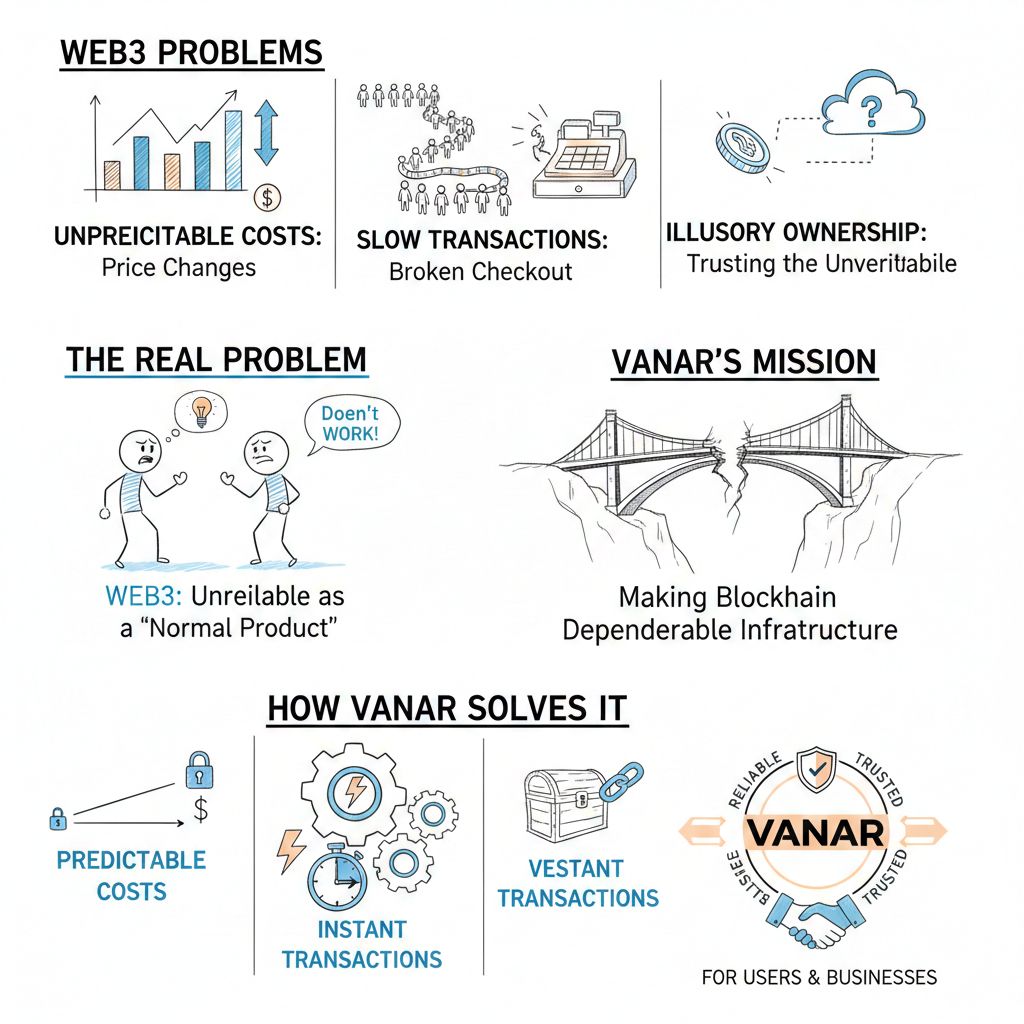
That’s the real problem Vanar is trying to solve: not convincing people to care about crypto, but making blockchain act like dependable infrastructure that real users and real businesses can actually rely on.
The first pain is the one that quietly kills adoption every time—unpredictable costs. In a consumer app, a game, or a brand campaign, you can’t build a smooth experience if the price of simple actions can spike without warning. It doesn’t matter if fees are “cheap” on a good day. If they’re unstable, the product feels unstable. Developers can’t forecast what it costs to run their app at scale. Finance teams can’t budget. Partnerships become harder because nobody wants to sign up for something that might become expensive or messy during peak usage. Vanar’s direction makes sense here because it’s centered around removing that “surprise cost” problem and pushing toward fees that behave in a more predictable, real-world way.
Then there’s the second pain that a lot of people don’t notice until it breaks: the gap between what’s onchain and what’s real. In many Web3 systems, the token is on the blockchain, but the meaningful content—metadata, files, proofs, records—often lives elsewhere. That’s fine until links change, metadata updates in ways users didn’t expect, or infrastructure gets moved. For gaming, collectibles, or any kind of digital ownership story, that fragility is a trust issue. For businesses, it’s worse: you can’t build serious workflows around assets or records if the most important part of them can drift offchain. Vanar’s “real-world adoption” angle matters if it actually closes that gap by treating data integrity like a core requirement, not an afterthought.
The third pain is about reputation and control. Brands and entertainment companies don’t get to experiment the way crypto-native teams do. If something goes wrong publicly—fees jump, transactions stall, onboarding confuses users—the headline isn’t “blockchain is early,” it’s “the brand messed up.” That’s why most mainstream partners either avoid Web3 or keep it tightly limited. Vanar’s focus on gaming, entertainment, and brand solutions is basically acknowledging that reality: if you want those sectors, the chain has to feel boring in the best way—predictable, stable, and safe to run consumer-facing experiences on without random failures.
And there’s a newer pain showing up as “AI” becomes part of everything: automation can’t be trusted if the system doesn’t hold clean, reliable context. A lot of chains are good at moving value and recording events, but they aren’t great at storing and serving structured information in a way that automated systems can use safely. If you want real automation—payments, compliance triggers, agent-like actions—you need data that’s not only present, but verifiable and usable. Vanar’s AI-native messaging matters if it translates into that kind of foundation: not AI as a buzzword, but AI as a reason the underlying system needs better structure and reliability.

So who’s actually suffering today? Regular users who just want things to work without weird steps and surprise costs. Developers trying to build consumer experiences where every extra click loses people. Studios and platforms in gaming who can’t afford unstable economics at scale. Brands that need predictable outcomes and don’t want reputational risk. Teams building anything connected to real-world records and compliance who need verifiable truth, not “trust me, the metadata is fine.”
That’s why a project like Vanar matters in this specific frame. If it succeeds, it’s not because it’s “another chain.” It’s because it makes the invisible problems—cost instability, fragile ownership, operational chaos, unusable data context—quiet enough that mainstream products can finally run without feeling like they’re balancing on top of a moving floor. That’s the gap between Web3 being interesting and Web3 being usable, and that’s the problem Vanar is trying to close.