
Vanar feels like a project that’s trying to solve a problem most blockchains quietly avoid talking about, which is what happens after you win the “tech demo” phase and you still have to convince normal people to use the product without feeling like they’re learning a new religion. The way Vanar frames itself is not as another generic Layer-1 racing for TPS bragging rights, but as a chain designed for real-world adoption with a very specific cultural DNA coming from gaming, entertainment, and brands, and that background matters because it usually changes what a team prioritizes when they build infrastructure.
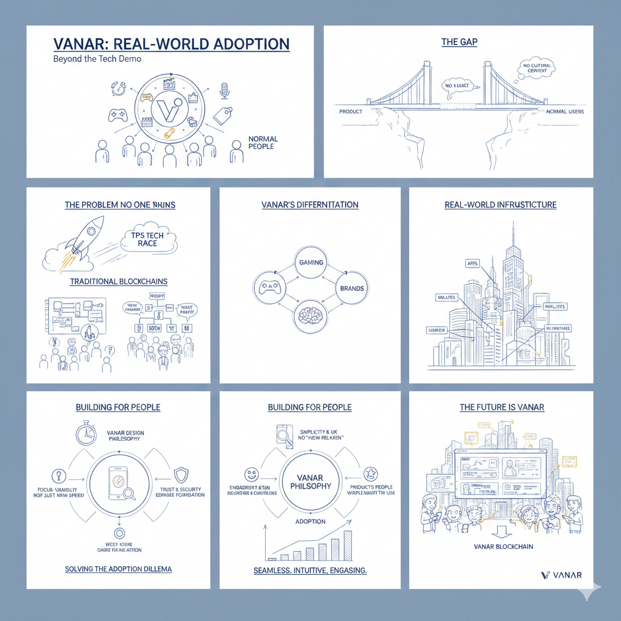
What stands out is how Vanar keeps pushing the idea that mainstream onboarding is not just about being fast and cheap, but about being predictable and usable, and that’s why their messaging leans into things like stable, fixed-fee thinking rather than only performance flexing. In their own technical materials, they describe a model where fees are meant to stay understandable for applications that need to price experiences cleanly, while also protecting the network from spam through tiering rather than letting the whole system get dragged around by fee chaos, and even if you don’t treat every line as final engineering reality, the design intent is clear and it’s aligned with how consumer apps actually behave at scale.
The bigger story, though, is that Vanar is trying to become more than a base chain by stacking product layers above it that are meant to make onchain systems readable, searchable, and ultimately actionable in a way that feels closer to how people use modern software. Their public architecture framing describes a layered approach where the chain is the foundation, and then higher components sit on top to make data behave like something you can actually work with, rather than just something you store or verify.
One of the most distinctive pieces in that direction is Neutron, which they position as a semantic memory layer, and the point they’re driving is simple even if the implementation is complex: data should not just be hashed and tossed somewhere, it should become compact, verifiable, queryable “memory” that can be reused, referenced, and explored. They even highlight dramatic compression claims in their own description, and the claim itself is less important than the ambition behind it, because what they’re really signaling is that they want data workflows that feel native to AI systems rather than bolted on as an afterthought.
Kayon is the next logical step in that same philosophy, because once you have structured memory, you need a way to interact with it that doesn’t require a developer to translate every question into a set of manual queries, and Kayon is presented as the layer that turns complex environments into something that can be asked about in natural language and acted on with context. The way they describe it leans strongly into enterprise-style use cases, where the value isn’t in “chatting with a bot,” but in turning scattered operational data into decisions, alerts, compliance checks, and automated actions that still remain verifiable and auditable.
Above that, they preview components like Axon and Flows as “coming soon,” and while those names are still more directional than fully defined publicly, the intention reads like a progression from infrastructure to automation to packaged applications, which is exactly the pattern you see when a project is aiming to be adopted by non-crypto users rather than just attracting liquidity for its own sake.
The token side of Vanar is straightforward in purpose, because VANRY is positioned as the unit that powers usage across the network, which matters because it connects the success of the ecosystem to actual onchain activity rather than only narrative. There is also an Ethereum ERC-20 representation of VANRY visible on Etherscan under the contract you shared, and that matters for accessibility, integrations, and interoperability because it lets the token exist where the most tooling and liquidity already lives, even while the project continues to build its own base environment.
In terms of progress and momentum, Vanar’s public-facing push right now appears to be a mix of product narrative and visibility, because they have been tying their presence to major industry events in early February 2026 and that’s usually a sign that a team wants to sharpen its story in front of partners, builders, and market attention at the same time. Community posts and ecosystem chatter also point to governance-related upgrades being discussed as part of the next phase, and while community summaries should always be treated as “watchlist signals” until they appear in official governance channels, it does suggest the project is thinking beyond simply shipping features and is also thinking about how control and incentives evolve as the ecosystem grows.
If you read Vanar as a single thesis, it’s basically this: build a chain that can support consumer-grade experiences, make costs predictable enough for real products to price correctly, then add layers that make the chain’s data and actions compatible with the way AI systems and enterprises actually operate, and use those layers to deliver outcomes that feel normal to end users. That’s a credible direction in a market where many L1s feel like infrastructure looking for a reason to exist, because Vanar is at least attempting to define the “reason” as the product itself, not the chain as a trophy.

The real test, and the part worth watching closely, is whether the most ambitious claims become developer-visible reality, because the difference between a strong narrative and a strong platform is always the same thing: documentation that builders can follow, benchmarks that outsiders can reproduce, integrations that real partners will publicly confirm, and applications that users will return to even when token markets are boring. If Vanar keeps turning its stack from a diagram into usable tooling, and if it keeps proving that its consumer-first approach creates actual recurring network usage, then it won’t need to shout about adoption because adoption will show up in the most honest metric crypto has ever had, which is people using the thing when no one is paying them to care.
