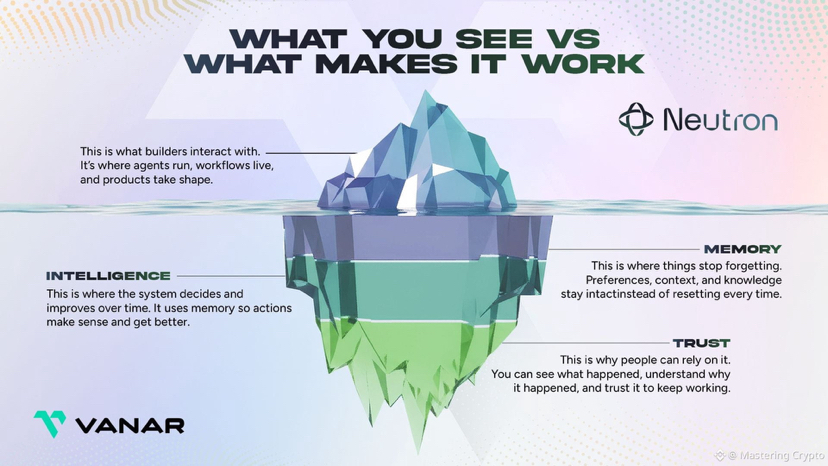
$VANRY Vanar Chain stands as one of the most audacious experiments in blockchain evolution as of 2026: a genuinely AI-native Layer 1 engineered from inception to embed intelligence directly into the protocol rather than bolting it on as an afterthought. Born from the rebranding and architectural pivot of the former Virtua ecosystem (once centered on metaverse and entertainment verticals with its TVK token swapped 1:1 to VANRY), Vanar has aggressively repositioned itself as the foundational infrastructure for PayFi, tokenized real-world assets (RWAs), autonomous AI agents, and applications that must reason, remember, and adapt without constant off-chain crutches. At its core lies a modular, EVM-compatible base layer boasting rapid block times (around 3 seconds), predictably low fixed fees (often hovering near $0.0005 per transaction regardless of network congestion or token volatility), thousands of TPS throughput, and a hybrid consensus blending Proof of Authority (PoA) for initial speed and security, Proof of Reputation (PoR) to reward verifiable trust, and emerging Delegated Proof of Stake (DPoS) mechanics that empower $VANRY holders to influence validator selection and governance. This foundation supports a sophisticated five-layer stack designed explicitly for AI workloads: the scalable Vanar L1 itself, Neutron—a semantic memory layer that compresses massive datasets, media, or contextual histories into lightweight, verifiable “Seeds” stored immutably on-chain (enabling persistent agent memory without exorbitant costs), and Kayon—a decentralized reasoning and inference engine that allows smart contracts to process natural-language queries, validate outputs, and execute complex decisions natively. Upcoming components like Axon and Flows promise even deeper orchestration of AI-driven automation and composable logic. What truly sets Vanar apart in an era of retrofitted “AI-blockchains” is its refusal to reduce on-chain activity to mere settlement; instead, it pursues “usable intelligence” where dApps learn from every interaction, maintain contextual continuity across sessions, automate compliance for RWAs, streamline global PayFi rails with embedded reasoning, and power truly autonomous agents that operate without centralized servers or fragmented middleware. By integrating these capabilities at the protocol level—while remaining carbon-neutral through partnerships like Google’s renewable-powered infrastructure—Vanar Chain positions itself not as yet another high-speed ledger, but as the cognitive backbone for the next phase of Web3: one where decentralized applications evolve from static code executors into living, adaptive entities capable of bridging virtual economies with tangible real-world utility. With a capped supply, community-driven upgrades (including recent governance proposals granting $VANRY holders influence over AI model parameters and incentives), live integrations such as Neutron with cross-network agent coordination, and a growing emphasis on mainstream onboarding for gaming, entertainment, and beyond, Vanar quietly but determinedly challenges the narrative that true on-chain intelligence remains an impossible dream. Vanry