
To understand why #Fogo is so much faster than other Layer 1s, you have to look under the hood at the Firedancer client. While most blockchains are built using languages like Rust or Go, Firedancer is a total rewrite of the $SOL
protocol in C. This might sound like a small detail, but in the world of high-performance computing, it makes all the difference.
⚙️ The Engineering Behind the Speed
Standard validator clients often suffer from "overhead"—extra computer cycles spent on memory management or safety checks that aren't optimized for raw speed.
Firedancer, which #Fogo uses as its canonical client, is designed like a high-frequency trading engine. It uses:
Software-Defined Networking
SIMD (Single Instruction, Multiple Data) processing
to handle massive amounts of data in parallel.
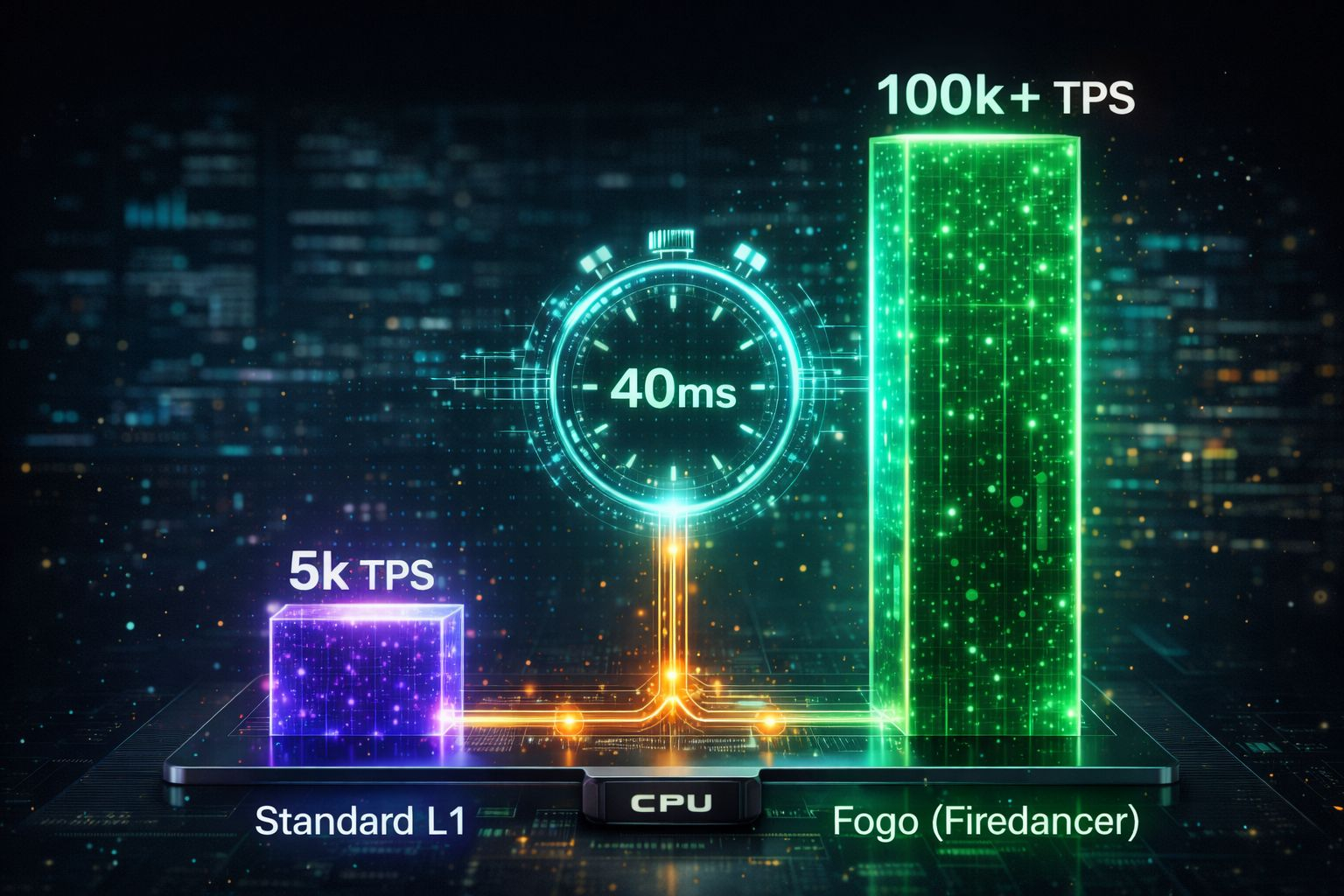
Blockchain transaction speed comparison chart
🔥 Why @fogo Standardized on Firedancer:
✅ Throughput
While traditional networks struggle at 5,000 TPS, a Firedancer-powered network like $FOGO can theoretically scale to over 100,000 operations per second.
✅ Deterministic Execution
This ensures that transactions are processed in a predictable, stable way, which is vital for institutional finance.
✅ Networking Efficiency
By using a custom networking stack, Firedancer reduces the "noise" in the network, allowing validators to stay in sync even under heavy load.

The team at @Fogo Official isn't just "forking" code; they are implementing the most advanced blockchain client ever created. By standardizing the entire network on the fastest available software, they ensure that $FOGO isn't held back by "slow" nodes.
This is "hardcore" engineering for a high-velocity future.
If you are looking for the "Formula 1" of blockchains, you have found it with #fogo. 🏎️💨

