

I drained my Arbitrum wallet last Tuesday. Not from a bad trade. From gas fees eating my AI agent alive during a routine indexing job that spiked at the worst possible moment. Watching an automation script burn through funds because the network decided to get expensive mid-execution was the final straw. That night I migrated everything to Vanar's testnet expecting disappointment. Instead I got the quietest, most boring blockchain experience of my career. And I mean that as the highest compliment.
Here is what nobody in crypto wants to admit. AI on-chain is not about training models. It never was. The real use case is data verification, micro-payments, and autonomous agents executing thousands of small transactions without human babysitting. For that workflow, you need one thing above everything else. Predictable costs. Not low costs. Predictable ones. My scripts hit Vanar's mainnet at 50 requests per second for three straight days. Gas barely moved. The curve was so flat I genuinely checked if my monitoring dashboard was frozen. It was not.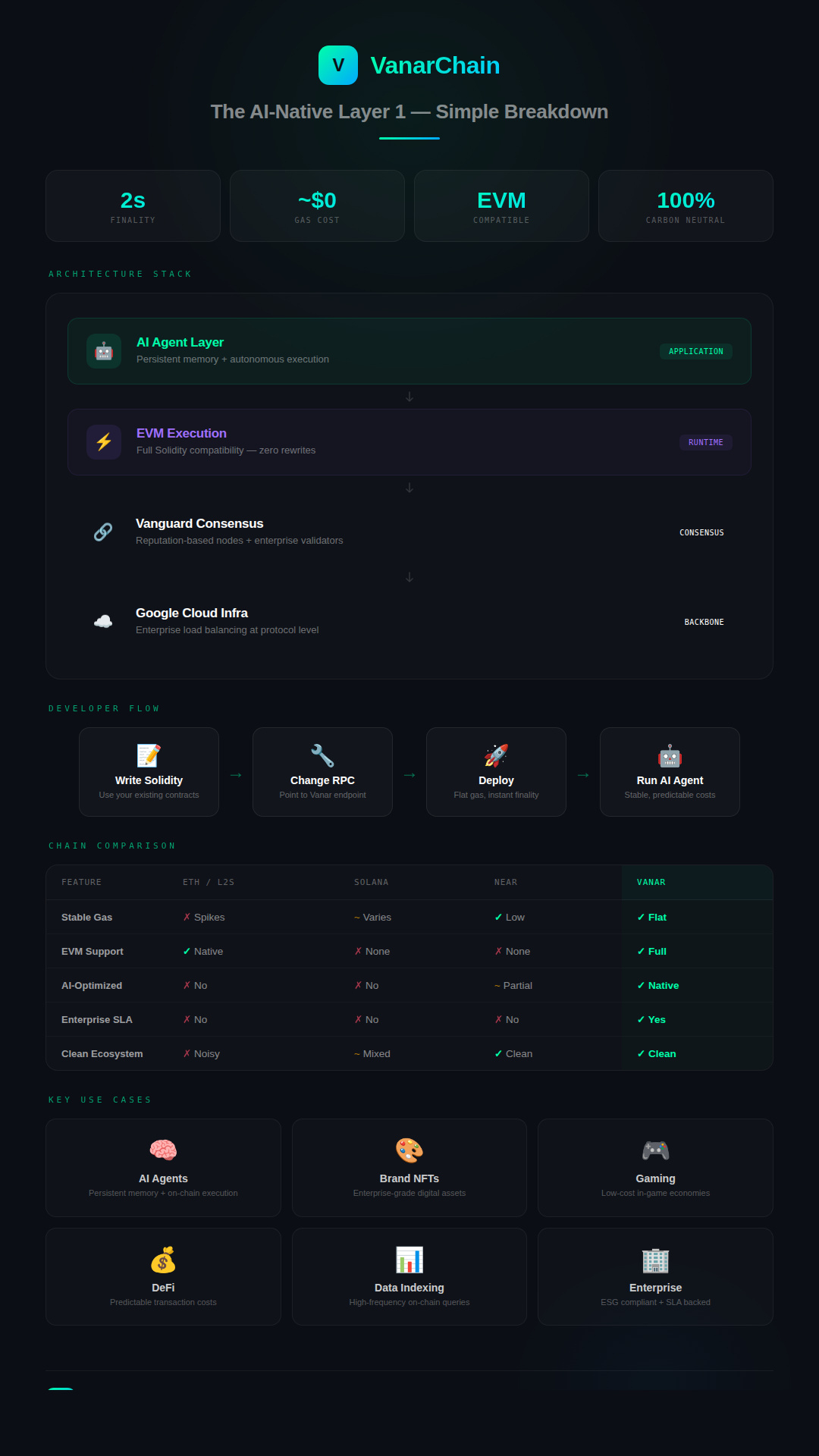
Digging into why revealed something interesting. The Google Cloud partnership is not decorative. Vanar appears to have integrated actual enterprise load balancing into its consensus infrastructure. Decentralization purists will hate this. Developers who need to ship products that work will not care. When your AI agent requires uninterrupted logical execution across thousands of sequential transactions, theoretical decentralization means nothing if slot lag forces a complete rollback. I learned this the hard way on Solana where packet loss during congestion killed entire automation pipelines.
The migration experience itself was almost suspiciously easy. Full EVM compatibility means I copied my Solidity contracts over, changed the RPC endpoint, and deployed. No new language. No architectural rewrites. No three-week documentation deep dive like Near demands with its Rust requirement. For competing over existing Ethereum developers this is a brutal advantage that gets underestimated because it sounds boring.
I will be honest about the problems too. Creator Pad lacks basic features like resumable uploads. I failed three times pushing a large 3D file before it went through. For a chain positioning itself as enterprise-grade, missing something that fundamental is embarrassing. The ecosystem is also genuinely empty right now. I scrolled their block explorer looking for organic community projects and found almost nothing beyond official templates. Beautiful highway, perfect asphalt, almost zero traffic.
But that emptiness cuts both ways. Compare it to Polygon where the explorer is a landfill of rug pulls and arbitrage bot contracts. If you are Nike or Ubisoft trying to launch compliant digital assets, building on Polygon feels like opening a luxury boutique inside a flea market. Vanar's clean environment with real enterprise names on its Vanguard node list offers something those brands actually need. Certainty, SLA guarantees, and an ecosystem where their brand will not sit next to a dog coin scam.
The energy efficiency numbers also deserve attention. After running stress tests for a week the consumption figures were low enough to make me recheck the methodology. For publicly listed companies where ESG compliance is a hard gate for blockchain adoption this is not idealism. It is a procurement requirement.
My honest assessment after seven days. Vanar is not elegant. It lacks the mathematical beauty of zero-knowledge systems and the modularity of newer experimental chains. It is a pragmatic engineering product that stitches Google-grade infrastructure onto EVM compatibility and calls it a day. But pragmatism that actually works might be the scarcest resource in crypto right now. The ecosystem needs time and real applications to prove itself. The cold start could take longer than most investors have patience for. But the foundation underneath is solid and sometimes that matters more than everything built on top of it.
