

Speed gets attention.
It always has.
Higher TPS. Faster blocks. Cleaner latency charts. The numbers flash across timelines and the conclusion feels obvious: progress equals acceleration. If a chain can move faster than the last one, it must be better.
I used to accept that framing without questioning it. In engineering, performance metrics are comforting. They’re measurable. They’re comparable. You can optimize them and prove you’ve done so. It feels like tangible advancement.
But over time, working around distributed systems, I learned something less comfortable.
Speed is visible. Control is invisible.
And invisible properties are usually the ones that decide whether a system survives.
In controlled environments, pushing performance isn’t mysterious. You reduce validation steps. You simplify execution paths. You assume more capable hardware. You streamline communication between nodes. Under clean conditions, throughput climbs and latency drops. The metrics look sharp.
Production environments don’t stay clean.
Users don’t arrive evenly. Traffic spikes at inconvenient moments. Integrations are written with different assumptions. Edge cases appear in combinations nobody modeled during launch. A service that was “statistically unlikely” to fail does exactly that during peak activity.
In those moments, speed stops being the headline.
What matters is whether the system remains coherent.
That’s where I find Vanar’s architectural direction interesting. The emphasis doesn’t appear to be centered on winning benchmark comparisons. It seems oriented toward something less glamorous but far more consequential: predictable control over execution.
Interactive applications, digital asset coordination, stable value transfers, AI-supported processes — these environments aren’t defined by transaction volume alone. They’re defined by dependency chains. One action triggers another. State updates rely on prior updates. Timing matters. Determinism matters.
In those contexts, uncontrolled flexibility becomes risk.
When a system tries to optimize for every possible workload at once, complexity expands. Each new feature introduces new execution paths. Abstractions layer on top of abstractions. Tooling adapts. Compatibility fixes accumulate. Nothing breaks outright, but the coordination surface grows.
And larger surfaces are harder to defend.
I’ve seen this pattern repeatedly in long-lived systems. Early design decisions, especially those made to maximize visible performance, become embedded everywhere — SDKs, documentation, validator configurations, developer assumptions. Years later, when workloads evolve, those decisions are still sitting in the foundation.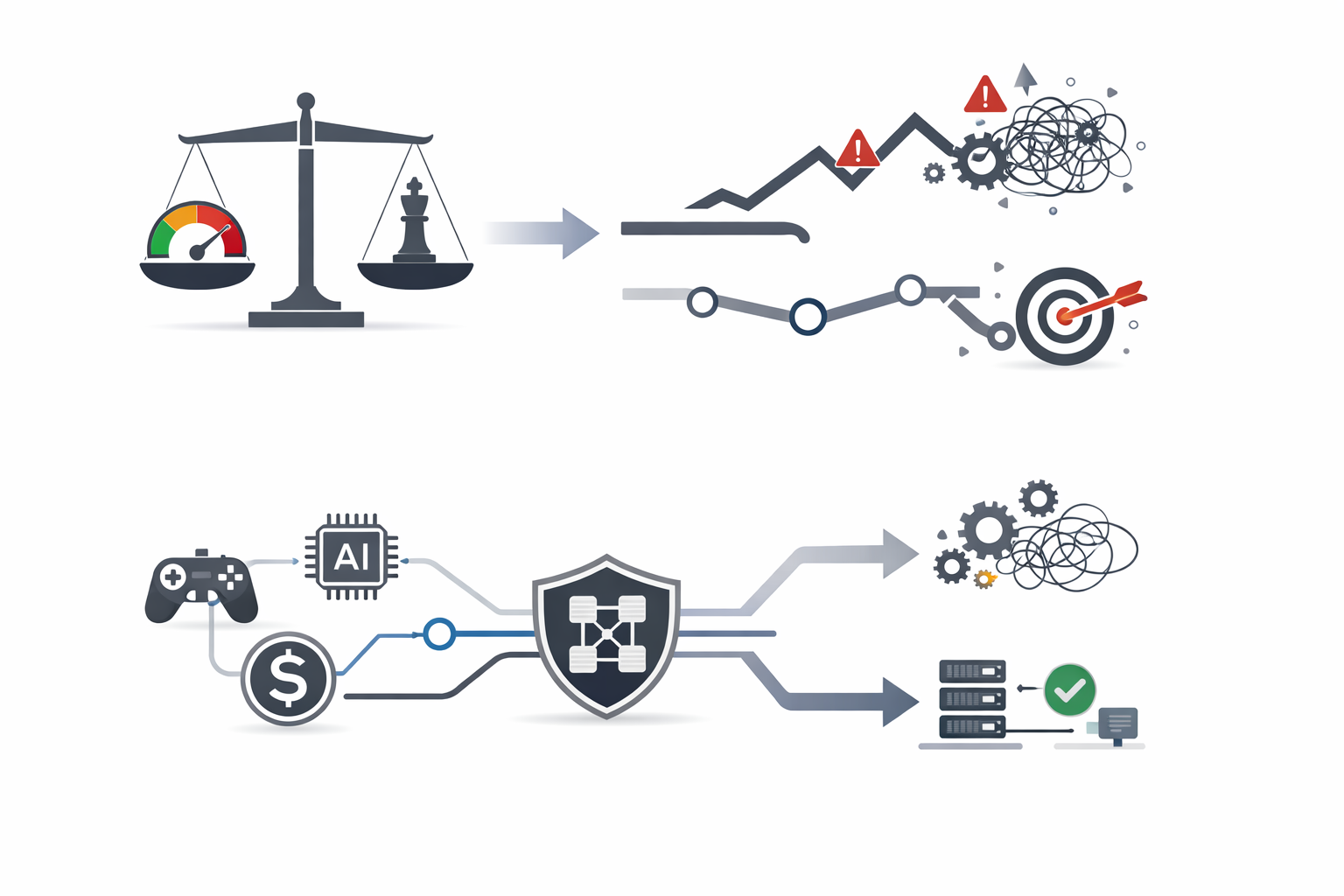
Changing them isn’t a patch. It’s a migration.
There are generally two ways infrastructure evolves.
One path begins broad. Be flexible. Support everything. Adapt as narratives shift. Over time, layers accumulate and internal complexity becomes reactive.
The other path narrows its operating assumptions early. Define the environments that matter most. Engineer deeply within those constraints. Accept tradeoffs in exchange for internal coherence.
Vanar appears closer to the second path.
By leaning into interactive digital systems and AI-integrated workflows, it narrows the problem space intentionally. That narrowing doesn’t mean less ambition. It means less ambiguity.
And ambiguity is where fragility hides.
When speed becomes the primary narrative, systems are pressured to demonstrate acceleration. When control becomes the priority, systems are pressured to demonstrate consistency. These are different incentives. One rewards visible spikes. The other rewards quiet reliability.
Control is harder to market.
You don’t screenshot “predictable coordination.” You don’t post charts showing “absence of structural drift.” Stability reveals itself slowly — in the lack of drama, in the absence of cascading issues, in developers shipping features instead of debugging edge cases.
In distributed systems, failure rarely looks cinematic. It looks like drift. Slight inconsistencies in state reconciliation. Rare synchronization mismatches. Edge cases that become less rare as load increases. Each issue manageable. Together, exhausting.
Eventually, teams spend more energy defending the system than expanding it.
That’s when ecosystems stall.
If infrastructure is meant to support gaming economies, AI-assisted processes, financial transfers, and digital assets simultaneously, then control becomes a scaling strategy. Not because it limits growth, but because it reduces coordination cost as growth compounds.
Speed creates momentum.
Control preserves it.
The long game in infrastructure isn’t about winning the first benchmark cycle. It’s about ensuring that early architectural assumptions don’t become structural liabilities later. It’s about designing constraints deliberately rather than inheriting them accidentally.
Markets often reward loud progress.
Engineering rewards systems that remain intact when conditions stop being ideal.
If Vanar and the broader VANRY ecosystem continue prioritizing execution discipline over performance theater, the differentiator won’t be a single metric. It will be whether complexity accumulates without destabilizing the foundation.
Because in the end, speed attracts attention.
Control keeps systems standing.
And the systems that remain standing are the ones that actually shape the next cycle.