
😰 Part I: The Anatomy of 3 AM
There's a specific kind of silence that exists only at 3 AM.
Not peaceful. Not quiet. Loud. Every breath, every heartbeat amplified by the void around you. The blue glow of a monitor carving shadows across your face. In my case — a Bitcoin chart that looked less like a price movement and more like an EKG flatline. 📉
I remember the smell. Stale coffee. Three-day-old takeout. The particular musk of a man who has forgotten there's a world outside this screen.
Then the sound. One sound. Small, polite, devastating.
Ding. 🔔
Not a message from a friend. Not news of something good. Just a Telegram notification, two words wide, cold as concrete:
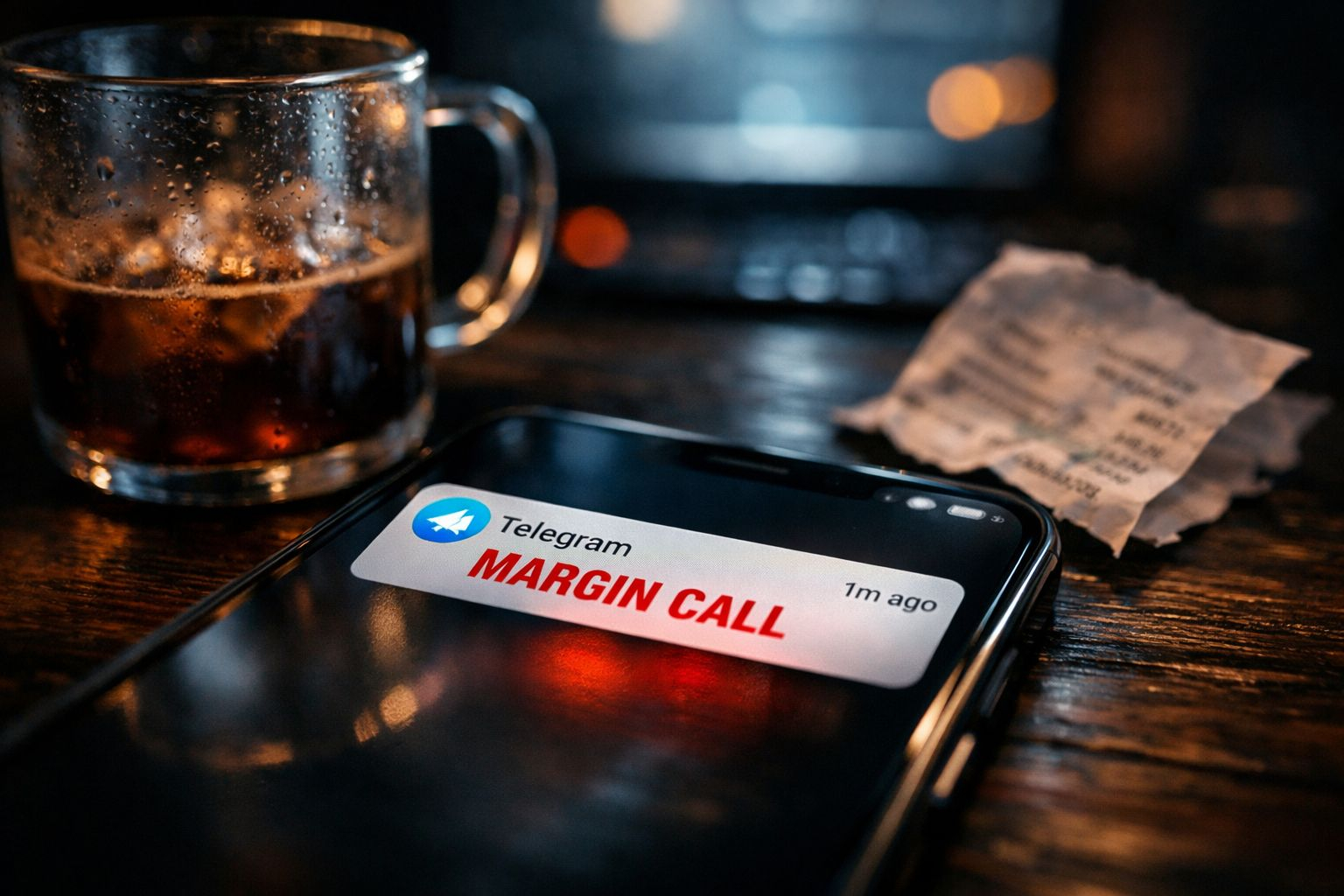
🚨 MARGIN CALL.
Six months. That's how long it took to accumulate the $2,000 sitting in my account. Six months of skipped dinners, of "not this time" to every invitation, of watching my savings grow one painful dollar at a time. Six months — and a single red candle erased it in eleven minutes.
I sat there in the dark and felt something shift in my chest. Not anger. Not despair. Something quieter than both. The slow, nauseating recognition of a man who has just understood the rules of the game he's been playing — and realized they were never in his favor.
🎰 People say markets are casinos. They're wrong. A casino is honest about its odds. The casino will tell you: the house has a 5.26% edge on the roulette wheel. The casino won't call you at 3 AM pretending to be your friend.
Markets don't tell you anything. Markets just take.
🧠 Part II: The Physics of Losing
I didn't sleep that night. I sat with the empty screen and I thought.
Not about revenge. Not about "getting it back." I was past that. I was thinking about architecture. About why, mathematically, structurally, psychologically — this game was designed to break people like me.
Here's what retail trading actually looks like when you strip away the charts and the jargon and the YouTube gurus with their Lamborghinis 🏎️:
You bring your own money to the table. Every dollar at risk is a dollar that could have paid your rent, bought your groceries, kept the lights on. Your brain knows this. Your nervous system feels this. Every tick against you isn't just a number — it's a threat to your survival. Your cortisol spikes 📈. Your hands shake. You close the winning trades too early because you're terrified of giving the profit back. You hold the losing trades too long because your ego refuses to admit you were wrong.
❗ The market doesn't beat you. Fear beats you. And fear is proportional to what you stand to lose.
This is what Nassim Taleb calls fragility. When chaos damages you — when volatility is your enemy — you are fragile. And fragile things, in this game, get destroyed.
I needed to become something else. I needed to find an asymmetry.
⚖️ Part III: The Equation That Changed Everything
Imagine two scenarios. 👇
😱 Scenario A — The Old Way:
You have $1,000. You trade it. If you're right, maybe you make $200. If you're wrong, you lose $1,000. That's your rent. That's your food. That's six months of pain, evaporated.
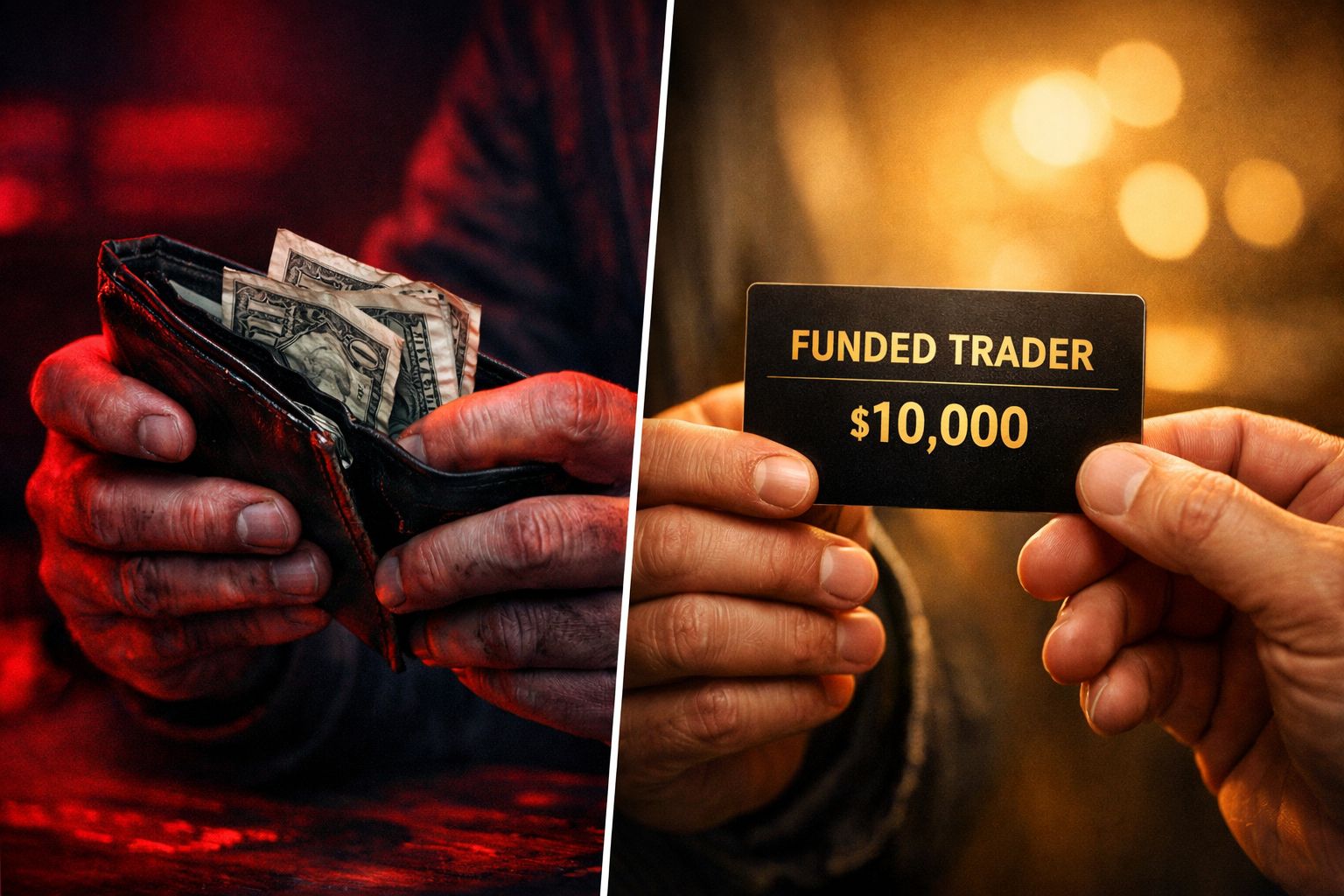
🚀 Scenario B — The New Way:
You pay $119. That's the price of a nice dinner with drinks. 🍽️ If you fail — the dinner gets cold and you order something cheaper next time. If you succeed — you get handed the keys to a $10,000 account. And you trade that money. Not yours.
The first scenario is retail trading. The second scenario is what I found at 4 AM, scrolling through my feed with red eyes, when I stumbled across a single word:
✨ Upscale.
I leaned closer to the screen.
🤖 Part IV: The Machine in the Messenger
I want you to understand how alien this felt.
Every broker I had ever used asked for the same things: passport photo 🪪, utility bill, address verification, tax ID, waiting period, minimum deposit, maximum bureaucracy. The Old World of finance, dressed up in a modern interface.
Upscale lived somewhere else entirely.
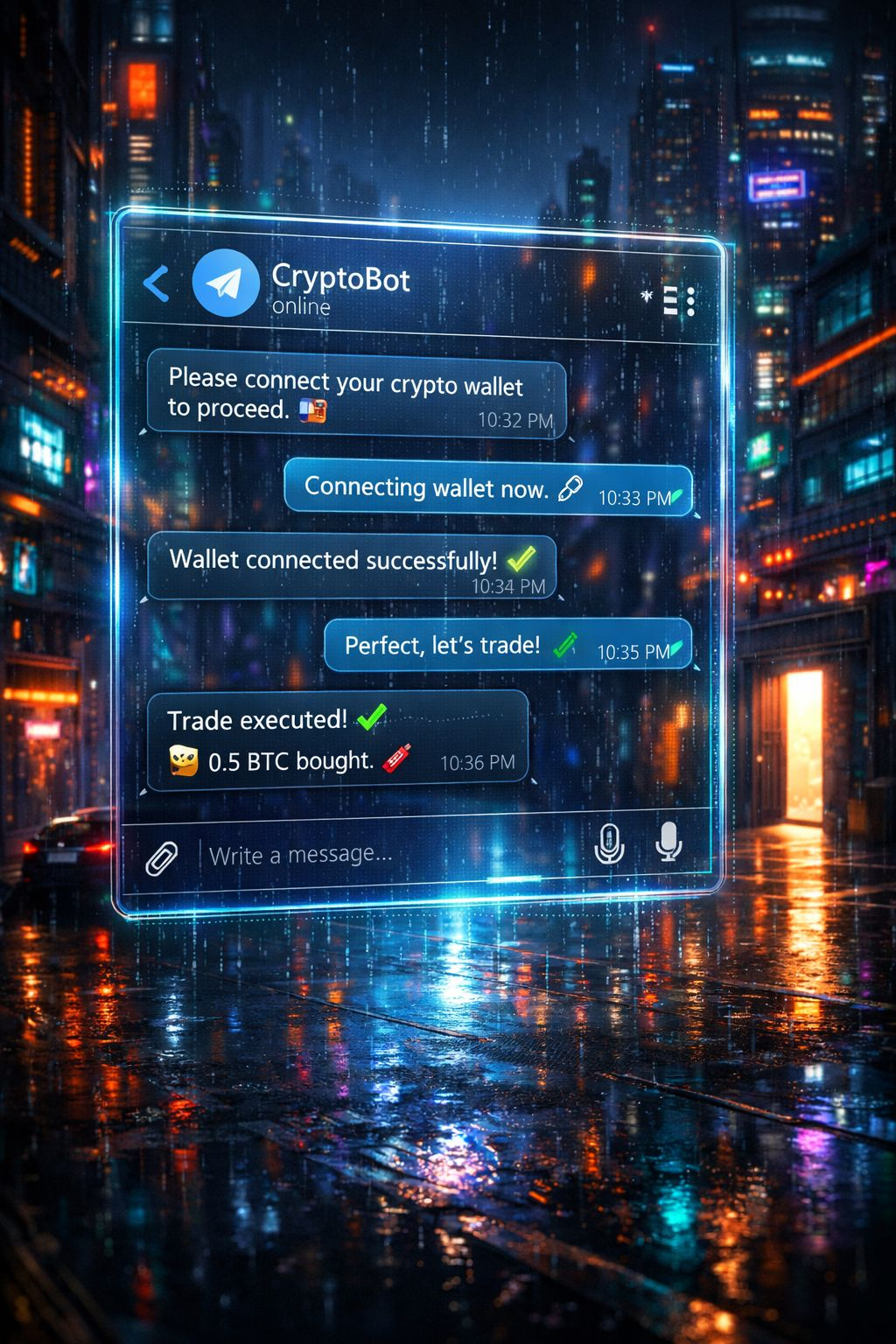
It existed inside Telegram 💬. You opened a bot. You connected a wallet. You paid in crypto — or even in Telegram Stars ⭐, the platform's own currency, like buying an upgrade in a video game. No KYC. No forms. No interrogation. No waiting room.
It felt like stepping out of a government building and into a neon-lit alley where someone hands you exactly what you need without asking for your blood type. 🌃
The proposition was this: complete a Challenge — a two-phase performance test — and they'd hand you real capital to manage:
💰 $5,000 → $10,000 → $50,000 → $100,000
You trade it, you keep 80% of every dollar you earn. If you lose, you lose access. You don't owe anyone anything.
This was the Asymmetry I was looking for. ⚡
🔒 Part V: Inside the Straitjacket
I chose the Basic Challenge on a $10,000 account. Cost: $119.
The rules were written like commandments 📜:
🥇 Phase 1
+5% profit
Daily -5% / Total -10%
🥈 Phase 2
+8% profit
Daily -5% / Total -10%
Simple. Clean. Merciless.
The platform felt like it was built for a different era — the right era. Decentralized price feeds, no manipulated wicks designed to hunt your stops at the worst possible moment 🎯. The assets were real: crypto futures, forex, commodities. The interface was spare and functional, like a cockpit stripped of anything unnecessary. ✈️
But the real innovation wasn't technical. It was psychological.
Because here's what happens when you trade with your own money: you lie to yourself.
"I'll hold a little longer."
"The market will come back."
"This is just a temporary dip."
You don't cut losses. You marry them. 💍
The drawdown limits made lying impossible.
On my third day, ETH reversed hard 🔴. My daily loss hit -3%. Two more percent and I was disqualified. My $119 was one bad hour away from disappearing.
I stared at the screen. I felt the old panic rising — but it stopped somewhere around my collarbone. Because this time, it wasn't my rent on the line. It was $119. The price of a jacket I never bought.
I closed the terminal. Put on shoes. Walked around the block. Came back forty minutes later, cold and calm, and opened smaller positions with tighter stops. 🧊
This is what discipline feels like when it isn't theoretical.
✅ Phase 1: +5.2% in four days.
✅ Phase 2: +8.1% in six days.
🏆 Part VI: The Weight of Someone Else's Capital
The notification came through like any other message.
💬 "Congratulations. You are now a Funded Trader."
I read it three times. I looked at the $10,000 in the account. And I felt something I didn't expect: lightness. Not excitement — lightness. The specific relief of a man who has set down a bag he didn't realize he'd been carrying for years. 🎒
This wasn't my money. If it burned, I'd walk away. I'd pay another $119 and try again. My savings — sitting safely in staking protocols, earning quiet, passive interest 💤 — would be untouched.
I wasn't fragile anymore.
My first month: +6%. 📈
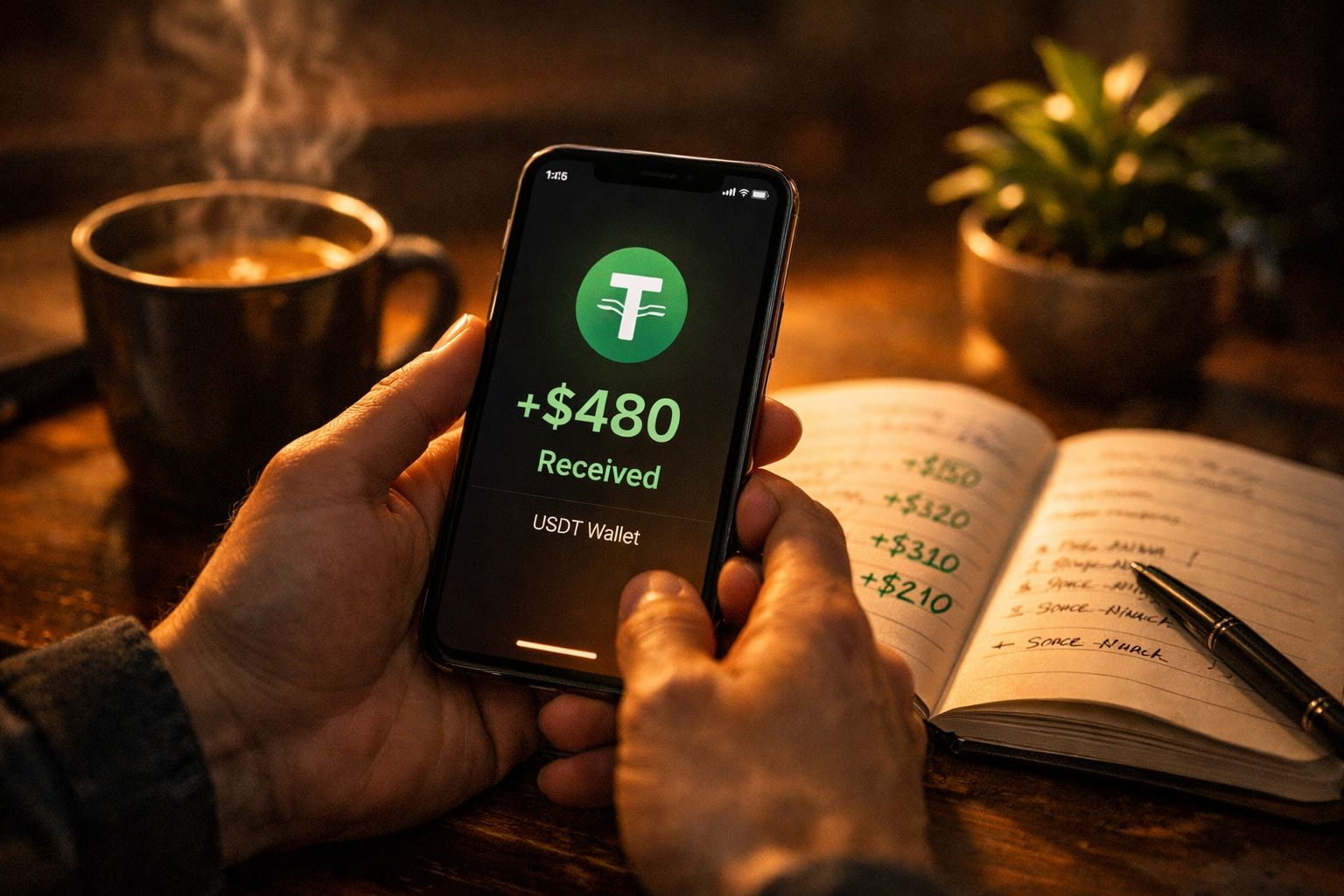
$10,000 × 6% = $600 profit
My 80% cut = $480 USDT → my wallet
Time taken = 30 days
Fear level = zero
I held the phone in both hands, looking at the transaction hash, doing the math slowly:
💸 I had spent $119
💰 I had made $480
📊 My initial investment had returned 4x in thirty days
And I had never once been afraid.
🦾 Part VII: The Philosophy of Antifragility
I know what the skeptics are saying. I've said it myself. 🤔
"But don't most people fail these challenges?"
Yes. Of course. 95% of retail traders lose money on their own accounts too — except when they fail, they lose their savings. They lose months of work. Sometimes they lose marriages, apartments, years of their lives. 😔
When someone fails a $69 challenge, they lose the price of a video game. 🎮
💡 The cost of failure is the most important variable in any equation involving learning. Lower it enough, and failure becomes information. It becomes tuition for a lesson worth learning. It stops being a catastrophe and starts being a data point.
This is what Taleb means when he talks about optionality — the ability to be exposed to upside while capping your downside. You buy the right to succeed without the obligation to suffer catastrophically if you don't.
Upscale is structured optionality. It is a bet where the worst case is a dinner you skip, and the best case is a career. 🎯
I don't trade scared anymore. I don't lie awake calculating whether a position will cover next month's rent. I drink my coffee while it's still hot ☕ and look at charts the way a surgeon looks at a patient: with interest, with skill, with detachment.
The market is chaos. But chaos only destroys what is fragile. 🌊
Build yourself so that chaos feeds you instead.

💭 Postscript: What I Would Tell the 3 AM Version of Myself
If I could walk back into that room — the stale coffee, the screaming monitor, the Telegram notification that cracked something in me — I would tell him three things:
💀 First: The problem isn't your analysis. It's the architecture. You are trading your blood. Stop.
📚 Second: Pay the $119. Lose it if you must. Lose it twice. Treat every failed challenge as the cheapest possible education the market has ever offered you.
🏗️ Third: Discipline is not a personality trait. It is a structure. Find a structure that forces you to be disciplined, and the discipline will follow.
The fishing rod is there 🎣. The boat is there. The ocean hasn't changed — it's still full of sharks 🦈, it's still unpredictable, it will still try to drown you if you swim into it alone.
But you don't have to swim anymore.
→ Try the challenge yourself: upscale.trade?ref=MK1BT ⚡
The market will always be there.
The question is who you are when you meet it. 🪞
🔑 Ready to try? Use referral code MK1BT when you sign up.
And reach out to me after — no bots, no templates. Just one trader talking to another. I'll help you get through the challenge.
The offer stands for as long as I'm in this game. ⚡