

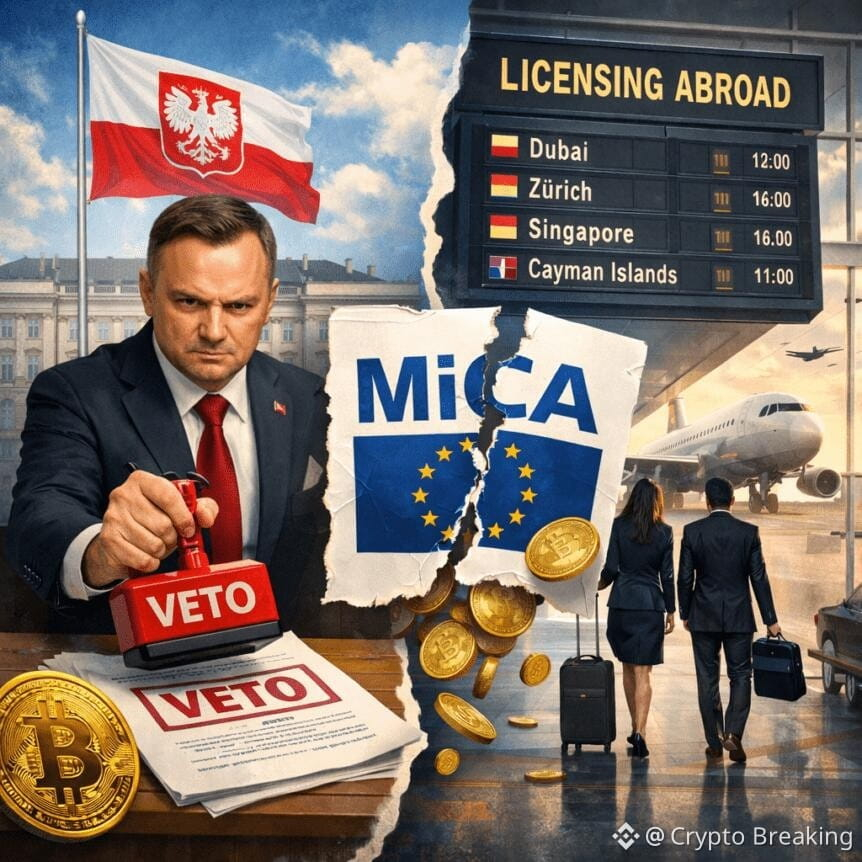
Poland’s president Karol Nawrocki vetoed Bill 2064, the second attempt to domestically align the country’s crypto rules with the European Union’s Markets in Crypto-Assets Regulation framework, intensifying uncertainty as the MiCA transition deadline approaches. Nawrocki’s Thursday action follows an earlier veto of a closely related measure in December, with the president describing both bills as “practically identical” to prior attempts. The decision underscores a broader political split over how aggressively Poland should regulate digital assets, even as industry groups warn that the absence of a timely, domestically implemented MiCA framework could leave local actors and foreign operators at odds with the EU regime. The government, for its part, pointed to MiCA’s overarching framework and the need to prepare a coherent national path, but the veto leaves a regulatory gap lingering into the summer window.
Key takeaways
Poland’s president vetoed Bill 2064, marking the second MiCA-alignment attempt blocked by the executive and injecting renewed uncertainty ahead of the EU-wide transition.
The Polish Financial Supervision Authority (KNF) warned that Poland has not designated a competent authority to supervise the crypto market, highlighting a gap as the July 1, 2026 MiCA deadline nears.
Foreign MiCA-licensees will be able to operate in Poland, while Polish firms face an uncertain licensing path domestically, creating regulatory asymmetry that critics say favors non‑Polish entities.
Industry voices; Kanga Exchange and Zonda Crypto officials stress that they have prepared alternative jurisdictional strategies to continue operations, signaling a counter-play to uncertain domestic rules.
Polish economist Krzysztof Piech is reportedly drafting a crypto-friendly MiCA implementation bill, signaling ongoing legislative experimentation as the debate unfolds.
Tickers mentioned: $COIN
Sentiment: Neutral
Market context: The MiCA transition is unfolding across the EU, with a hard deadline of July 1, 2026. In Poland, the lack of a domestically enacted MiCA law has produced an uneven regulatory landscape relative to foreign players licensed under MiCA, potentially shaping market access and competitive dynamics as exchanges and fintechs plan their compliance pathways.
Why it matters
The veto spotlights a central tension in Poland’s crypto policy: how to reconcile domestic rules with a broad EU framework that aims to standardize oversight across member states. The KNF’s warning—that Poland has not designated a competent supervisory authority—adds urgency to this debate, because MiCA enforcement hinges on clear national governance. Without a designated authority, Polish platforms could confront delays or regulatory uncertainty that complicate onboarding processes for new products, licensing, and cross-border operations. The absence of a robust national regime also risks creating a regulatory mismatch with foreign firms that secure MiCA licenses outside Poland, then passport services back into the country.
Industry players have signaled they anticipated the possibility of delays and adapted accordingly. Sławek Zawadzki, co-CEO of Kanga Exchange, emphasized that the group had prepared alternative jurisdictional solutions from the outset, should Polish law fall behind the EU timetable. He stressed that this approach was preemptive rather than reactive, as regulatory clarity remained the ultimate objective. The sentiment inside the industry reflects a broader push to attract innovation while avoiding onerous rules that could curb growth. The situation also has implications for smaller Polish operators, some of whom may struggle if licensing avenues within Poland remain uncertain or blocked for an extended period.
Meanwhile, the debate has drawn political attention from figures who view the current drafts as too heavy-handed. Tomasz Mentzen has publicly criticized the proposed measures as excessive regulation that could stifle the sector, highlighting a political fault line over how to nurture crypto entrepreneurship while protecting consumers. In the wake of Nawrocki’s veto, some observers are pushing for a more crypto-friendly approach that retains EU alignment but tailors compliance to Poland’s market realities.
The broader EU context remains in focus. The MiCA framework aims to harmonize licensing, consumer protections, and market surveillance across member states, potentially enabling cross-border service provision and easier access for crypto firms willing to operate under EU rules. Yet the Polish episode illustrates how national prerogatives, industry interests, and regulatory sequencing can complicate the transition, particularly for domestic businesses that have long operated outside the European licensing regime. A foreign operator such as Coinbase, for instance, has already expanded operations in Poland after securing a MiCA license elsewhere in the EU, a move that underscores the regulatory asymmetry highlighted by Polish executives. Coinbase (EXCHANGE: COIN) is a notable example of how companies leverage EU licensing to access Polish markets, while domestic players seek a similar doorway that remains blocked by the absence of a Polish MiCA implementing law.
As the debate evolves, Piech’s reported draft could offer a path forward. The economist indicated on social media that a crypto-friendly MiCA implementation bill is in the final stages of preparation, signaling that policy makers are considering alternatives that could balance EU standards with domestic industry needs. The outcome will influence not only Polish exchanges but also the broader ecosystem of wallets, DeFi projects, and custody providers seeking regulatory clarity in Poland as they plan product launches and capital formation strategies.
In short, the veto does not end the MiCA adaptation conversation in Poland; it reframes the terms of the debate and compounds the incentives for faster, clearer, and more pragmatic regulation that can support innovation while maintaining consumer protections.
What to watch next
Dispatch of a new Polish MiCA proposal or revised framework from lawmakers in the coming months.
Any designation of a national competent authority for crypto market supervision and the associated implementing rules.
Actions by Polish exchanges and fintechs evaluating licensing pathways outside Poland, including passporting possibilities under MiCA.
Further public statements from KNF and the president’s office clarifying timelines and expectations for compliance.
Sources & verification
KNF announcement outlining the lack of a designated competent authority and MiCA deadlines.
Statement from President Nawrocki regarding the veto and his critique of the bills as “wrong law.”
Bill 2064 text and related Sejm records detailing the legislative path and prior vetoes (Bill 1424).
Reports on Coinbase expanding operations in Poland and securing a MiCA license in Luxembourg in 2025.
Public remarks from Kanga Exchange’s Sławek Zawadzki about alternative jurisdictional strategies and the impact on Polish firms.
Polish economist Krzysztof Piech’s discussion of a crypto-friendly MiCA implementation bill draft.
Poland’s MiCA standoff shapes a critical summer for crypto regulation
The ongoing impasse surrounding Poland’s implementation of MiCA illustrates how national political dynamics can slow the adoption of a unified EU regime. Nawrocki’s veto signals a preference for tightly scoped, industry-friendly regulations that avoid overburdening participants in Poland’s crypto market, even as EU-wide transitions press ahead. The KNF’s warning about the absence of a designated supervisory body crystallizes the operational risk for exchanges that must navigate both Polish expectations and EU-level standards. In practice, foreign operators licensed under MiCA may enjoy a smoother entry into Poland than purely domestic firms, a situation that could influence investment decisions, product development, and the competitive landscape in the near term.
As industry leaders recalibrate, Piech’s forthcoming draft could provide a viable compromise—one that preserves MiCA’s core protections while offering a regulatory path tailored to Poland’s market structure. In parallel, the market will be watching for concrete steps from the government and supervisory authorities that clarify licensing routes and supervisory responsibilities, a move that could unlock new liquidity channels and support for innovation in the Polish crypto ecosystem. The summer period will thus be pivotal for investors, founders, and operators seeking stability, certainty, and alignment with Europe’s broader regulatory architecture.
This article was originally published as Poland President Again Vetoes MiCA, Crypto Firms Seek Licenses Abroad on Crypto Breaking News – your trusted source for crypto news, Bitcoin news, and blockchain updates.