
Introduction
As blockchain technology continues to evolve, one major limitation remains unsolved at scale: secure, efficient, and decentralized data storage. While blockchains excel at consensus and computation, they are not designed to store large volumes of data. This gap has led to the rise of decentralized storage networks. Among them, Walrus stands out as a next-generation solution that addresses cost, scalability, and security challenges through innovative cryptographic design.
Walrus is a decentralized blob storage network developed by Mysten Labs. It introduces new mechanisms that significantly reduce storage overhead while maintaining strong security and availability guarantees, even in highly dynamic and asynchronous network environments.
Why Decentralized Storage Matters in Web3

Modern Web3 applications rely heavily on off-chain data. NFTs require permanent and verifiable media storage, rollups need temporary yet reliable data availability, and decentralized applications depend on trustworthy hosting for front-end code and user-generated content. Traditional centralized cloud storage undermines decentralization by introducing single points of failure, censorship risks, and trust assumptions.
Decentralized storage networks aim to solve these issues by distributing data across independent nodes. However, existing solutions often suffer from inefficiency, high costs, or limited scalability.
Limitations of Existing Storage Models
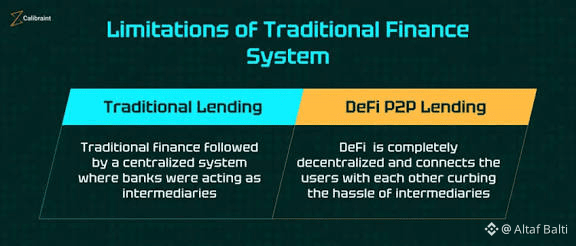
Most decentralized storage systems fall into two categories. The first relies on full replication, where multiple complete copies of data are stored across nodes. While simple and robust, this approach is extremely expensive, often requiring more than 20x replication to achieve high security guarantees.
The second category uses erasure coding, which reduces storage overhead by splitting data into fragments. Although more efficient, traditional erasure-coded systems face serious recovery challenges. When nodes fail or leave the network, restoring lost fragments often requires downloading the entire file, leading to high bandwidth costs and poor scalability.
Introducing Walrus

Walrus is designed to overcome these limitations. It is a permissionless, decentralized blob storage network optimized for large-scale, long-term data availability. Instead of choosing between security and efficiency, Walrus achieves both through a novel encoding protocol and a blockchain-based control layer.
At its core, Walrus separates data storage from coordination. Actual data is handled by storage nodes, while metadata, incentives, and governance are managed through a blockchain.
Red Stuff: The Core Innovation
The key technical breakthrough behind Walrus is Red Stuff, a two-dimensional erasure coding protocol. Unlike traditional one-dimensional encoding, Red Stuff encodes data both row-wise and column-wise. This design enables self-healing recovery, meaning lost data fragments can be reconstructed using bandwidth proportional only to the missing data, not the entire file.
Red Stuff achieves high security with approximately 4.5x replication, far lower than full replication systems. More importantly, it is the first protocol to support storage challenges in asynchronous networks, preventing malicious nodes from cheating by exploiting network delays.
Asynchronous Complete Data Storage (ACDS)
Walrus introduces the concept of Asynchronous Complete Data Storage (ACDS). In real-world decentralized networks, message delays and node churn are unavoidable. ACDS ensures that data remains recoverable and consistent even when the network is asynchronous and some nodes behave maliciously.
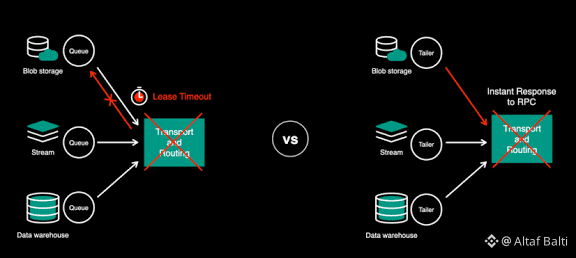
This means that as long as a sufficient number of honest nodes exist, data can always be reconstructed correctly, regardless of timing assumptions.
Writing, Reading, and Recovery in Walrus
When a user writes data to Walrus, the blob is encoded using Red Stuff and distributed across storage nodes. Once enough nodes acknowledge storage, a proof of availability is recorded on-chain. This allows the user to safely delete local copies.
For reading, clients collect encoded fragments from nodes, verify them cryptographically, and reconstruct the original data. Recovery is efficient: if a node loses its data fragment, it can rebuild it by requesting small pieces from other nodes, rather than downloading the entire file.
Handling Node Churn and Epoch Changes
In permissionless systems, nodes frequently join and leave. Walrus handles this through epoch-based committees and a multi-stage reconfiguration process. Reads and writes continue uninterrupted during transitions, ensuring high availability even during network changes.
This design makes Walrus suitable for long-term, production-grade storage.
Real-World Use Cases
Walrus supports a wide range of applications, including NFT media storage, rollup data availability, decentralized social platforms, AI dataset provenance, and encrypted data storage. Its efficiency and security make it especially attractive for applications that require both scale and trust minimization.
Conclusion
Walrus represents a major step forward in decentralized storage. By combining innovative two-dimensional erasure coding with blockchain-based coordination, it delivers strong security guarantees at a fraction of the cost of traditional systems. As Web3 continues to grow, solutions like Walrus will play a critical role in building truly decentralized and scalable infrastructure.

