

Most people think blockchain is about speed, low fees, and smart contracts. These are the things that are easy to see. But there is something much more important that decides whether a blockchain can actually be trusted over time. That thing is data.
Every action on a blockchain creates data. When you send tokens, use a protocol, or move assets, records are written. That data is not just technical information. It is proof. Proof of what happened, what you own, and what the system says is true. You might not need that proof today, but one day you might need it for an audit, a dispute, or to safely exit a system.
If that data is missing or hard to access, you cannot verify anything. You are forced to trust whoever controls the records. And once trust replaces verification, the system is no longer truly decentralized.
Walrus was built because of this exact problem.
Walrus is not another blockchain trying to run apps or compete on transactions. It does not execute smart contracts. It does not manage balances. Walrus has one job only: to keep blockchain data available and verifiable over time.
Today, many Web3 projects look decentralized, but their data often is not. Apps may run on-chain, but the information they depend on is frequently stored off-chain or with a small group of providers. As long as those providers behave, everything works. But if they disappear, fail, or restrict access, users lose the ability to independently verify the past.
The system may still function, but real decentralization is gone.
Walrus does not accept that tradeoff. Instead of treating storage as a background feature, Walrus makes data availability part of the security model itself. It is not enough that transactions are confirmed. The data behind them must remain accessible so users can always check what really happened.
One reason this issue is often ignored is because it does not appear early. In the beginning, there is not much data. Storage is cheap. Everyone is active. It feels safe to assume that data will always be there. But as time passes, history grows. Storage becomes expensive. Fewer people can afford to store and serve everything. Slowly, responsibility moves to a smaller group of operators. Nothing breaks suddenly, but decentralization quietly weakens.
Walrus was designed with this future in mind.
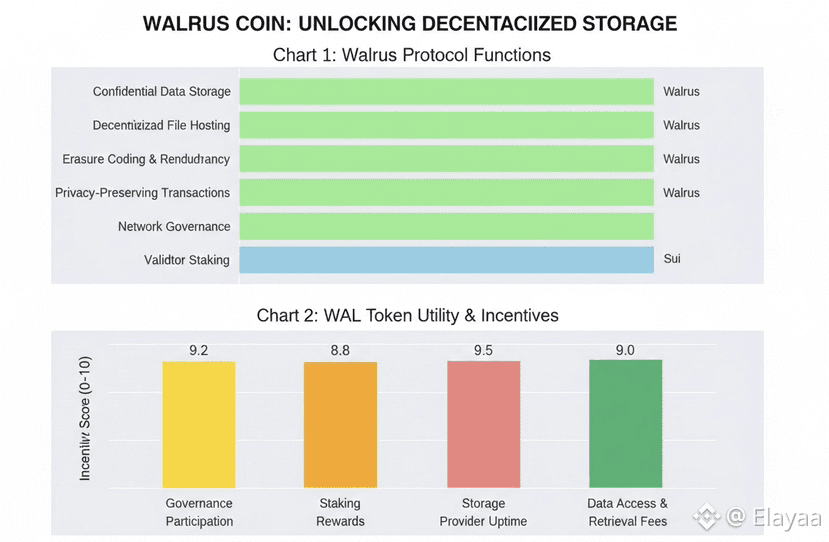
Instead of making every participant store full copies of data, Walrus breaks data into encrypted pieces and spreads them across many independent nodes. No single node has everything, but the system can always rebuild the data when it is needed. This keeps data available without pushing out smaller participants or creating centralized control.
Another key part of Walrus is what it does not do. It does not execute transactions. It does not manage balances. It does not run applications. Many blockchains try to do everything in one system. Over time, their state grows. Storage requirements increase. Running a full node becomes harder and more expensive. Participation drops. Infrastructure slowly centralizes.
Walrus avoids this by staying focused. Data is published, kept accessible, and verified. Nothing more. This makes the system simpler, lighter, and more sustainable over long periods.
Walrus is built on the Sui blockchain, which allows it to coordinate data and economics efficiently without heavy network overhead. This helps Walrus scale while staying fast and decentralized.
Then there is $WAL.
$WAL is not about hype or short-term speculation. It exists to make sure data availability is not based on goodwill. Operators who store data and keep it accessible are rewarded. If they fail to do their job, they are penalized. In simple terms, $WAL makes data availability a responsibility, not a favor.
This matters most when the market is quiet. During hype, money and attention keep systems running. When activity drops, many networks lose participants and cut infrastructure. But those are exactly the times when users may still need access to historical data.
Walrus is designed to keep working even then.
For users, the value is clear. You do not have to trust someone else’s database. You do not have to rely on a third party to tell you what happened. You can verify the past yourself.
Walrus is not loud infrastructure. It does not chase trends. But over time, it becomes the foundation everything else depends on. Apps can change. Chains can upgrade. Trends can fade. But data stays.
If the data is not available, nothing else matters.
That is why Walrus matters.


