

In crypto, most attention goes to what moves fast. New chains. New apps. New features. Speed and activity are easy to measure, and they look impressive. But long-term trust in a blockchain does not come from how fast it runs today. It comes from whether people can still verify what happened years later.
That depends on data.
Every transaction, every interaction, every change on a blockchain creates data. That data becomes the record of ownership, actions, and agreements. One day, users may need that data to check a past event, prove a balance, or exit a system safely. If the data is missing, verification is impossible.
When verification is impossible, users are forced to trust whoever holds the records.
Walrus was created to make sure that never happens.
Walrus is not designed to be a general-purpose blockchain. It does not run smart contracts or host applications. It does not try to compete on speed or fees. Walrus exists for one reason only: to keep blockchain data available and verifiable over time.
Many Web3 systems today still depend on off-chain or semi-centralized storage. Even if execution is decentralized, access to data often is not. This creates a hidden weak point. If a small group controls data access, users lose their ability to independently verify what happened.
Walrus treats this as a serious design failure.
Instead of assuming data will always be there, Walrus builds availability directly into the system. It uses cryptography and economic incentives to make sure data can always be accessed without relying on any single provider.
One of the most important design choices in Walrus is how it handles storage. Full replication sounds safe, but as data grows, it becomes expensive. Over time, only large operators can afford to store everything. Smaller participants drop out. The network becomes more centralized.
Walrus avoids this by splitting data into encrypted pieces and spreading them across many independent nodes. The data can always be reconstructed, but no single party controls it. This allows the system to scale while remaining decentralized.
Walrus also avoids execution. It does not manage balances or run contracts. Many blockchains struggle because their state grows endlessly, making it harder for regular users to participate. Walrus stays light by focusing only on data availability. Data is published, kept accessible, and verified. That is all.
Built on the Sui blockchain, Walrus can coordinate storage and incentives efficiently without creating heavy network bottlenecks. This gives it scalability without sacrificing decentralization.
Now comes the role of $WAL.
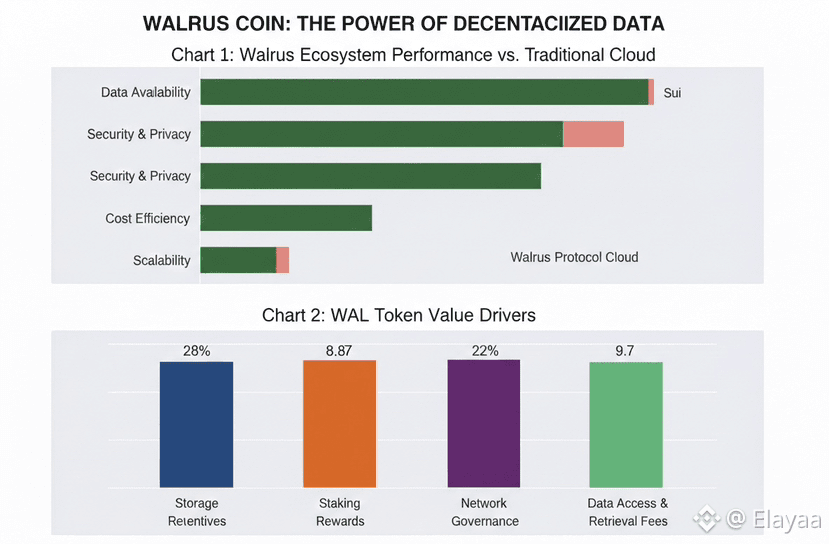
$WAL is not about transaction volume. It is not designed to profit from congestion. It exists to make sure operators have a reason to keep data available long term. Those who store data and keep it accessible are rewarded. Those who fail are penalized. In this way, economics enforces reliability.
This design matters most during quiet periods. When hype fades, many systems lose participants and cut infrastructure. But users still need access to past data. $WAL keeps the network honest even when attention is gone.
Walrus is the kind of infrastructure people rarely talk about, but always depend on. Applications may change. Markets may rise and fall. But data remains.
If the data cannot be accessed, none of the rest matters.
Walrus is not built for today’s hype cycle. It is built for the years that come after.

