

Introduction Of Walrus
Blockchains have grown up. What started as simple value transfer has turned into an ecosystem expected to handle real applications, sensitive data, institutional workflows, and massive amounts of information. That shift exposed a weakness most chains still struggle with: blockchains are terrible at storing data, especially large or private data, at scale.
Walrus exists to solve that problem head-on.
Built as a decentralized, privacy-preserving storage and data interaction layer, Walrus combines cryptography, distributed storage design, and DeFi-native incentives into a single, cohesive protocol. Its native token, WAL, coordinates security, governance, staking, and economic alignment across the network.
Running on the high-performance Sui blockchain, Walrus takes advantage of parallel execution, object-centric data models, and low-latency finality. The end result is a decentralized storage system that feels practical, scalable, and realistic for developers, enterprises, and institutions—not just crypto hobbyists.
This deep dive explores what Walrus is building, how it works, and why it matters.
1. The Core Problem Walrus Tackles
1.1 The Risks of Centralized Storage
Modern internet infrastructure depends heavily on centralized cloud providers. They work well, until they don’t.
Common issues include:
Single points of failure
Data breaches and insider threats
Arbitrary censorship or takedowns
Escalating storage and bandwidth costs
Zero user ownership or verifiable integrity
For Web3 applications, this is a fundamental contradiction. An app cannot be meaningfully decentralized if its data lives on servers controlled by a handful of companies.
1.2 Why On-Chain Storage Doesn’t Scale
Storing large data directly on a blockchain is rarely viable:
Costs explode quickly
Throughput collapses
Retrieval becomes inefficient
Block space is wasted
Even the most advanced L1s are not designed to store media files, datasets, AI models, or long-lived application state at scale.
1.3 Walrus’ Key Insight
Walrus separates data availability and integrity from execution.
Large data objects live off-chain, but remain verifiable, censorship-resistant, and cryptographically secure. Execution and coordination happen on-chain. This division preserves decentralization while keeping costs and performance under control.
2. What Walrus Actually Is
At its core, Walrus is a decentralized blob storage and data availability protocol designed for Web3.
Its guiding principles are straightforward:
Privacy by default
Horizontal scalability
Cryptographic verification
Economic security through staking
Tight integration with DeFi and governance
Walrus is not just a storage backend. It is a full protocol stack that enables private data ownership, programmable access, and decentralized applications without centralized infrastructure.
3. Architecture and Technical Design
3.1 Blob-Based Storage
Walrus introduces blobs, large data objects that can represent:
Files
Media assets
Application state
Encrypted datasets
AI training data
Each blob is content-addressed, meaning its identity is derived from a cryptographic hash. If the data changes, the hash changes. Integrity is automatic.
3.2 Erasure Coding for Efficiency
Instead of copying full datasets across every node, Walrus uses erasure coding:
Data is split into fragments
Redundant parity shards are added
Only a subset is needed to recover the original
This dramatically improves efficiency while maintaining fault tolerance. Even if a significant portion of nodes go offline, the data remains recoverable.
3.3 Decentralized Storage Nodes
Storage providers in Walrus:
Stake WAL tokens
Contribute hardware and bandwidth
Store encrypted data fragments
Earn rewards for uptime and reliability
Dishonest behavior triggers slashing. The incentives are clear, and they scale with network usage.
3.4 Privacy and Encryption
Privacy is not optional.
Walrus supports:
End-to-end encryption
User-controlled access keys
Private data sharing
Confidential application state
Storage nodes never see readable data. Even the infrastructure layer remains blind.
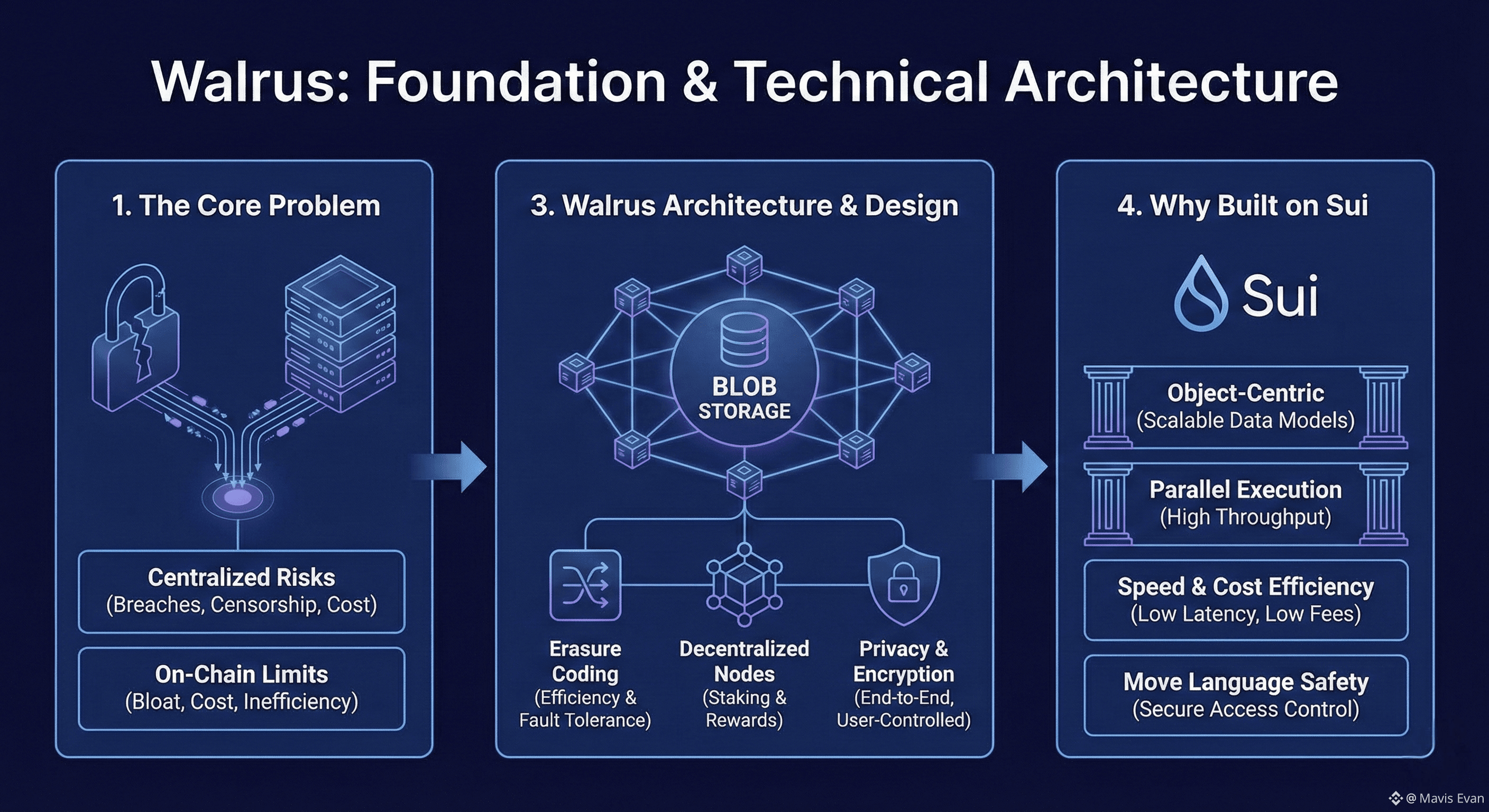
4. Why Walrus Is Built on Sui
Walrus is tightly coupled to Sui for good reasons.
4.1 Object-Centric Design
Sui treats assets as objects rather than shared global state. This maps cleanly to blob-based storage, where each data unit has its own lifecycle, permissions, and ownership.
4.2 Parallel Execution
Sui processes transactions in parallel, which allows Walrus to:
Scale horizontally
Handle large upload and retrieval volumes
Support real-time and data-heavy applications
4.3 Speed and Cost Efficiency
Fast finality and low fees make frequent data interactions economically viable, even at scale.
4.4 Move Language Safety
Move provides strong guarantees around access control and asset safety. That matters when data ownership and permissions are part of the protocol itself.
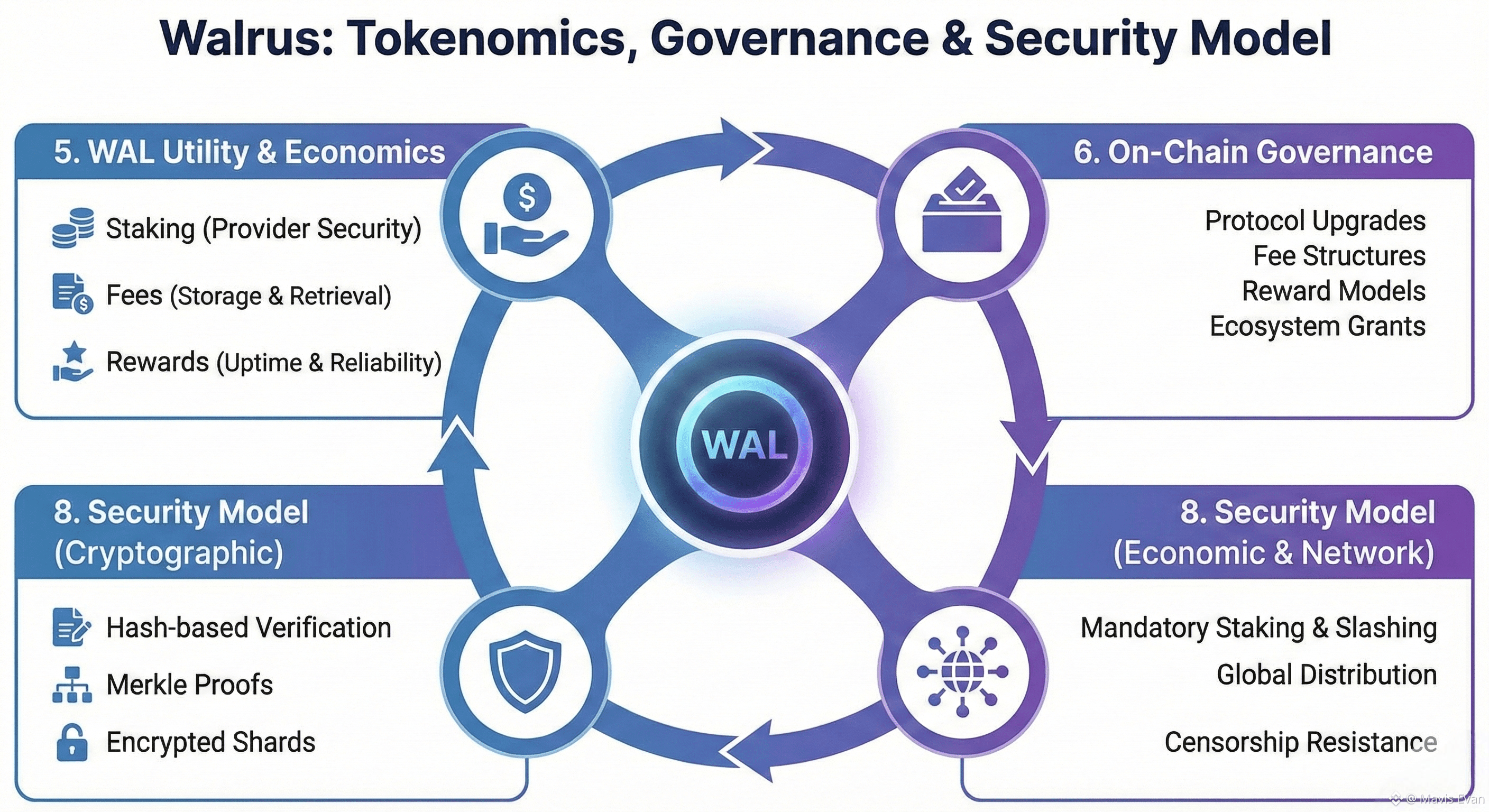
5. WAL Token Utility and Economics
5.1 What WAL Is Used For
The WAL token underpins the entire ecosystem:
Staking for storage providers
Security via slashing and incentives
Governance participation
Fees for storage and retrieval
Rewards for performance and availability
Nothing in the system works without it.
5.2 Supply and Emissions
Exact parameters evolve through governance, but the structure generally includes:
A capped or fixed supply
Gradual emissions to infrastructure providers
Long-term incentive alignment
Early contributors are rewarded, without sacrificing sustainability.
5.3 A Usage-Driven Economy
Walrus ties rewards to real demand:
Stored data volume
Retrieval frequency
Network reliability
This keeps the economy grounded in utility rather than hype.
6. Governance and Decentralization
6.1 On-Chain Governance
WAL holders can vote on:
Protocol upgrades
Fee structures
Reward models
Network parameters
Ecosystem grants
Everything is transparent and verifiable on-chain.
6.2 Phased Decentralization
Walrus follows a practical rollout:
Core team deployment
Storage node onboarding
Governance activation
Community-led evolution
Stability first, autonomy over time.
7. Real-World Use Cases
7.1 Decentralized Applications
Walrus allows dApps to store:
User data
Encrypted messages
App state
Media assets
No centralized servers required.
7.2 Private DeFi and Institutions
Institutions need discretion. Walrus supports:
Transaction metadata privacy
Selective disclosure
Audit-friendly encryption
This makes regulated DeFi possible without sacrificing confidentiality.
7.3 NFTs and Media
NFT decentralization fails without decentralized media. Walrus offers:
Persistent availability
Censorship resistance
Cost-efficient large file storage
7.4 AI and Data Markets
Large datasets are critical for AI. Walrus enables:
Decentralized dataset hosting
Secure data sharing
Verifiable integrity
This opens the door to decentralized AI pipelines.
7.5 Enterprise Infrastructure
Enterprises can use Walrus for:
Secure backups
Document storage
Cross-border data sharing
Compliance-friendly encryption
8. Security Model
8.1 Cryptographic Guarantees
Hash-based verification
Merkle proofs
Encrypted shards
Users verify data without trusting providers.
8.2 Economic Security
Mandatory staking
Slashing for misbehavior
Rewards for uptime
Attacks become expensive and irrational.
8.3 Censorship Resistance
Data is globally distributed across independent nodes. No single actor controls availability.
9. Developer Experience and Ecosystem
9.1 Tooling
Walrus offers:
SDKs
APIs
Smart contract integrations
Move-focused documentation
Integration is designed to be straightforward.
9.2 Ecosystem Positioning
Walrus is shaping up to be a core infrastructure layer within the Sui ecosystem, supporting DeFi, gaming, NFTs, social platforms, and data-heavy applications.
10. Competitive Position
Walrus competes with other decentralized storage networks, but stands out through:
Native integration with a high-performance L1
A focus on private and regulated use cases
Blob-optimized architecture
Deep ties to DeFi and governance
It complements execution-focused chains rather than replacing them.
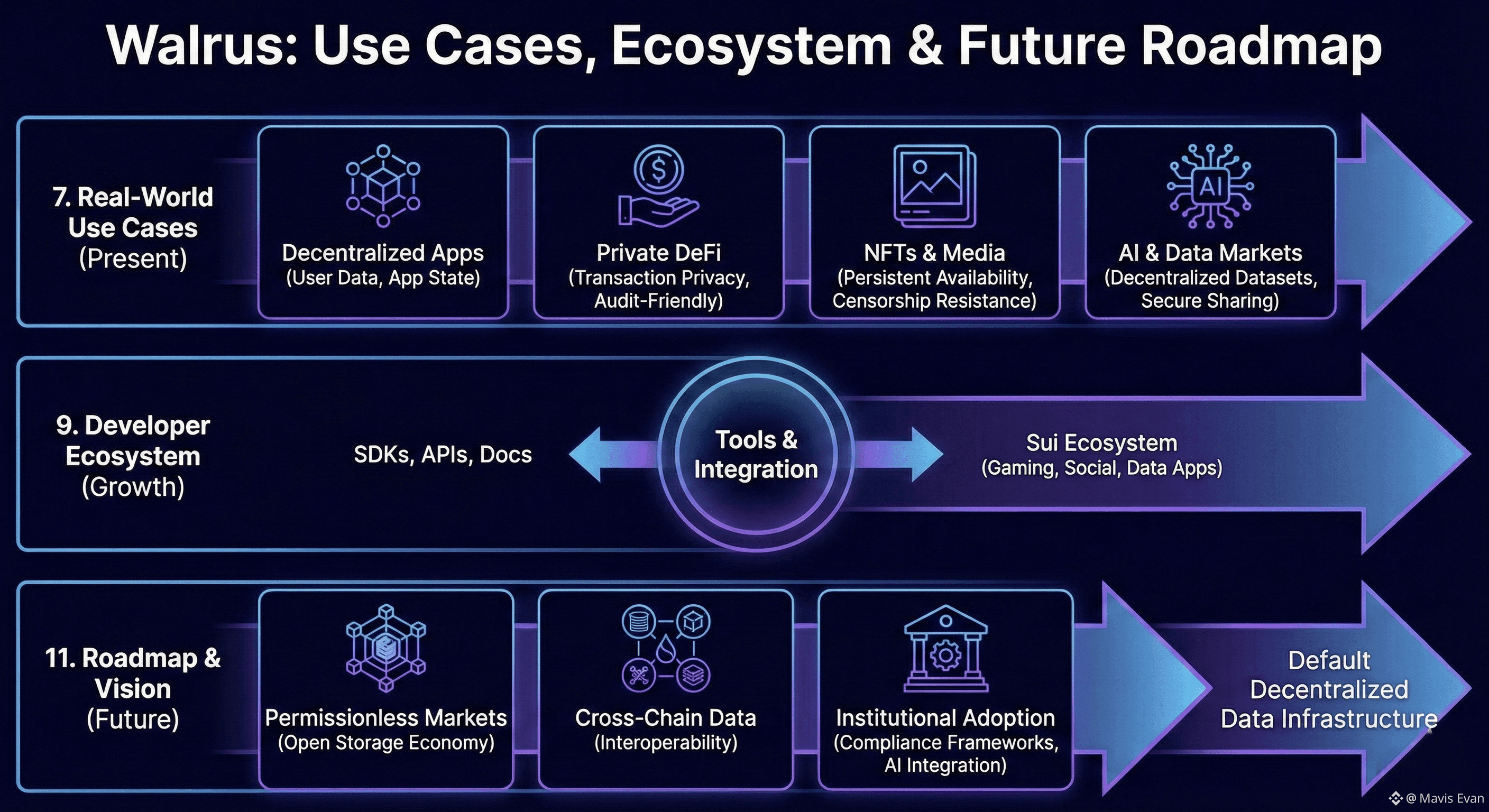
11. Roadmap and Long-Term Vision
Walrus is working toward:
Fully permissionless storage markets
Advanced access control primitives
Cross-chain data availability
Institutional adoption frameworks
Integration with AI and real-world data
The goal is clear: become default decentralized data infrastructure.
Conclusion
Walrus addresses one of Web3’s most stubborn bottlenecks: scalable, private, decentralized data storage. By combining cryptography, economic incentives, and modern blockchain design, it enables applications that were previously impractical or impossible.
Built on Sui and powered by the WAL token, Walrus is positioning itself as critical infrastructure for the next phase of decentralized systems—where data matters just as much as execution.
As Web3 moves closer to real-world adoption, protocols like Walrus will define whether decentralization can scale beyond theory and into everyday use.

