Trust used to be simple. You trusted people, institutions, and systems because there were faces, rules, and accountability. Today, trust has become abstract. Our lives live online, yet we hand our data to platforms we will never meet, governed by policies we never read, controlled by decisions we never influence. Somewhere along the way, trust stopped feeling human.
Walrus was born inside that discomfort.
Walrus, powered by its native token WAL, is not trying to impress with noise or promises. It is trying to rebuild something far more fragile and valuable: confidence that your digital life will not disappear, be manipulated, or be taken from you without consent. In a world described as trustless, Walrus quietly engineers trust back into the system, not through authority, but through structure.
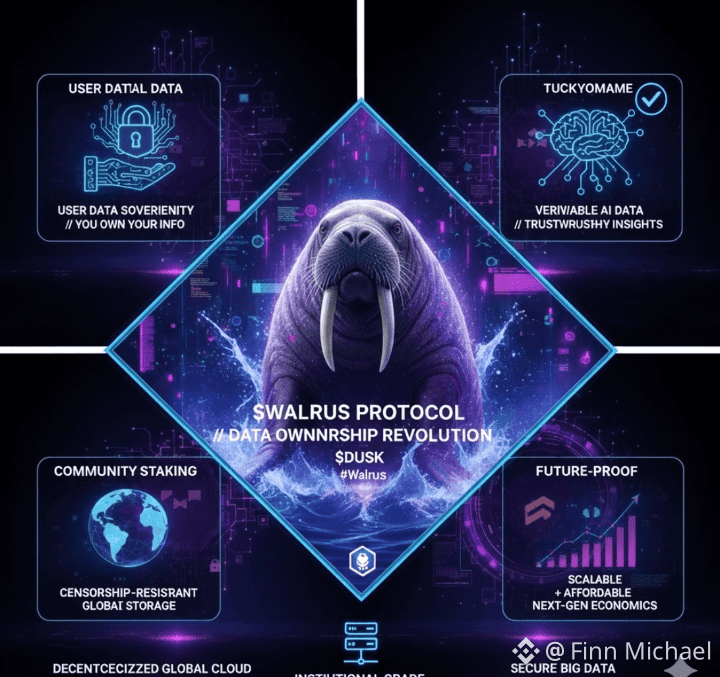
At its heart, Walrus is a decentralized protocol for secure, private, and resilient data storage and interaction. It runs on the Sui blockchain, a network designed to move fast, scale naturally, and treat data as something alive rather than locked away. This matters because Walrus is not focused on tiny pieces of information. It is designed for real data. Creative work, enterprise records, personal archives, and the digital footprints that define modern existence.
Instead of placing this data in one location, Walrus breaks it into protected fragments using erasure coding. These fragments are distributed across a decentralized network using blob storage. No single server holds the full truth. No single failure can erase it. Even if parts of the network disappear, the data survives, quietly waiting to be reassembled.
This design choice carries emotional weight. It means your work is not lost because a company shuts down. Your voice is not muted because a platform changes direction. Your memories are not collateral damage in someone else’s business decision. Walrus does not ask you to trust a brand. It asks you to trust mathematics, cryptography, and incentives aligned toward honesty.
Privacy inside Walrus is deeply personal. Data can be encrypted before it is ever shared. Access is controlled through cryptographic permissions, not promises. You decide who sees your information, how long they can see it, and under what conditions. In a time when personal data is harvested quietly and traded loudly, this level of control restores a sense of ownership many people forgot they lost.
The WAL token exists to keep this promise alive. Storage providers stake value to participate, making dishonesty expensive and reliability rewarding. Users pay for storage and retrieval in a system that sustains itself rather than depending on hidden monetization. Governance decisions are shaped by the community, allowing those who rely on Walrus to guide its future.
There is something powerful about strangers cooperating without needing to trust each other personally. They trust the system instead. They trust that rules are enforced equally. They trust that incentives reward good behavior and punish bad actors. This is how Walrus engineers trust in a world that claims trust is obsolete.
For developers and businesses, Walrus offers more than ideology. It offers stability in an unstable environment. Centralized cloud services are fast, but fragile. Regulations change. Accounts get frozen. Data gets compromised. Walrus provides an alternative where resilience is built in, not bolted on. Where availability does not depend on permission.
For individuals, Walrus represents something quieter and more emotional. It represents peace of mind. The feeling that what you create will still exist tomorrow. That your digital presence is not temporary by design. That memory does not belong to whoever owns the server.
As artificial intelligence grows and digital creation accelerates, the amount of data we produce will only increase. The value of that data will rise alongside it. The systems we choose today will decide who controls the future narrative. Walrus takes a clear stand. Data should not be fragile. Trust should not be blind. Control should not be centralized.
In the end, Walrus is not fighting the idea of a trustless world. It is redefining it. It shows that trust does not have to come from power or permission. It can come from transparency, resilience, and respect for human ownership. And in doing so, Walrus quietly reminds us that even in decentralized systems, trust still matters.