Crypto has become exceptionally good at moving fast, but surprisingly bad at remembering. Over the last few years, blockchains have optimized execution to the extreme. Transactions finalize in seconds, fees trend toward zero, and throughput numbers dominate every roadmap. Yet behind this progress sits an uncomfortable truth most users only encounter when something breaks: blockchains were never built to handle the volume, weight, and longevity of the data modern applications now depend on. Walrus exists because this gap is no longer theoretical. It is already shaping how decentralized systems succeed or quietly fail.
The core issue is not storage in the abstract, but trust over time. Early on, blockchains could get away with minimal onchain data and loosely coupled offchain systems. DeFi protocols managed small state sizes, NFTs pointed to lightweight metadata, and anything heavy lived on centralized servers without much protest. As usage expanded, that compromise started to crack. Today, large datasets influence execution outcomes, governance decisions, compliance, and user experience. When that data disappears, becomes unavailable, or cannot be independently verified, decentralization becomes performative rather than real. Walrus is designed specifically for this moment, where execution has outpaced the infrastructure needed to preserve its consequences.
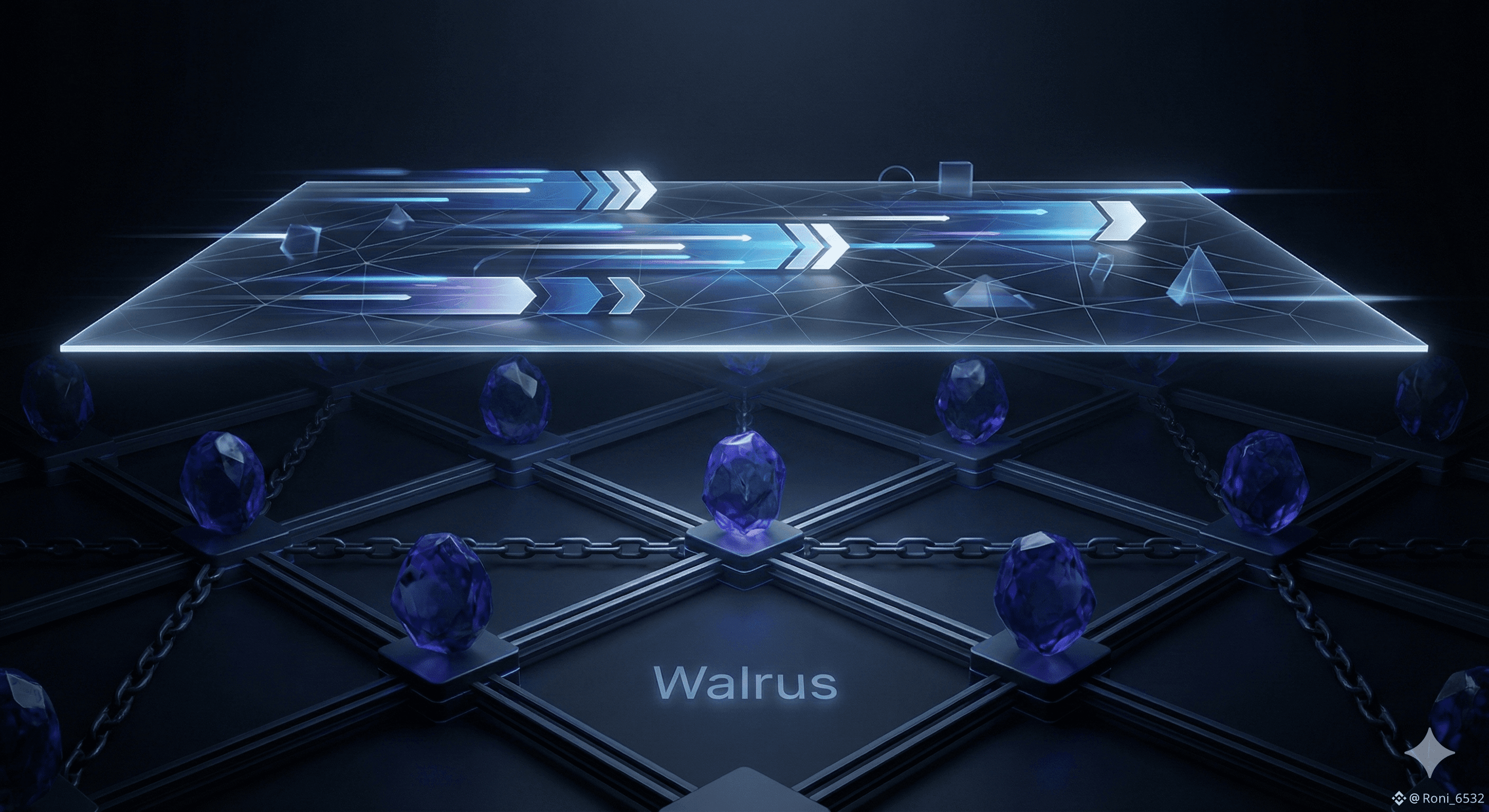
What makes Walrus distinct is that it does not try to force large-scale data into blockchain state. Instead, it accepts a reality many builders already understand: storing everything onchain is inefficient, but trusting traditional cloud providers undermines the entire premise of crypto. By operating on Sui and using erasure coding with blob storage, Walrus distributes large files across a decentralized network while keeping them verifiable and available. This approach reflects a more mature view of blockchain architecture, where execution and data are separated but still cryptographically linked. The result is not faster transactions, but something arguably more important: systems that can be audited, replayed, and trusted long after execution has finished.
This matters because data availability failures are rarely dramatic. They surface months later as broken references, unverifiable claims, or dependencies that silently vanish. For users, this feels like fragility. For builders, it becomes technical debt that cannot be easily paid down. Walrus addresses this by treating data as shared infrastructure rather than an application-specific afterthought. Instead of every project reinventing its own fragile storage solution, Walrus offers a common layer where availability is a network property, not a promise made by a single provider. That shift reduces systemic risk in ways that are difficult to measure until something goes wrong.
Privacy adds another layer of complexity that Walrus approaches realistically. In crypto, privacy is often framed as making data disappear, but real systems do not work that way. Financial applications, enterprise use cases, and regulated environments all require data to exist, be stored, and sometimes be accessed under specific conditions. Walrus does not pretend otherwise. Its design allows data to be stored and verified without being universally exposed, aligning more closely with how privacy actually functions in production systems. This is especially relevant as onchain infrastructure increasingly intersects with real-world assets, compliance frameworks, and institutional participation.
The role of the WAL token fits into this picture as coordination rather than speculation. Storage networks only work when incentives align between those providing resources and those relying on them. Walrus uses $WAL to secure participation, availability, and long-term sustainability of the network. This is not a growth hack or a marketing lever. It is an acknowledgment that decentralized storage, unlike centralized cloud services, requires explicit economic alignment to remain reliable over time. Without that alignment, decentralization erodes quietly, even if interfaces remain unchanged.
Timing is what ultimately makes Walrus relevant now. Modular blockchains have made it clear that execution, settlement, and data availability no longer need to live in the same place. As execution layers like Sui push performance forward, the data they generate grows faster and becomes more valuable. Ignoring that reality leads to systems that work beautifully in the short term and fail subtly in the long term. @walrusprotocol exists to address that imbalance, not with hype or grand claims, but by solving a problem crypto has consistently postponed.
In that sense, Walrus is not about competing for attention in a crowded market. It is about reinforcing the parts of the system that users only notice when they are missing. Walrus is infrastructure for memory, accountability, and continuity. As the ecosystem matures, those qualities matter more than raw speed. Execution moves value forward, but data is what allows trust to persist. That is why Walrus, and $WAL, exist now rather than earlier. Not because the idea is new, but because the cost of ignoring it has finally become too high.