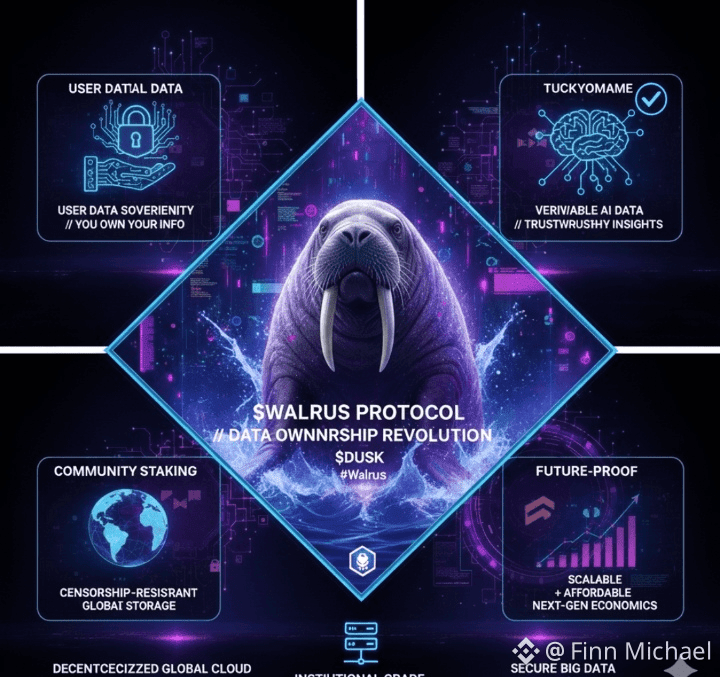
There is a quiet injustice in the modern internet. We are told to create, to share, to build, yet the moment those creations stop serving someone else’s interests, they can vanish. Accounts are frozen. Platforms pivot. Policies shift. What remains is a hollow feeling that all the effort, passion, and time poured into digital work was never truly safe. Walrus exists because forgetting has become too easy, and remembering has become a privilege instead of a right.
Walrus is a decentralized storage and data protocol built for permanence in an age of disposability. Instead of trusting centralized clouds that hold absolute power over access and pricing, Walrus distributes data across a global network of independent nodes. Files are transformed into encoded fragments and spread in a way that no single participant can control or censor them. Even if parts of the network fail, the data can still be recovered. This design turns storage into something resilient, neutral, and difficult to silence.
At a deeper level, Walrus challenges how we think about ownership. Today, uploading data often means surrendering control. Walrus reverses that relationship. Data remains yours, cryptographically protected and verifiable, not held hostage by a platform’s terms of service. This shift is subtle but profound. It restores confidence to creators who fear losing their work, researchers who need guarantees of long-term preservation, and developers who cannot afford infrastructure that disappears beneath them.
The technology behind Walrus is powerful but intentionally quiet. Through advanced erasure coding, data is stored efficiently without endless duplication. Only a portion of the fragments is required to reconstruct the original file, which keeps costs low while maintaining high reliability. This balance is critical in a world where data is growing faster than budgets, especially for independent builders and open communities.
Walrus works in coordination with the Sui blockchain, which handles ownership records, payments, staking, and governance. This separation allows Walrus to focus on what matters most: making data available, provable, and durable. Storage becomes programmable. Applications can verify data existence on chain. Access rules can be enforced transparently. In practice, this means storage becomes part of the logic of the application, not an external dependency waiting to fail.
This foundation is especially important for artificial intelligence. AI systems depend on massive datasets, yet society increasingly demands accountability. Where did the data come from? Who owns it? Can it be audited? Walrus provides the infrastructure to answer those questions honestly. It enables datasets to be stored with provenance, accessed responsibly, and governed collectively. In doing so, it offers a path toward AI built on trust rather than opacity.
The WAL token powers this ecosystem as a mechanism of accountability. Users pay WAL to store data. Storage providers stake WAL to earn rewards for honest behavior. Failure to store or serve data results in penalties. Governance decisions are shaped by those who are economically and emotionally invested in the network’s health. This structure ensures that incentives align with long-term reliability, not short-term exploitation.
Walrus is already finding real-world use. Builders are storing large digital assets, decentralized applications are hosting content without relying on centralized servers, and communities are experimenting with new forms of data ownership. Growth has been measured and intentional, reflecting a focus on stability rather than spectacle. That restraint is part of what gives the project credibility.
Privacy remains central to the design. Because data is fragmented and optionally encrypted, no single node can exploit or inspect the content it stores. This protects individuals and organizations alike while preserving availability. It is a reminder that transparency and privacy do not have to be enemies when systems are designed thoughtfully.
Walrus is not claiming to solve everything. Decentralized networks are complex, and governance is an ongoing responsibility. But Walrus is making a clear statement: the future of the internet should not depend on forgetting. It should be built on systems that honor effort, preserve knowledge, and resist silent erasure.
In the end, Walrus represents a cultural shift as much as a technical one. It asks us to imagine an internet that remembers, not because it is profitable, but because it is fair. A world where data lasts because it matters. A future where digital memory is protected not by trust in institutions, but by trust in shared systems. That is the promise Walrus is quietly working to fulfill.