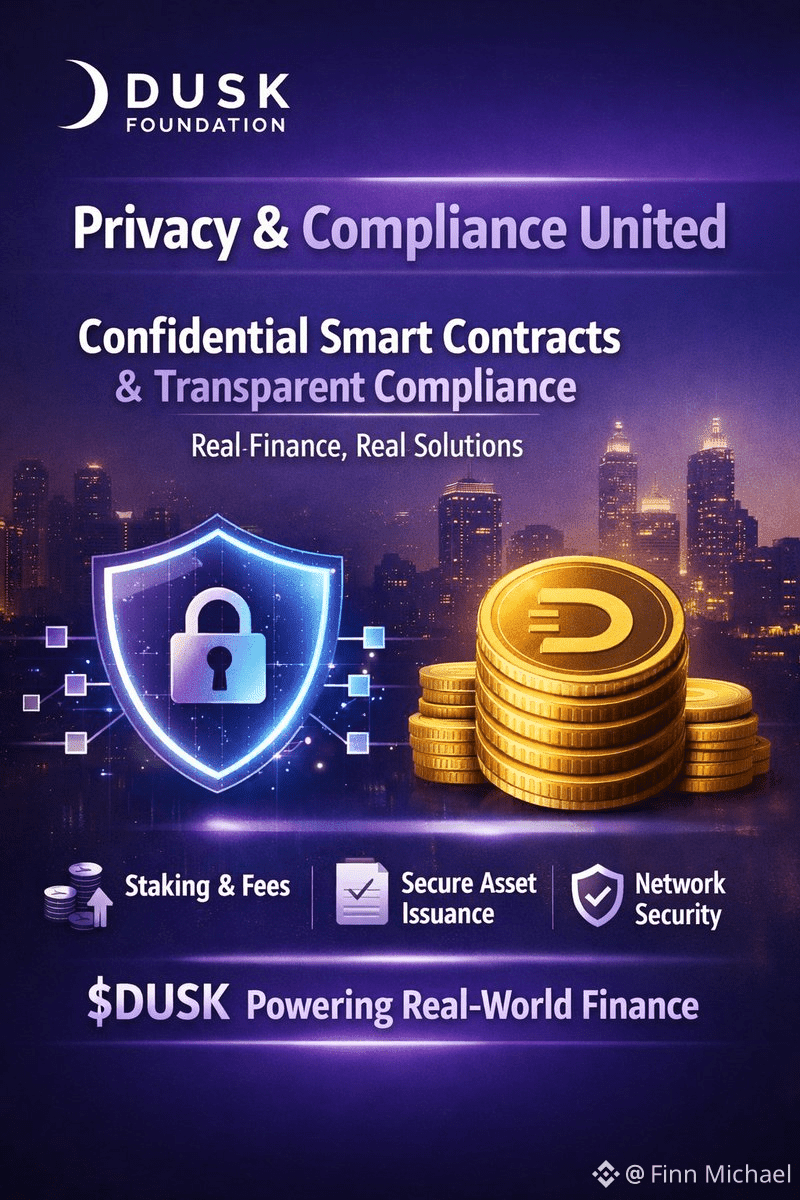
There is a silent tension that follows people everywhere money exists. A feeling that every transaction leaves a trace, every decision is monitored, and every mistake can be judged forever. Finance has become efficient, digital, and fast, yet emotionally it feels colder than ever. Dusk was created in response to that feeling, not as a reaction, but as a correction.
Founded in 2018, Dusk did not try to shout its way into relevance. It listened first. It listened to institutions struggling with regulation that never quite fit new technology. It listened to users who wanted the freedom of blockchain without living under constant exposure. And it listened to a financial system that desperately needed evolution, not destruction. Out of that listening came a Layer 1 blockchain built for real markets and real people.
Dusk begins with a simple belief: trust cannot exist where everyone is being watched. Traditional finance hides too much behind closed doors. Public blockchains reveal too much to the open world. Both create anxiety in different ways. Dusk steps into the middle, creating a space where actions can be verified without turning lives into open books. Through advanced cryptography, the network proves that transactions are valid without revealing private details. It allows truth to exist without stripping away dignity.
This is where Dusk feels different on a human level. Privacy here is not a loophole. It is a form of respect. It protects individuals from unnecessary exposure and protects businesses from strategic vulnerability. At the same time, it does not abandon responsibility. Rules still exist. Compliance still matters. Regulators can audit. Institutions can verify. The system does not rely on blind faith. It relies on provable honesty.
Regulation is often treated as the enemy of innovation, but Dusk understands why regulation exists. Financial systems touch lives deeply. When they fail, the damage is not theoretical. Savings disappear. Futures collapse. Dusk embeds compliance directly into its foundation so that safety is not optional or delayed. Conditions are checked before harm can occur. Responsibility is enforced by code, not by hope.
The structure of Dusk reflects this care. Its modular design allows different layers to focus on what they do best. Security and settlement form a stable base, ensuring that decisions are final and reliable. Execution layers give developers freedom to build applications using familiar tools or privacy-focused logic. This flexibility mirrors real life. People do not all need the same solutions, but everyone needs protection.
One of the most meaningful results of this design is how Dusk brings real-world assets onto the blockchain. For decades, serious financial instruments were locked behind borders, paperwork, and privilege. Dusk allows assets like bonds and equities to move on-chain in a way that respects existing laws. Settlement becomes faster. Costs drop. Access widens. What was once distant begins to feel reachable.
Decentralized finance on Dusk carries a sense of maturity. It is not built to escape rules, but to operate within them intelligently. Financial products are private, compliant, and enforced automatically. This creates an environment institutions can trust and individuals can rely on without fear of sudden collapse or exposure.
What truly defines Dusk is not a single feature, but its restraint. In an industry addicted to noise, Dusk chose silence. In a race for attention, it chose stability. It understands that finance does not need spectacle. It needs confidence. The kind that allows people to sleep at night knowing their financial lives are not being exploited or observed without consent.
Dusk is not trying to make finance louder or faster. It is trying to make it calmer. Safer. More human. It represents a moment where technology stops watching every move and starts earning trust instead.
And in a world exhausted by systems that demand transparency without care, that moment matters more than ever.