Closing Profits Is Also a Skill – Not a Weakness
One of the hardest decisions in trading is not entering a trade.
It’s not placing stop loss.
It’s not even handling a losing position.
The hardest decision is closing a winning trade.
When profit is running, emotions become louder than logic. Greed disguises itself as confidence. Hope pretends to be analysis. And suddenly, a good trader starts acting like a gambler.
This is where most accounts bleed — not because the trade was bad, but because the exit was undisciplined.
---
The Moment That Tests a Trader
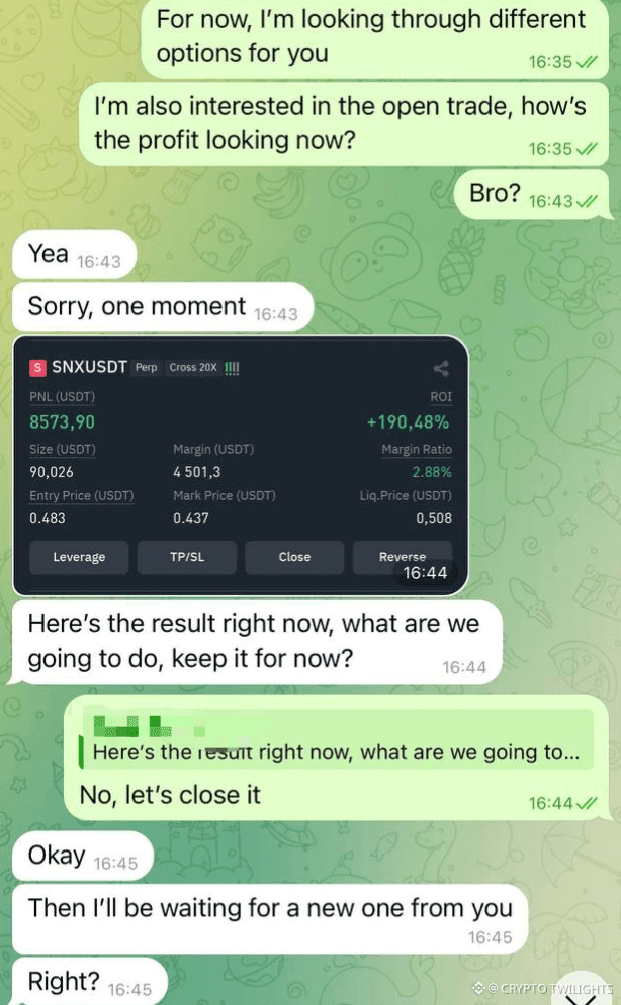
Look at the situation carefully:
The trade is open
Profit is already substantial
ROI looks impressive
The other person asks: “Should we keep it open?”
This single question separates professional thinking from emotional thinking.
A professional does not answer with excitement.
A professional answers with clarity.
> “No, let’s close it.”
That sentence may look simple, but it carries years of experience, losses, lessons, and self-control.
---
Why Closing in Profit Is Difficult
Human psychology is not designed for trading.
When we see green numbers:
We imagine more green
We fear missing out on a bigger move
We forget risk
We rewrite our plan in real time
The market does not reward imagination.
The market rewards execution.
Many traders turn winners into losers because they wanted a little more. That “little more” often costs everything.
---
Profit Is Not Real Until It’s Closed
Unrealized profit is just a number on a screen.
It can disappear:
In one candle
In one news spike
In one emotional mistake
Closing a trade is not fear.
Closing a trade is confirmation.
It means:
The plan was followed
The objective was met
Capital is protected
The trader survives to trade another day
Survival is the first rule of trading.
---
Discipline Over Ego
A disciplined trader asks:
Is my target achieved?
Is risk increasing now?
Is the reward still worth it?
An ego-driven trader asks:
What if it goes higher?
What if this is the big move?
What if I miss the top?
Ego wants perfection.
Discipline wants consistency.
Markets don’t pay for perfection.
They pay for repetition of good behavior.
---
The Power of Saying “Enough”
There is strength in knowing when to stop.
Closing a profitable trade does not mean:
You are scared
You lack confidence
You don’t understand the market
It means:
You respect probability
You respect your system
You respect your capital
One closed profit is better than ten imagined profits.
---
Trading Is a Game of Decisions, Not Emotions
Every trade has three stages:
1. Entry
2. Management
3. Exit
Most traders focus only on entry.
Professionals are defined by exit decisions.
A good exit:
Reduces stress
Builds confidence
Protects mindset
Creates long-term growth
You don’t need to catch the entire move.
You only need your part of the move.
---
Consistency Beats One Big Trade
Accounts don’t grow from one trade. They grow from:
Repeated discipline
Controlled risk
Timely exits
Closing profit today gives you:
Capital for tomorrow
Mental clarity
Emotional balance
Holding for greed gives you:
Stress
Overexposure
Regret
---
Final Thought
The market will always give another opportunity.
There will always be another setup.
Another candle.
Another trade.
But capital and discipline, once lost, are hard to recover.
Closing a profitable trade is not the end of the journey —
It is proof that you are trading with maturity.
Sometimes the best trade you can make
is knowing when to say:
“That’s enough. Close it.”